
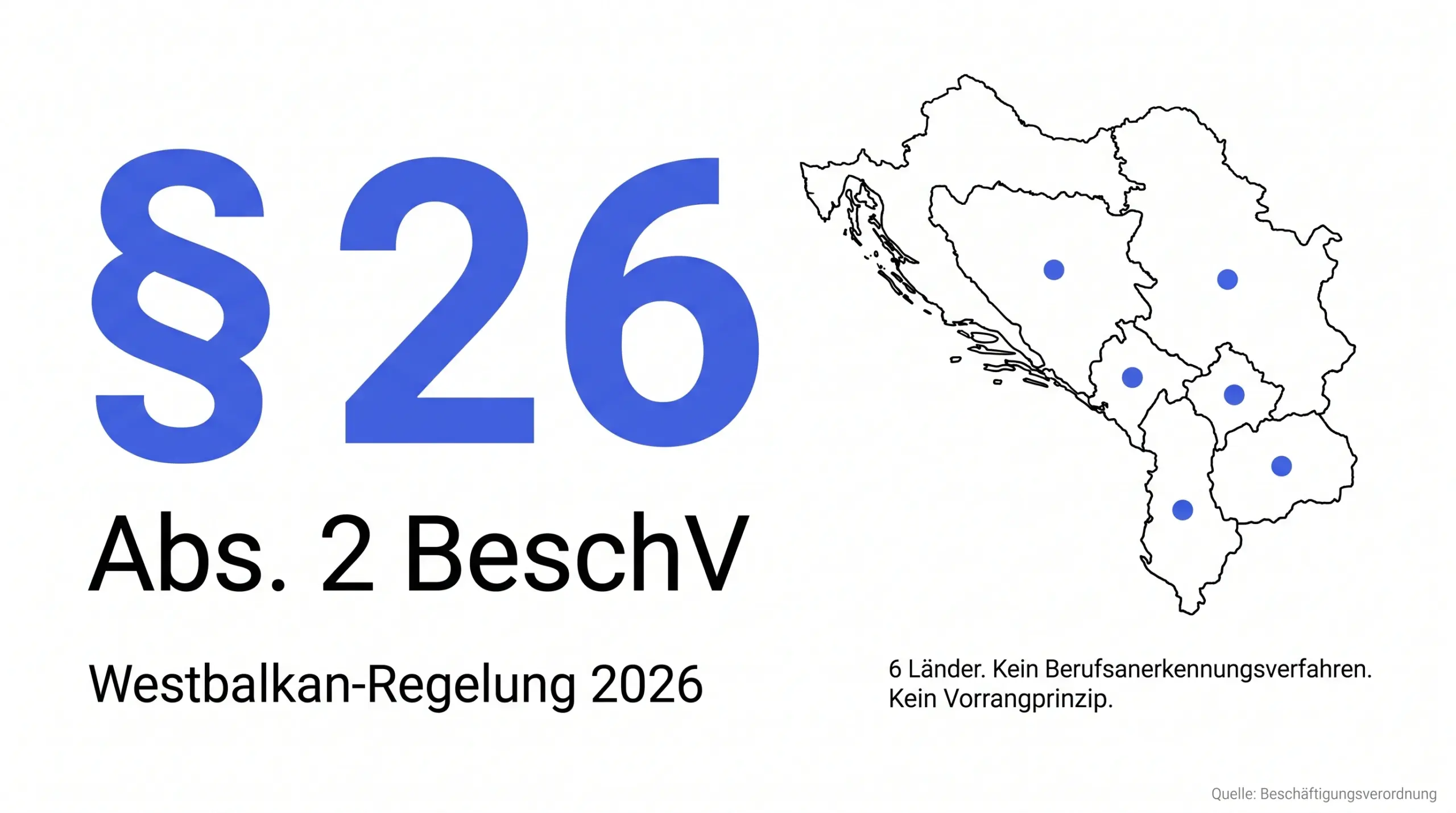
Über die Westbalkanregelung können Arbeitskräfte aus sechs Staaten in Deutschland eine Beschäftigung aufnehmen, ohne dass ihre Qualifikation vorher anerkannt wird — außerhalb der reglementierten Berufe. Ein Schnellverfahren ist sie nicht. Die Bundesagentur für Arbeit muss zustimmen, das Kontingent ist begrenzt und auf Monate verteilt, und der erste Antrag muss in einem der sechs Staaten gestellt werden.
Was die Westbalkanregelung ist — und was sie nicht ist
Die Westbalkanregelung bezeichnet den Verfahrensweg nach Paragraf 26 Absatz 2 der Beschäftigungsverordnung. Danach können für Staatsangehörige aus Albanien, Bosnien und Herzegowina, dem Kosovo, Montenegro, Nordmazedonien und Serbien Zustimmungen mit Vorrangprüfung zur Ausübung jeder Beschäftigung erteilt werden. Die Verordnung bestimmt damit eine Zulassung im Sinne von Paragraf 19c Absatz 1 des Aufenthaltsgesetzes. Der sieht eine Aufenthaltserlaubnis „unabhängig von einer Qualifikation als Fachkraft“ vor, wenn die Beschäftigungsverordnung eine solche Zulassung bestimmt.
Entscheidend ist, was nicht verlangt wird. Die Bundesagentur für Arbeit hält fest: „Die Anerkennung der beruflichen Qualifikation in Deutschland ist keine Voraussetzung.“ Ein Koch aus Serbien muss seinen Abschluss also nicht dem deutschen Bildungssystem angleichen lassen. Bei den Fachkräftewegen ist dieses Verfahren ein eigener Schritt.
Eine Ausnahme nennt die Bundesagentur ausdrücklich: „Ausgenommen sind reglementierte Berufe. Dazu zählen zum Beispiel Ärztinnen und Ärzte. In diesem Fall muss zunächst die Qualifikation anerkannt werden.“ Für solche Positionen gewinnt der Weg keine Zeit. Ob ein bestimmter Beruf reglementiert ist, gehört vor die Suche geklärt — nicht vor den Visumstermin.
Der Unterschied zu den Fachkräftewegen liegt genau an der Qualifikation. Fachkraft mit Berufsausbildung ist nach Paragraf 18 Absatz 3 Nummer 1 des Aufenthaltsgesetzes, wer „eine inländische qualifizierte Berufsausbildung oder eine mit einer inländischen qualifizierten Berufsausbildung gleichwertige ausländische Berufsqualifikation besitzt“. Paragraf 18 Absatz 2 Nummer 4 macht die festgestellte Gleichwertigkeit zur Erteilungsvoraussetzung, soweit sie für den jeweiligen Titel verlangt wird.
Diese Wege stehen Staatsangehörigen aller Länder offen, setzen aber das Anerkennungsverfahren voraus. Die Westbalkanregelung verzichtet darauf und stellt dafür eigene Hürden auf: sechs Herkunftsstaaten, ein gedeckeltes Kontingent, ein zwingender Antragsort. Ein Tausch, kein Vorteil.
Was die Bundesagentur für Arbeit tatsächlich prüft
Paragraf 26 Absatz 2 der Beschäftigungsverordnung besteht aus fünf Sätzen. Der erste lautet im amtlichen Wortlaut: „Für Staatsangehörige von Albanien, Bosnien und Herzegowina, Kosovo, Montenegro, Nordmazedonien und Serbien können Zustimmungen mit Vorrangprüfung zur Ausübung jeder Beschäftigung erteilt werden.“
Zwei Dinge stehen damit fest. Erstens gibt es ein Zustimmungsverfahren der Bundesagentur für Arbeit. Zweitens nennt der Verordnungstext diese Zustimmung eine Zustimmung mit Vorrangprüfung, also mit der Prüfung, ob vorrangig eine inländische Arbeitskraft zur Verfügung steht. In der Praxis führt die BA diese Prüfung nach ihrer Weisung vom 3. November 2023 bis auf Weiteres nicht durch. Sie kann sie jederzeit wieder verlangen.
Geprüft werden außerdem die Arbeitsbedingungen. Die Bundesagentur formuliert die Anforderung so: „Die Bedingungen, unter denen die Person in Ihrem Betrieb arbeitet, müssen denen eines vergleichbaren Arbeitnehmenden in Deutschland entsprechen.“ Maßstab ist damit der vergleichbare Arbeitnehmende im Inland. Davon getrennt führt die Bundesagentur die visarechtlichen Voraussetzungen auf, zu denen gehört, dass das Arbeitsentgelt den Lebensunterhalt deckt.
Der Arbeitgeber kann die Zustimmung vorab einholen, bevor die Arbeitskraft das Visum beantragt. Für Verlängerungen gilt das nicht — dort ist nach Angabe der Bundesagentur die Ausländerbehörde zuständig.
Für wen die Regelung gilt — sechs Staaten, Gehaltsschwelle über 45, Sperrfrist
Der Kandidatenkreis ist abschließend benannt. Er umfasst Albanien, Bosnien und Herzegowina, Kosovo, Montenegro, Nordmazedonien und Serbien. Wer aus einem anderen Staat rekrutiert, braucht einen anderen Rechtsweg.
Kroatien steht trotz derselben Region nicht auf dieser Liste. Es ist EU-Mitgliedstaat und fällt deshalb nicht unter die Regelung. Was für kroatische Staatsangehörige stattdessen gilt, steht in Personal aus Kroatien: EU-Mitglied, kein Visum nötig.
Die Altersgrenze mit Gehaltsschwelle
Bei der erstmaligen Zustimmung kommt ab einem bestimmten Alter eine zusätzliche Bedingung hinzu. Die Bundesagentur für Arbeit führt sie unter den persönlichen Voraussetzungen der Westbalkanregelung: „Für Arbeitskräfte, die älter als 45 Jahre sind und für die Sie zum ersten Mal die Zustimmung der Bundesagentur für Arbeit einholen, gilt: Die Person muss ein Bruttojahresgehalt in Höhe von 55 Prozent der jährlichen Beitragsbemessungsgrenze in der allgemeinen Rentenversicherung (2026: 55.770 Euro pro Jahr) erhalten oder den Nachweis über eine angemessene Altersversorgung erbringen.“
Maßgeblich ist die Jahressumme; auf zwölf Monate gerechnet entspräche sie 4.647,50 Euro brutto — Umrechnung aus der Jahresangabe der Bundesagentur für Arbeit, kein eigener Grenzwert. Trägt die Stelle diese Summe nicht, bleibt der Nachweis einer angemessenen Altersversorgung; nur wenn auch der ausfällt, ist der Weg bei Kandidaten über 45 Jahren versperrt. Beides gehört vor die Kandidatenauswahl.
Die 24-Monats-Sperre
Die Beschäftigungsverordnung schließt in Paragraf 26 Absatz 2 einen Personenkreis für 24 Monate aus: „Die Zustimmung darf nicht erteilt werden, wenn der Antragsteller in den letzten 24 Monaten vor Antragstellung Leistungen nach dem Asylbewerberleistungsgesetz bezogen hat.“ Gemeint ist der tatsächliche Leistungsbezug, nicht ein gestellter Asylantrag als solcher. Diese Unterscheidung gehört in das erste Gespräch mit einem Kandidaten.
Ebenfalls im Verordnungstext geregelt. Paragraf 9 der Beschäftigungsverordnung findet keine Anwendung. Dessen Absatz 1 stellt jene von der Zustimmung frei, die eine Aufenthaltserlaubnis besitzen und „zwei Jahre rechtmäßig eine versicherungspflichtige Beschäftigung im Bundesgebiet ausgeübt“ haben oder sich „seit drei Jahren ununterbrochen erlaubt, geduldet oder mit einer Aufenthaltsgestattung im Bundesgebiet“ aufhalten. Diese Freistellung greift hier nicht — außer bei Altfällen mit einer Zustimmung nach der bis Ende 2020 geltenden Fassung.
Welche Stellen infrage kommen — und wer für die Eignung geradesteht
Außerhalb der reglementierten Berufe ist keine Qualifikationsstufe vorgeschrieben; der Verordnungstext spricht von „jeder Beschäftigung“. In Gastronomie und Hotellerie sind das vor allem Küchenpositionen vom Commis de Cuisine bis zum Chef de Partie, Service- und Restaurantpositionen, Rezeption mit entsprechenden Sprachkenntnissen sowie Housekeeping und Hauswirtschaft. Im Bau und im Ausbau sind es Helfer- und Montagetätigkeiten, in Reinigung, Lager und Logistik ebenfalls die Helfer- und Anlerntätigkeiten. Bei jedem Beruf mit Meister- oder Zulassungspflicht ist vorher zu klären, ob er unter die Ausnahme fällt.
Daraus folgt eine Verschiebung, die Betriebe unterschätzen. Wenn keine deutsche Stelle die Qualifikation prüft, prüft sie niemand außer Ihnen. Was im anerkennungspflichtigen Verfahren eine Behörde übernimmt, wird hier zur Aufgabe des Betriebs — Arbeitsproben, Fachinterviews, Referenzen aus dem Herkunftsstaat.
Das Kontingent: bis zu 50.000 Erstzustimmungen je Kalenderjahr, verteilt auf Monate
Die Regelung ist mengenmäßig gedeckelt. Die Beschäftigungsverordnung begrenzt die Zustimmungen in Paragraf 26 Absatz 2 auf bis zu 50.000 je Kalenderjahr. Der amtliche Wortlaut der Beschäftigungsverordnung: „Die Anzahl der Zustimmungen in den Fällen des Satzes 2 ist auf bis zu 50 000 je Kalenderjahr begrenzt.“ Satz 2 ist die Vorschrift über die erstmalige Zustimmung. Der Deckel gilt damit für Erstanträge, die bei einer deutschen Auslandsvertretung in einem der sechs Staaten gestellt werden.
Wichtiger als die Jahreszahl ist, wie sie verteilt wird. Die Bundesagentur für Arbeit beschreibt das so: „Die Zustimmungen sind auf Monate und Staatsangehörigkeiten aufgeteilt. Die Monatskontingente sind der BA vorgegeben, d.h. die BA legt die Höhe der Monatskontingente nicht selbst fest und kann sie daher nicht verändern.“ Anträge werden nur bearbeitet, solange das Monatskontingent der betreffenden Staatsangehörigkeit noch nicht ausgeschöpft ist.
Die Bundesagentur nennt dazu ein eigenes Beispiel: „Daher kann es sein, dass Sie für Arbeitnehmer aus dem Kosovo erst im Dezember eine Vorabzustimmung erhalten, obwohl Sie den Antrag im Juni gestellt haben.“ Das beschreibt keinen Ausnahmefall, sondern den Normalbetrieb bei stark nachgefragten Staatsangehörigkeiten.
Wie weit die Staaten dabei auseinanderliegen, zeigt der Bearbeitungsstand, den die Bundesagentur für Arbeit laufend veröffentlicht. Zum Stand 07.09.2026 wurden Anträge für Bosnien und Herzegowina, Montenegro, Nordmazedonien und Serbien tagesaktuell bearbeitet, für Albanien solche mit Eingangsdatum 08.05.2026 und für den Kosovo solche mit Eingangsdatum 03.02.2026.
Beim Kosovo entspricht das rund sieben Monaten Rückstand, in vier der sechs Staaten gibt es keinen. Diese Werte ändern sich fortlaufend. Das hat Folgen für die Personalplanung. Der Herkunftsstaat ist kein Detail. Er ist eine Terminfrage.
Wie das Zustimmungs- und Visumverfahren abläuft
Vier Stationen führen von der offenen Stelle zur Arbeitsaufnahme, drei davon bei Behörden. Sie sind nicht der Vermittlungsprozess, den wir in So laufen die sieben Schritte der Auslandsrekrutierung beschreiben; dort ist die Gesamtdauer mit rund vier Monaten angesetzt. Ein Kontingentrückstand wie beim Kosovo kommt darauf obendrauf.
Was geklärt sein muss, bevor der erste Antrag läuft
Drei Punkte entscheiden darüber, ob das Verfahren durchläuft oder in Schleifen gerät. Erstens vollständige Unterlagen von Beginn an: Fehlende oder fehlerhafte Dokumente führen zu Nachforderungen, und jede Nachforderung kostet Zeit. Zweitens ein realistisches Anforderungsprofil — ein Profil, das sich in Deutschland nicht besetzen lässt, lässt sich international ebenso wenig besetzen. Drittens die Vorbereitung der Ankunft. Dazu zählen Unterkunft, erster Arbeitstag, Einarbeitung sowie Behördengänge.
Station 1: Arbeitsvertrag oder verbindliches Stellenangebot
Am Anfang steht die Zusage des Betriebs. Die Bundesagentur verlangt: „Sie müssen mit der künftigen Arbeitskraft einen Arbeitsvertrag geschlossen haben oder ihr ein verbindliches Angebot für einen Arbeitsplatz unterbreitet haben.“ An diesem Dokument setzt die spätere Prüfung der Arbeitsbedingungen an: Je genauer Tätigkeit und Vergütung darin beschrieben sind, desto belastbarer ist der Vergleich mit einem vergleichbaren Arbeitnehmenden im Inland.
Station 2: Zustimmung der Bundesagentur für Arbeit
Die Bundesagentur prüft die Arbeitsbedingungen; die Vorrangprüfung aus dem Verordnungstext ist derzeit ausgesetzt. Über 45 kommt die Gehaltsschwelle hinzu. Der Arbeitgeber kann die Zustimmung vorab einholen. An dieser Station hängt das Monatskontingent.
Station 3: Antrag bei der deutschen Auslandsvertretung in einem der sechs Staaten
Hier ist der Verordnungstext eindeutig. Paragraf 26 Absatz 2 Satz 2 lautet: „Die erstmalige Zustimmung darf nur erteilt werden, wenn der Antrag auf Erteilung des Aufenthaltstitels bei der jeweils zuständigen deutschen Auslandsvertretung in einem der in Satz 1 genannten Staaten gestellt wird.“ Ein Antrag aus Deutschland heraus oder aus einem Drittstaat erfüllt diese Voraussetzung nicht. Die Wartezeit auf den Termin steuern weder Arbeitgeber noch Vermittler.
Station 4: Einreise, Anmeldung, Aufenthaltserlaubnis
Nach Ausstellung des Visums reist der Kandidat ein, meldet sich beim Einwohnermeldeamt an und beantragt bei der örtlichen Ausländerbehörde die Aufenthaltserlaubnis, die bei diesem Weg auf Paragraf 19c Absatz 1 des Aufenthaltsgesetzes gestützt wird. Befristet ist sie in jedem Fall. Das Aufenthaltsgesetz sieht in Paragraf 18 Absatz 4 vier Jahre vor oder, wenn Arbeitsverhältnis oder Zustimmung kürzer befristet sind, diesen kürzeren Zeitraum zuzüglich sechs Monate. Ein befristeter Arbeitsvertrag begrenzt damit die Dauer des Aufenthaltstitels.
Angaben zur Orientierung, keine Rechtsberatung.
Was die Regelung nicht leistet
Sie ersetzt keinen Vorlauf. Die Statistik der Bundesagentur für Arbeit weist für April 2025 bis März 2026 eine Vakanzzeit von 156 Tagen bei Helfer- und Anlerntätigkeiten aus, 183 Tagen auf Fachkraftniveau und 165 Tagen über alle Anforderungsniveaus hinweg. Diese Zeit beschreibt den heimischen Markt, nicht den internationalen Weg. Beide dauern Monate — der internationale aber in benannten Stationen, deren Stand sich erfragen lässt.
Sie ersetzt keine Sprachplanung. Die Bundesagentur führt Deutschkenntnisse nicht unter den Voraussetzungen der Zustimmung auf — über die Einsetzbarkeit im Betrieb entscheiden sie trotzdem. Welches Niveau eine Position verlangt, behandeln wir in Deutschkenntnisse Gastronomie: B1, B2 oder reicht weniger? Die Festlegung gehört in das Stellenprofil, nicht in das Visumverfahren.
Und sie ersetzt keine Einarbeitung. Wer korrekt einreist und im Betrieb schlecht aufgenommen wird, geht wieder. Das Verfahren endet mit der Arbeitsaufnahme; die Bindung beginnt dort erst.
Kostenlosen Rückruf anfordern →
Unverbindlich. Rückruf innerhalb eines Werktags (Mo.–Fr. 9–18 Uhr), danach eine schriftliche Ersteinschätzung. In 15 Minuten klären wir, ob die Westbalkanregelung für Ihre offene Stelle der passende Weg ist und was Sie dafür vorbereiten müssen.
Weiterlesen
- Westbalkan-Personal: Was Gastronomie und Hotellerie klären — was der Betrieb vorbereiten muss, von Eignungsprüfung über Unterkunft bis Einarbeitung
- Helferstellen besetzen: 156 Tage sind der Schnitt — wie lange Helferstellen tatsächlich offen bleiben
- Personal aus Nordmazedonien und Albanien: Marktprofil — zwei der sechs Herkunftsstaaten im Profil
- Köche aus Serbien und Montenegro: Marktprofil 2026 — welche Qualifikationen dort üblich sind
- Arbeitserlaubnis oder Aufenthaltserlaubnis: Der Unterschied — welcher Titel wofür gebraucht wird
Quellen
- Bundesministerium der Justiz: Beschäftigungsverordnung, Paragraf 26 — Beschäftigung bestimmter Staatsangehöriger. Rechtsstand 2026. https://www.gesetze-im-internet.de/beschv_2013/__26.html (abgerufen 13.09.2026).
- Bundesministerium der Justiz: Beschäftigungsverordnung, Paragraf 9 — Beschäftigung bei Vorbeschäftigungszeiten oder längerem Voraufenthalt. Rechtsstand 2026. https://www.gesetze-im-internet.de/beschv_2013/__9.html (abgerufen 13.09.2026).
- Bundesministerium der Justiz: Aufenthaltsgesetz, Paragraf 18 — Grundsatz der Fachkräfteeinwanderung; allgemeine Bestimmungen. Rechtsstand 2026. https://www.gesetze-im-internet.de/aufenthg_2004/__18.html (abgerufen 13.09.2026).
- Bundesministerium der Justiz: Aufenthaltsgesetz, Paragraf 19c — Sonstige Beschäftigungszwecke; Beamte. Rechtsstand 2026. https://www.gesetze-im-internet.de/aufenthg_2004/__19c.html (abgerufen 13.09.2026).
- Bundesagentur für Arbeit: Westbalkanregelung — Informationen für Unternehmen. Bearbeitungsstand 07.09.2026. https://www.arbeitsagentur.de/unternehmen/fachkraefte-ausland/westbalkanregelung (abgerufen 13.09.2026).
- Bundesagentur für Arbeit: Weisung 202311002 vom 03.11.2023. 2023. https://www.arbeitsagentur.de/datei/weisung-202311002_ba046192.pdf (abgerufen 19.10.2026).
- Bundesagentur für Arbeit: Vakanzzeit von Arbeitsstellen nach Anforderungsniveau in Deutschland, April 2025 bis März 2026, aufbereitet von Statista. 2026. https://de.statista.com/statistik/daten/studie/1318407/umfrage/vakanzzeit-gemeldeter-arbeitsstellen-nach-anforderungsniveau (abgerufen 13.09.2026).