When people talk about the Western Balkans as a source market, Serbia and Montenegro are usually the first countries that come to mind. North Macedonia and Albania are less frequently in the spotlight—unfairly so, since both countries fall under the same Western Balkans regulations, bring their own strengths to the table, and expand the candidate pool precisely where individual markets reach their limits. This market profile objectively categorizes both countries based on their legal framework, market size, qualifications, language, and an honest assessment of which businesses these markets are a good fit for. It complements our profile on chefs from Serbia and Montenegro by including these two countries, which are most often overlooked in practice. As always, this is not a substitute for an individual assessment, but it provides a objective framework within which individual cases can be evaluated—without making sweeping generalizations about countries of origin, in either direction.
Why It’s Worth Taking a Look at These Two Countries
The situation in Germany remains tense: on average, a job vacancy remains unfilled for 165 days; in the hospitality industry, that figure is 198 (Federal Employment Agency, 2026). Anyone who wants to fill positions in a predictable manner needs access to markets where candidates are available and the hiring process is well-defined—and that is exactly what North Macedonia and Albania offer. The fact that they are rarely discussed has to do with habit, not substance: Recruitment channels in the region have historically developed via Serbia, and many companies simply don’t know anyone who has successfully filled positions there. This very information gap is an opportunity, because in practice, less-discussed markets also mean less competition for the same candidates—an advantage that will last exactly as long as others’ habits do.
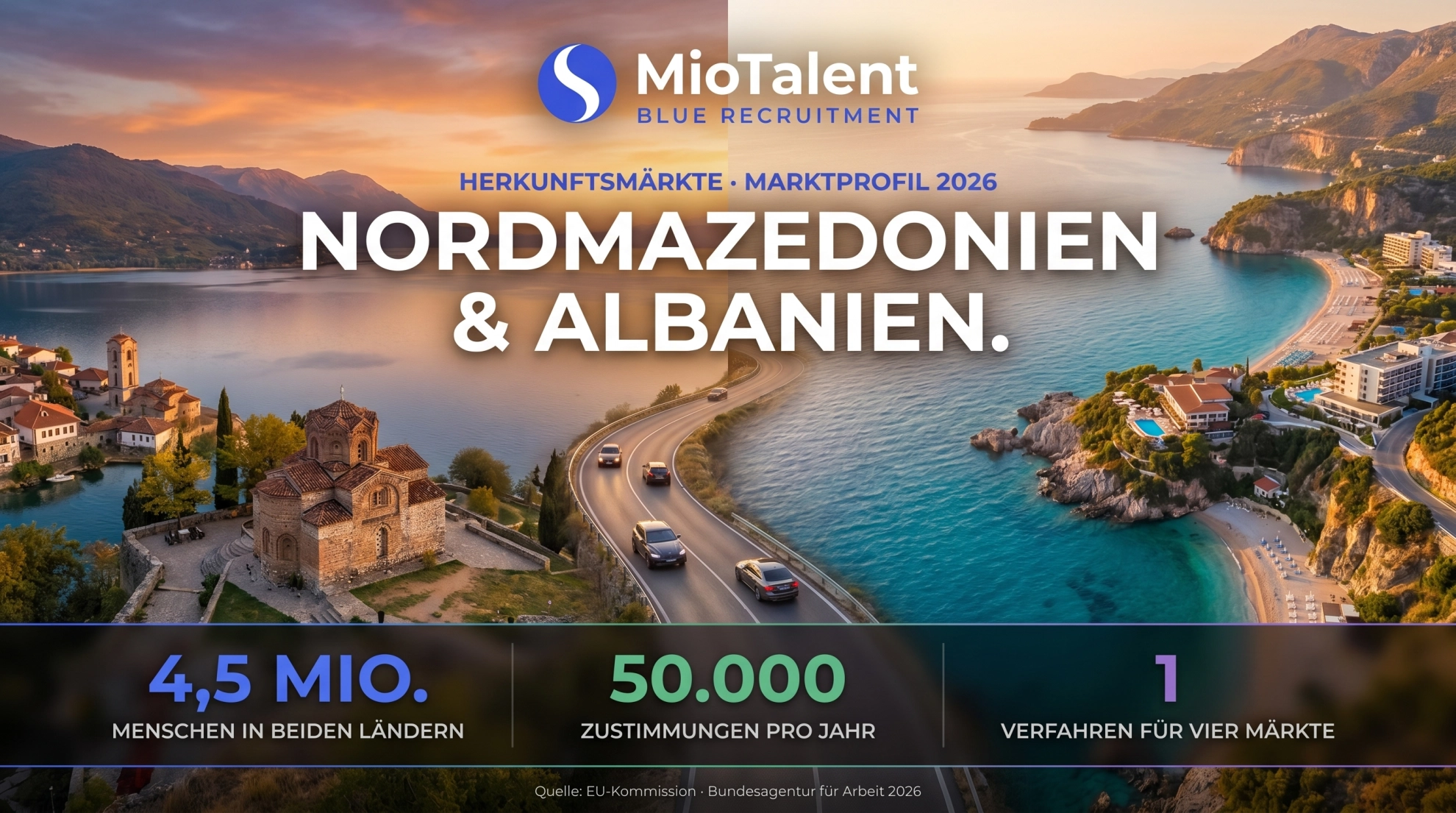
Both are among the six countries covered by the Western Balkans regulation under Section 26(2) of the Employment Regulation. The regulation allows their nationals to engage in any employment in unregulated occupations, even without formal qualifications, within a quota of up to 50,000 approvals per year. The procedural process is thus identical to that for Serbia and Montenegro—once you’ve mastered the process, you can apply it to four markets instead of two. This is precisely where the strategic value lies: the Western Balkans Regulation is a tool, and North Macedonia and Albania double the scope of its application. Added to this is the geographical proximity of the entire region: short travel distances, in-person job interviews on-site at a reasonable cost, and uncomplicated visits home—factors that present their own hurdles in more distant recruitment countries but simply do not apply here.
Profiles of North Macedonia and Albania
North Macedonia has a population of about 1.8 million and has been an EU candidate country since 2005—longer than any other country in the region. Albania has a population of about 2.8 million and has been a candidate since 2014; accession negotiations for both countries began in 2022 (European Commission). Together, they thus represent a candidate population of just over 4.5 million people—smaller than Serbia alone, but larger than Montenegro and Croatia combined.
Economically, the two profiles differ. Albania has been experiencing significant growth in tourism for years, driven by the Adriatic and Ionian coasts—with the well-known dual effect: Practical experience in the restaurant and hotel industries is structurally present in the market, but is also needed domestically during the country’s own peak season. North Macedonia is more heavily influenced by industry and services and has a long tradition of labor migration to Central Europe; for many families, working abroad is the norm, which lowers practical barriers—from the decision to make the move to organizing the relocation. Established migration networks also mean that there are existing communities, support centers, and practical knowledge in Germany, which makes settling in easier and strengthens ties—a factor that doesn’t appear in any statistics but plays a key role in the first year of employment.
In terms of recruitment, this means that Albania tends to provide practical experience in the hospitality industry, while North Macedonia offers a broad range of workers for kitchen, housekeeping, support, and entry-level positions. These two profiles complement each other—and they complement Serbia and Montenegro rather than competing with them. For the staffing strategy, this complementarity is the key point: Four markets with a single process mean four independent sources for the same pipeline—if one is temporarily unavailable, for example due to the season or quota restrictions, the others continue to provide support.
Qualifications and Language: An Honest Assessment
As is the case throughout the region, qualifications range from formal vocational training to many years of practical experience without a formal degree. Both paths are viable: Recognizable degrees open the door to the skilled worker track under the Skilled Worker Immigration Act, while experience without formal recognition paves the way through the Western Balkans Regulation or the experience-based track. The vocational training systems in both countries differ from Germany’s dual training system; practical skills are often acquired directly on the job. Certificates alone are therefore not sufficient for selection—the professional assessment prior to placement remains the decisive quality control step, conducted through structured interviews and work samples rather than a review of documents. Here, too, it makes sense to differentiate based on the area of work: guest contact requires different skill sets than kitchen or housekeeping, and those who describe the position precisely in advance will find the right candidate more quickly.
When it comes to language, plain language applies throughout the region: German is the bottleneck, not the craft itself. In Albania, people speak Albanian; in North Macedonia, they speak Macedonian, and a significant portion of the population also speaks Albanian—neither of which are structurally similar to German. Achieving a practical B1 level takes many months and should therefore be addressed at the very beginning of the process—during the administrative procedures—not at the end. For positions involving guest contact, B1 remains the sensible target; in the kitchen and housekeeping, a lower level is often sufficient to get started. Those who plan with realistic expectations will encounter no surprises; those who ignore the language issue will encounter nothing but surprises. The good news is the same as everywhere else in the region: language preparation in the country of origin shifts the learning period to a phase when administrative procedures are already underway—it thus requires some lead time, but no additional time.
The procedural path: Identical, predictable, subject to quotas
The process is exactly the same as for Serbia and Montenegro: Based on a specific employment contract, the Federal Employment Agency grants preliminary approval, followed by a visa application at the appropriate German diplomatic mission abroad, and after entry, registration on-site: registration of residence within two weeks, a tax identification number, social security enrollment through the employer, and a residence permit from the Foreigners’ Registration Office. For most jobs in the restaurant and hotel industries, the qualification recognition process is not required because these occupations are not regulated.
Three planning factors deserve attention. First, the quota: The 50,000 approvals per year apply to all six Western Balkan countries combined and are allocated by month and nationality—early planning throughout the year remains the most effective strategy. Those looking to fill positions in the second half of the year should not apply for approval at the last minute, but rather submit the application at the very beginning of the planning process. Second, the age limit: For workers over 45 years of age receiving approval for the first time, a minimum gross annual salary of 55,770 euros or proof of adequate retirement benefits will apply in 2026 (Federal Employment Agency, 2026). Third, the parallel process: Language preparation, document collection, and preliminary approval all take place simultaneously so that everything is ready when the visa is issued—those who tackle these steps one after another end up wasting months. Our document checklist details exactly which documents are needed at each stage, from certified translations to apostilles.
Plain Language: Competition for the Same Candidates
The Western Balkans Regulation is open to any German company—and that is precisely its downside. Everyone familiar with the process competes for candidates from the region, including Austria and other destination countries with their own channels. The program provides access, but not a head start—it’s the ticket in, not the seat. The head start comes from what happens before the process begins: reliable on-site selection, skills assessment, language preparation, and a process that supports the individual through their transition into the company and during their first few months on the job.
That’s why the key question regarding these markets isn’t whether they’re lucrative—they are—but rather what structure is used to tap into them. A job posting on a portal in Skopje or Tirana won’t reach anyone who isn’t already looking for a job. A local partner network, on the other hand, reaches the right candidates. To achieve this, MioTalent works with a partner network in the Western Balkans and its own agency in the region—meaning that tapping into these markets isn’t a project every company has to handle on its own. When it comes to evaluating service providers, the same standard applies here as everywhere else: Those who have concrete answers regarding the selection process, language preparation, and support after arrival have a structure; those who merely quote the regulations have a brochure.
Who These Two Markets Are Suited For
North Macedonia and Albania are suitable for companies that want to systematically tap into the Western Balkans rather than on an ad hoc basis—as an extension of the candidate region beyond Serbia and Montenegro, with identical procedures and their own unique strengths. They are well-suited for a wide range of staffing needs—from kitchen and housekeeping to unskilled and semi-skilled positions—where the Western Balkans regulation is most effective, since no professional recognition is required, thereby completely eliminating the longest step in the process. And they are suitable for businesses that think in terms of pipelines: Those who serve multiple source markets simultaneously are not dependent on the availability of workers from a single one.
The honest summary: Two markets with a combined population of about 4.5 million people, an established procedural framework, and complementary profiles—overlooked primarily because they are discussed less frequently, not because they are less effective. Anyone who views the Western Balkans as a whole—with Serbia and Montenegro as established pillars, North Macedonia and Albania as extensions, and Croatia as an opportunistic EU option—has turned a regulatory framework into a strategy that does not depend on any single market. Our article on the Western Balkans scheme explains the fundamentals of the scheme; the article on the duration of international recruitment outlines the timeline for the process.
Sources: Federal Employment Agency (vacancy periods and Western Balkans Regulation 2026); European Commission (country data and accession status); Skilled Workers Immigration Act (as of 2024).