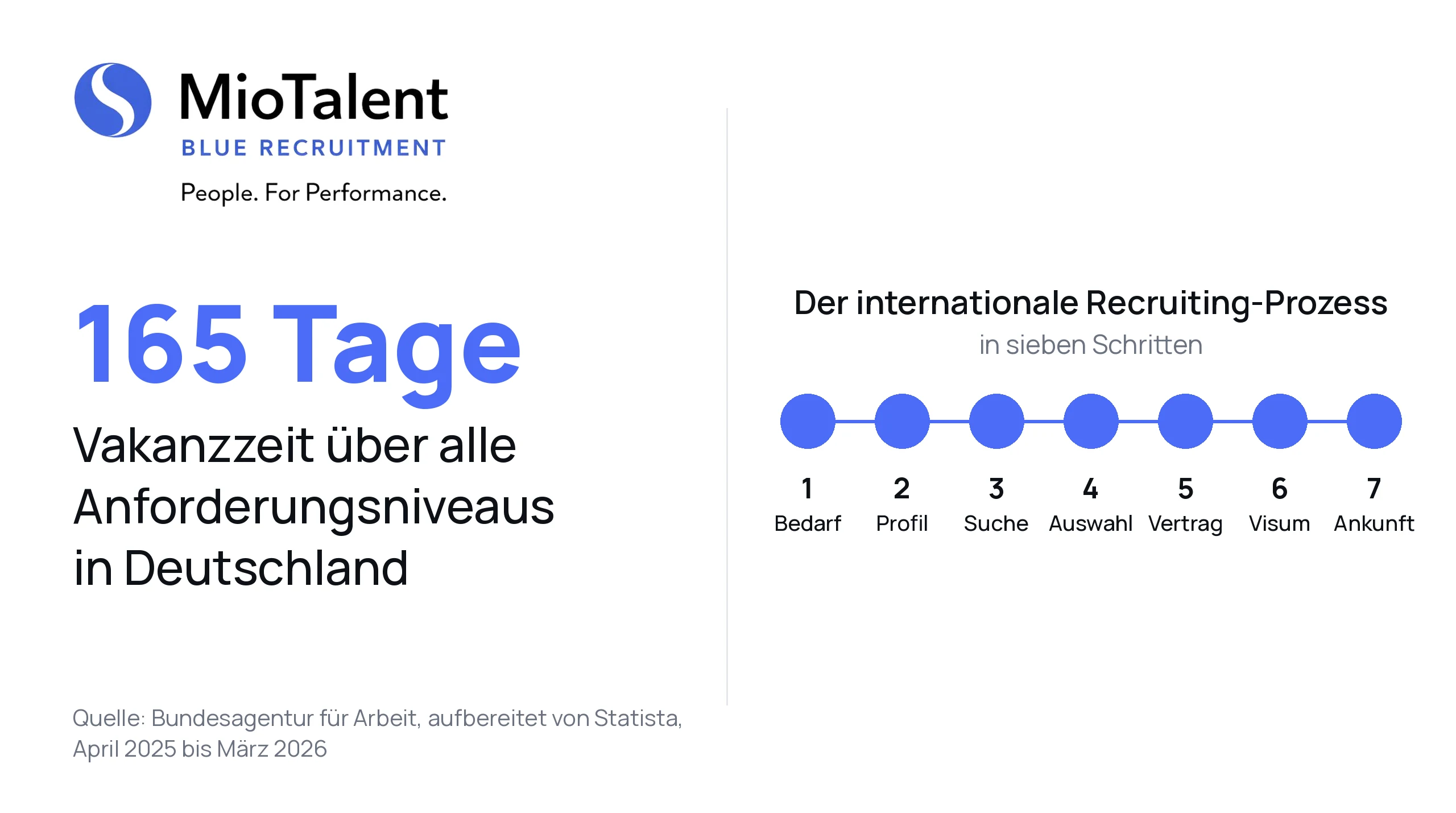
International recruitment can’t be explained in a single sentence. It follows a process—and that process determines whether it ultimately results in a hire or a vacant position. Here, we describe the process in seven steps, with realistic timeframes and without any marketing promises.
Why seven steps—and why the order matters
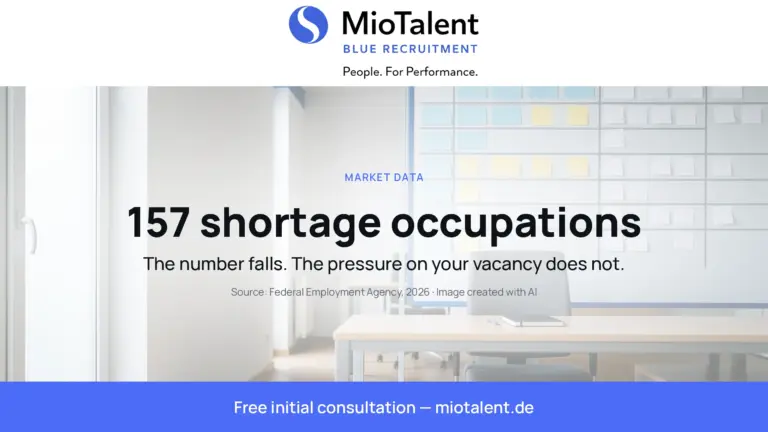
The Federal Employment Agency reports an average vacancy duration of 183 days for skilled workers in 2026; in the hospitality industry, the figure is 198 days (Source: Federal Employment Agency, Vacancy Duration by Skill Level, 2026). On average, therefore, a position remains open for about six months before it is filled. This figure serves as the benchmark against which international recruitment is measured.
Anyone who works without structure loses money in each of these months: through lost revenue, through extra work for the existing team, and through damage to their reputation in the market. Anyone who works with structure doesn’t primarily gain speed—they gain predictability. That’s the real lever.
The international recruiting process refers to the structured sequence of steps involving needs analysis, job profiling, searching for candidates abroad, selection, contract drafting, handling of official paperwork, and onboarding—in other words, the chain of steps that takes place between a vacant position and a fully integrated employee.
Phase 1 — Needs, Profile, Market Assessment
Step 1: Needs Assessment
It doesn’t start with a job posting, but with a question: What position actually needs to be filled, and to what extent does the internal job description align with what the market can actually offer?
The Federal Employment Agency distinguishes between four skill levels, each with significantly different vacancy durations: Assistants: 156 days; Specialists: 157 days; Skilled Workers: 183 days; Experts: 109 days (Source: Federal Employment Agency, Vacancy Duration by Skill Level, 2026). Anyone who posts a job as a “skilled worker” even though a qualified assistant could also perform the job is unnecessarily prolonging their own vacancy period. The needs analysis corrects this ambiguity before the first step in the search process.
In practice, this means that job responsibilities, shift schedules, physical requirements, language proficiency, team composition, and growth prospects are clarified—not because compliance requires it, but because each of these variables narrows or broadens the pool of candidates.
Step 2: Job Description and Qualification Requirements
The profile is derived from the needs analysis. A good profile precisely describes three things: what the candidate must be able to do, what they can be trained to do, and what is non-negotiable. For the restaurant and hotel industries, the critical factors are almost always the same: German language skills, physical stamina, willingness to work shifts, formal qualifications, or professional experience.
Formal qualifications are what distinguish international recruitment from national recruitment. A chef from Serbia typically has a different training background than a chef from Bavaria. The question is not whether the qualifications are the same—they are not. The question is whether they are equivalent, and who determines that. This clarification belongs in the profile, not in the subsequent administrative phase.
Phase 2 — Candidate Search and Selection
Step 3: Searching for Candidates in the International Market
The Federal Employment Agency’s BA-X Job Index stood at 106 points in February 2026—the highest level in 14 months (Source: Federal Employment Agency). In other words: Demand for workers is rising, and the domestic labor market is becoming increasingly tight. As a result, international markets are no longer just an option, but a necessity.
MioTalent focuses primarily on candidate pools from the Western Balkans—Serbia, Montenegro, North Macedonia, Bosnia and Herzegovina, and Albania. The reason is not ideological, but operational: Under the Western Balkans regulation pursuant to Section 26(2) of the Employment Ordinance, the procedural path is clear; the training tradition in the restaurant and hotel industries is solid; and the geographical proximity reduces future travel and retention issues. A dedicated agency in Montenegro handles the on-site selection process.
Other markets—India, Pakistan, and the Philippines—are, in principle, accessible, but experience has shown that they involve longer visa processes and require more preparation. We state this openly because a pipeline is only reliable if its bottlenecks are known.
Step 4: Selection and Suitability Assessment
The selection process in international recruiting takes place on two levels: a formal review (documents, proof of qualifications, language certificates) and a personal assessment (interview, skills test, suitability for the specific company).
The in-person screening process typically consists of two to three stages: an initial interview conducted by our on-site selection team, a video interview with the employer, and—optionally—a trial shift in a partner kitchen or a practical test. A recommendation is made only after this process is complete—and the legal phase begins only after the recommendation is issued.
This is where direct hiring often falls short: The employer makes a decision based on a five-minute phone call, while the candidate makes a decision based on a glossy video. Both underestimate the effort required to adapt to the company’s culture and language. A structured selection process isn’t bureaucracy—it’s the only safeguard against early departures.
Phase 3 — Contract, Government Agencies, Entry
Step 5: Drafting the Contract and Acceptance
Once a candidate has been selected, the formal phase begins. The employment contract is drawn up in accordance with German law—even if the candidate is still abroad. This is not merely a formality: the minimum wage, working time regulations, notice periods, and social security obligations apply from the first day of employment in Germany. Anyone who deviates from these requirements risks jeopardizing the employee’s residence permit and their own reputation as an employer.
The contract also serves as the basis for the visa application. Without a signed employment contract, you cannot obtain a visa. This sequence is non-negotiable.
Step 6: Visa, Recognition, Administrative Process
For many employers, this process becomes a black box. That’s understandable—it involves several departments with different responsibilities and time frames:
– the German diplomatic mission in the country of origin (visa application) – the competent recognition authority (for regulated professions or equivalency assessment) – the Federal Employment Agency (approval procedure) – the local immigration office at the place of work (residence permit after entry)
The duration depends on the country of origin, the skill level required, and the application process. Experience shows that the Western Balkans scheme proceeds more quickly than a process under the Skilled Immigration Act. There is no reliable guarantee that “everything will be taken care of in four weeks” at this stage—anyone who promises that does not understand the process.
What MioTalent handles during this phase: preparing the application documents, accompanying the candidate to the appointment, communicating with the authorities, and providing status updates to the employer. This does not artificially speed up the process—it prevents the typical delays caused by incomplete documentation.
Step 7: Entry, Arrival, Integration into the Workplace
The operational phase begins upon arrival, and statistically, this is the phase in which most international hires fail—not during the hiring process, but in the day-to-day operations. The first 90 days determine whether the contract will turn into a long-term relationship.
Three things are critical during these 90 days: arranged housing, a clear onboarding plan with a designated point person on the team, and honest communication about what isn’t going smoothly. Language, dealing with government agencies after arrival, opening a bank account, registering with the residents’ registration office, and obtaining a social security number—all of this happens at the same time the employee starts work. Companies that leave new employees to fend for themselves in this process often lose them within the first six months.
What You Can Realistically Expect From the Process
A realistic timeline for a position from the Western Balkans—from the needs assessment to the start of work—is about four to six months, depending on the season, the workload at the diplomatic mission, and the quality of the preparatory work. For other countries of origin, this timeframe can extend to six to nine months.
These figures are below the average vacancy period in the hospitality industry of 198 days (source: Federal Employment Agency), but they are not a guarantee. They are based on experience and structured procedures. Anyone who hears promises of faster hiring should be wary.
It’s also realistic to expect that not every candidate is a good fit. Not every contract gets signed. Not every entry into the country goes smoothly. A reputable pipeline operates on the basis of a success rate; it doesn’t claim a 100 percent success rate.
How MioTalent Handles This Process in Practice
MioTalent manages the international recruitment process as a cohesive process—not simply as a service for forwarding resumes. The employer is assigned a dedicated contact person, receives a timeline, and is billed exclusively on a success-based fee structure: the fee is due only after a successful hire.
Our focus on the Western Balkans, with our own office in Montenegro, serves as the operational foundation. GDPR-compliant data processing, contracts governed by German law, and certifications from the BWA, the German-Serbian Chamber of Commerce (AHK), and the German Chamber of Industry and Commerce (DIHK) form the formal basis. Together, these two elements make up the pipeline.
If you’re considering whether international recruitment is a realistic option for your company, the first step isn’t a contract—it’s a conversation. During this conversation, we’ll determine whether your hiring needs align with the talent pipeline—and whether the talent pipeline aligns with your hiring needs. Both scenarios are possible, and we’ll discuss them openly.