Anyone recruiting international professionals for the restaurant and hospitality industries will quickly run into the language issue. How well does someone need to speak German for things to run smoothly at work? The honest answer: It depends on the position—and on what companies are willing to contribute themselves.
Why the Language Issue Must Be Decided Early On
The turnover rate in the hospitality industry is 60.5 — one of the highest rates among all industries in Germany (Source: Federal Employment Agency, 2024). One of the most common reasons for early turnover is not a lack of professional competence, but rather a lack of communication skills: Employees do not fully understand instructions, the team cannot find a common rhythm, and misunderstandings pile up.
Language is not a soft factor. It is a tangible factor that binds people together—in both directions. A candidate whose language proficiency matches the position will stay longer. A candidate whose language proficiency is consistently too low for the requirements will leave the company sooner—or will be fired.
That is why the language requirement should be included in the job description, not discussed during the job interview after the candidate has been hired.
What the language levels A1 through C1 Actually Mean
The Common European Framework of Reference for Languages (CEFR) defines six proficiency levels that describe what a person can do with a language—not how many words they know.
A1 refers to basic language use: understanding and speaking simple sentences, introducing oneself, and communicating basic needs.
A2 indicates advanced elementary proficiency: handling routine everyday situations, understanding simple instructions, and reading short written messages.
B1 indicates independent language use: understanding the main points of clear, standard language; producing simple, coherent texts; and handling most everyday situations in professional life.
Level B2 indicates advanced independent use: understanding complex texts and specialized discussions, communicating spontaneously and fluently, and expressing nuanced viewpoints.
C1 indicates competent language use: understanding complex, longer texts; using language flexibly and effectively for social, academic, and professional purposes.
What level is realistic for which position?
Service and Restaurant Associate
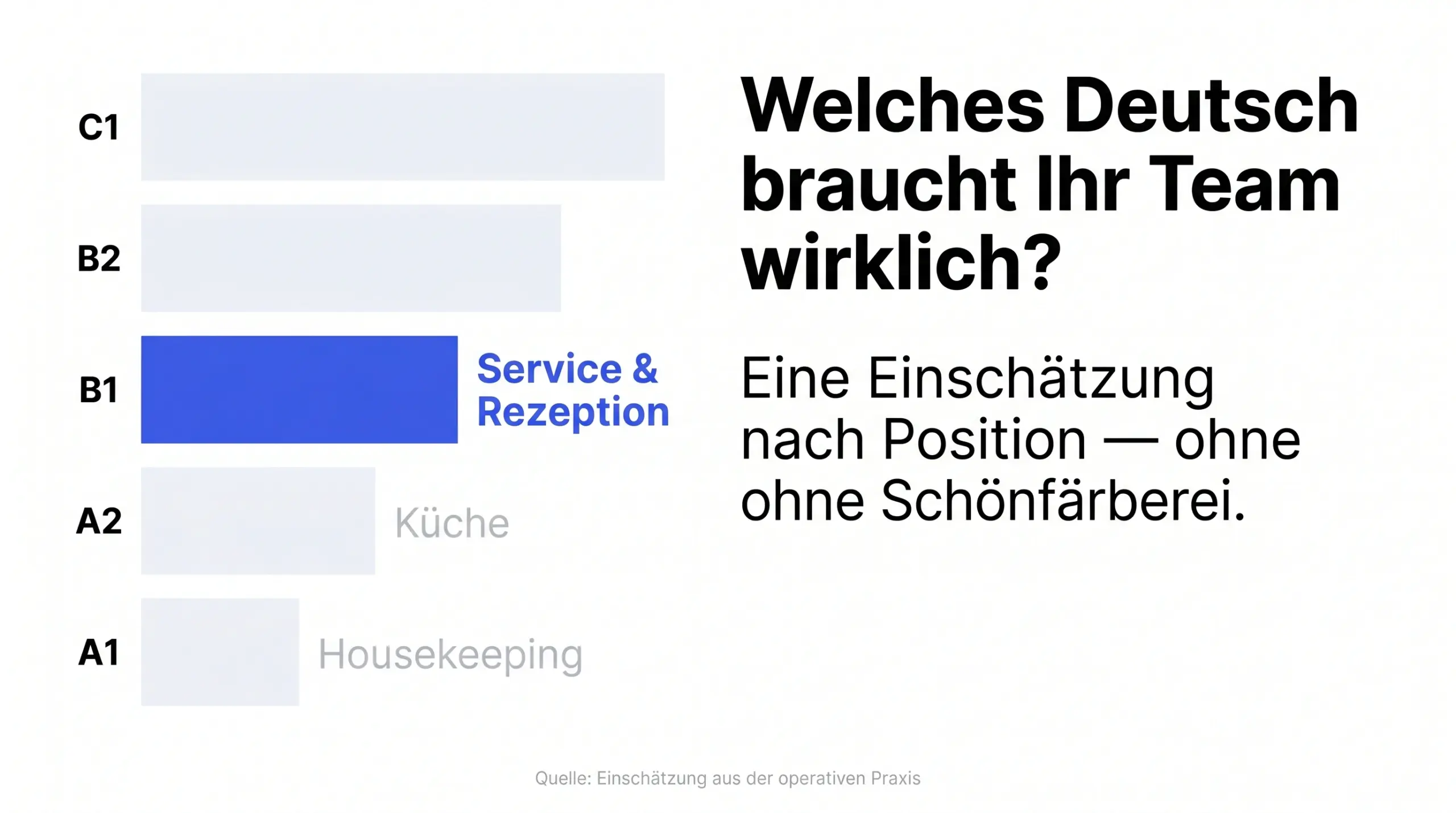
Service work involves a lot of speaking. Employees communicate with guests every day—taking orders, explaining dishes, responding to complaints, and making recommendations. In practice, a language proficiency level below B1 is too low for full-service positions that involve direct contact with guests.
Realistic minimum level: B1, ideally approaching B2 for upscale establishments or those with complex wine lists and multi-course menus. Important: Achieving a B1 level at the time of entry is feasible—no candidate from the Western Balkans automatically has a C1 level. What matters is whether the level is sufficient for the specific position and whether the establishment is willing to actively support the candidate during the first few months.
Kitchen — Chef, Commis de Cuisine, Dishwasher
The kitchen is structured differently from the front-of-house in terms of communication. Language there consists mainly of short, directive exchanges: instructions, feedback, and safety guidelines. Complex conversations with guests generally do not take place.
Realistic minimum level: A2 for entry-level kitchen positions (commis, dishwasher), B1 for cooks responsible for a station or staff. An experienced cook with an A2 level and a high level of professional expertise is more productive in many establishments than a candidate with a B2 level and little professional experience.
Housekeeping and Cleaning
Housekeeping is the position that requires the least amount of verbal communication with guests. Communication takes place primarily internally—with management, with coworkers, and through written lists and reports.
Realistic minimum level: A1 to A2. A basic understanding of the language is sufficient for most operational requirements. It is important to be able to understand safety instructions and respond to simple requests.
Reception and Front Office
Front desk positions are the most linguistically demanding roles in a hotel. The employee serves as the first point of contact for international guests, handles written inquiries, coordinates with other departments, and represents the hotel.
Realistic minimum level: B2 for full-time front desk positions. In addition, knowledge of English is practically mandatory in this field. For night shift front desk positions or roles with significantly reduced communication requirements, B1 may be sufficient.
The Importance of Language Skills in the Visa Application Process
Formally, proof of language proficiency is not a mandatory requirement for most application procedures—neither under the Western Balkans Regulation nor under the Skilled Workers Immigration Act for skilled trades. The visa is not contingent on whether an applicant can demonstrate B1 or B2 proficiency.
That does not mean that language is irrelevant. It means that the test takes place in a practical setting—on the job, in everyday life. Placing a candidate with an A1 level in a service center is legally sound but operationally problematic.
The language issue therefore belongs in the candidate selection process, not in communication with government agencies. MioTalent assesses language proficiency on-site during the selection process and only recommends a position if the candidate’s proficiency level is a good fit for the role. If the candidate’s proficiency is borderline, this is communicated openly—along with an assessment of whether it can realistically be improved through preparation before arrival.
What Businesses Can Do Specifically
Language is not just a matter for candidates. Companies that successfully integrate international employees actively contribute to this in two ways.
First: Language preparation before arrival. In Serbia, Montenegro, and other Western Balkan countries, there are German courses specifically geared toward professional language skills. MioTalent coordinates these courses as part of the preparation process. A candidate who has already studied German in a structured manner for four to eight weeks before arrival gets off to a noticeably better start at the company.
Second: Support during the first 90 days. Language acquisition takes place in everyday life—not in the classroom. A company that assigns a language partner within the team, provides simple written instructions, and offers feedback on language development fosters both engagement and productivity. This doesn’t require resources—it requires attention.
Related articles in this series: Integrating Foreign Employees—What Matters After They Arrive (Week 21). International Onboarding—Why the First 90 Days Are Crucial (Pillar, Week 30). You can find the seven-step recruiting process in the article from May 4, 2026.