Hardly any other pair of terms causes as much confusion in international recruiting as “work permit” and “residence permit.” Companies ask for one, government agencies talk about the other, recruiters sometimes use one term and sometimes the other, and candidates often don’t even know which document they actually need. The result is incorrect applications, unnecessary delays, and—in the worst case—failed hires that didn’t fall through because of any substantive obstacle, but rather because of a conceptual one. The good news: The solution is much simpler than the widespread confusion would suggest—it requires only a clear distinction between the terms and an understanding of how the German system has linked the two issues of residence and work. This article provides exactly that clarification—without bureaucratic jargon and without oversimplifications that won’t hold up with the immigration authorities. After all, this confusion over terminology is not harmless: in practice, it costs weeks when applications end up in the wrong place or when people wait for a document that doesn’t even exist.
Two Terms, One Misunderstanding
A residence permit answers the question: Is this person allowed to be in Germany? A work permit answers the question: Is this person allowed to work in Germany? A common misconception is that these are two separate documents that must be applied for one after the other at different agencies—and that this entails duplicate procedures, duplicate waiting periods, and duplicate fees.
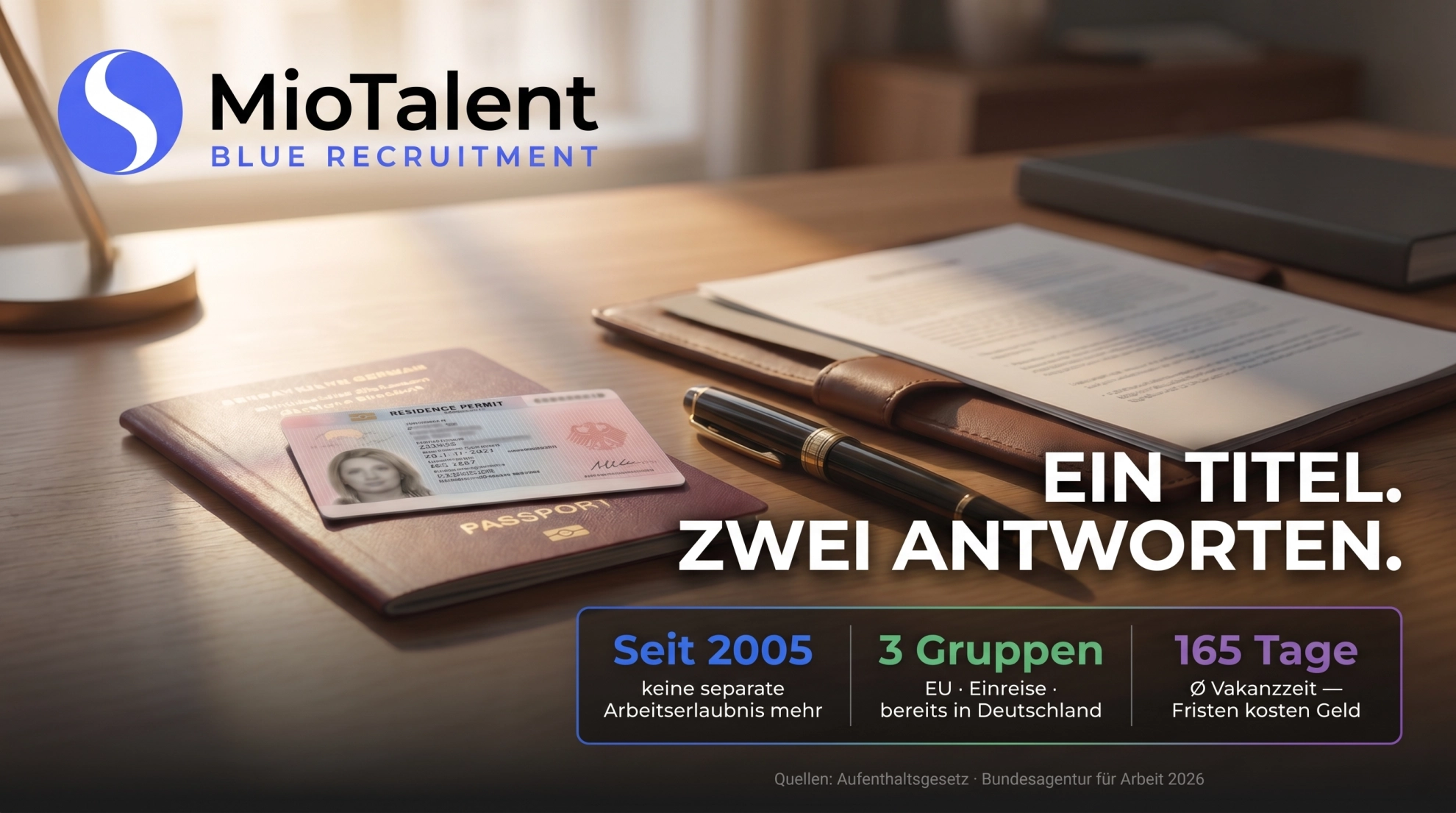
In fact, since the 2005 immigration reform, German law has combined both issues into a single procedure: Since that reform, there has simply been no such thing as a standalone work permit for third-country nationals that must be applied for separately. Whether and to what extent a person is permitted to work is now specified as an ancillary provision directly in the respective residence permit—for example, as a note stating that gainful employment is permitted or that employment is allowed only with a specific employer. So anyone asking about a work permit is actually looking for the correct residence permit with the correct ancillary provision. This is not just nitpicking; it sets the course for the entire process. Those who understand the system ask the authorities the right question—and receive the correct answer more quickly as a result.
Who Needs What: The Three Groups
In practice, candidates can be divided into three groups. The first group consists of nationals of the EU, the EEA, and Switzerland: They need neither a visa nor a residence permit nor any special authorization—the free movement of workers allows them to work on the same terms as Swiss nationals. Hiring someone from Croatia is therefore, from a procedural standpoint, almost the same as hiring a domestic worker. All that remains are the standard registration requirements after entry—residence, tax identification number, social security—but there are no legal hurdles regarding permits.
The second group consists of third-country nationals who enter Germany specifically for employment: They go through the visa process at a German diplomatic mission abroad, enter the country with a national visa, and then receive a residence permit from the Foreigners’ Registration Office—each of which includes provisions governing employment. This includes pathways under the Skilled Workers Immigration Act and the Western Balkans Regulation. For this group, the principle of sequence applies: first the specific employment contract, then the procedure—no residence permit without a job offer to support it.
The third group is often overlooked: third-country nationals who already live in Germany. For them, the key factor is the provision in their existing permit. If it states that gainful employment is permitted, they can be hired immediately; if employment is restricted or not permitted, the process must go through the Foreigners’ Registration Office. The answer to the hiring question is therefore literally in the document—you just have to read it. Incidentally, this group is surprisingly interesting for businesses: People with an existing residence permit and work authorization can be hired without a visa process and without a waiting period—the entire international portion of the process is eliminated.
An Overview of the Most Important Titles
Four types of permits cover the practice of international recruitment almost entirely. The national visa is the entry permit for employment purposes and the first document in the chain. The residence permit is the standard temporary permit issued after entry, which allows employment in accordance with its ancillary provisions—it is the norm in the restaurant and hotel industries. Its duration depends on the purpose and the employment contract; it is generally extended without a new substantive review process as long as employment continues. The EU Blue Card is the permit for highly skilled professionals with corresponding salary thresholds and plays a minor role in the hospitality industry. Finally, the settlement permit is the permanent permit that can be obtained after several years—the most welcome document of all for employers, because it permanently resolves any employment-related issues. To foster employee retention, it is worthwhile to actively support this path—those who help their skilled workers meet the requirements for permanent residency are investing in their own workforce stability.
What is crucial for employment is not so much the name of the permit as its additional provisions: These provisions definitively determine whether any type of employment is permitted, or only a specific type, with a specific employer, and to a specific extent. A document indicating unrestricted employment is as straightforward for the employer in day-to-day operations as a German passport; a document tied to a specific employer requires the authorities to be involved again with every change of employer.
Prior Approval: The Process Within the Process
Where, exactly, does the Federal Employment Agency fit into all of this? Its approval is a prerequisite for granting the title in most employment pathways—but it is an administrative step between government agencies, not a separate document that the candidate would need to apply for. In its approval, the Federal Employment Agency reviews the terms of employment depending on the procedural route—in particular, ensuring that the candidate is not employed under worse conditions than comparable domestic workers. This step can be expedited through prior approval: The employer obtains the Federal Employment Agency’s approval before the visa application is submitted, and the diplomatic mission can then make a decision without having to go through its own approval loop. Particularly when using the Western Balkans Regulation route, this sequence is the most effective time-saving measure in the entire process, because it removes the coordination loop between the diplomatic mission and the Federal Employment Agency from the critical path—the basics of this are explained in our article on the Western Balkans Regulation.
What Employers Need to Check
Now that the terms have been clarified, the question of the employer’s obligations remains, and these are clearly defined by law. Before hiring a third-country national, the employer must verify whether the individual has a valid residence permit and whether that permit authorizes the specific employment—including any ancillary provisions. A copy of the permit must be retained for the duration of employment. Anyone who employs a person without a valid permit or in violation of its restrictions risks severe and avoidable penalties—and this applies to the employer, not just the employee. This verification requirement is not a form of harassment, but a measure of self-protection: It takes ten minutes and requires paying attention to the ancillary provisions—and it is the reason why a copy of the permit belongs in the personnel file before the first work schedule is drawn up.
The review also includes the calendar: residence permits are temporary, and renewals require advance notice. A well-organized business that keeps track of its international employees’ deadlines and reminds them of renewals in a timely manner protects both sides equally—the employee from losing their status, and the business from a sudden gap in the work schedule in the middle of the season. With an average vacancy period of 165 days (Federal Employment Agency, 2026), failing to renew a permit is a costly oversight. A simple list of deadlines in HR administration has proven effective: title, expiration date, a reminder three months in advance—that’s all the administration needed to fully manage this risk.
The distinction in one sentence
If you want to remember this, just keep this sentence in mind: There is no separate application for a work permit in Germany—the permission to work is included in the residence permit, and the task is to obtain the correct permit with the appropriate supplementary provision. Everything else is a matter of procedure: finding the right path based on country of origin, occupation, and qualifications; obtaining advance approval to expedite the process; and ensuring a thorough review before the first day of work. Our overview of labor migration to Germany in 2026 outlines the overall legal framework and all available pathways; the article on professional recognition clarifies whether additional recognition is required for a specific profession.
Sources: Residence Act; Skilled Workers Immigration Act (as of 2024); Employment Regulation; Federal Employment Agency (job vacancy data for 2026).