Croatia is the exception in the region: it is the only country of the former Yugoslavia that is already an EU member. For German employers, this changes almost everything in terms of procedures—and almost nothing in terms of the job market. This profile provides an honest overview of both aspects: what steps are no longer required when hiring from Croatia, what remains, and why the legally simplest approach isn’t automatically the most effective one. It is precisely this confusion that leads to unmet expectations in practice.
The Special Legal Case: EU Member State Instead of a Third Country
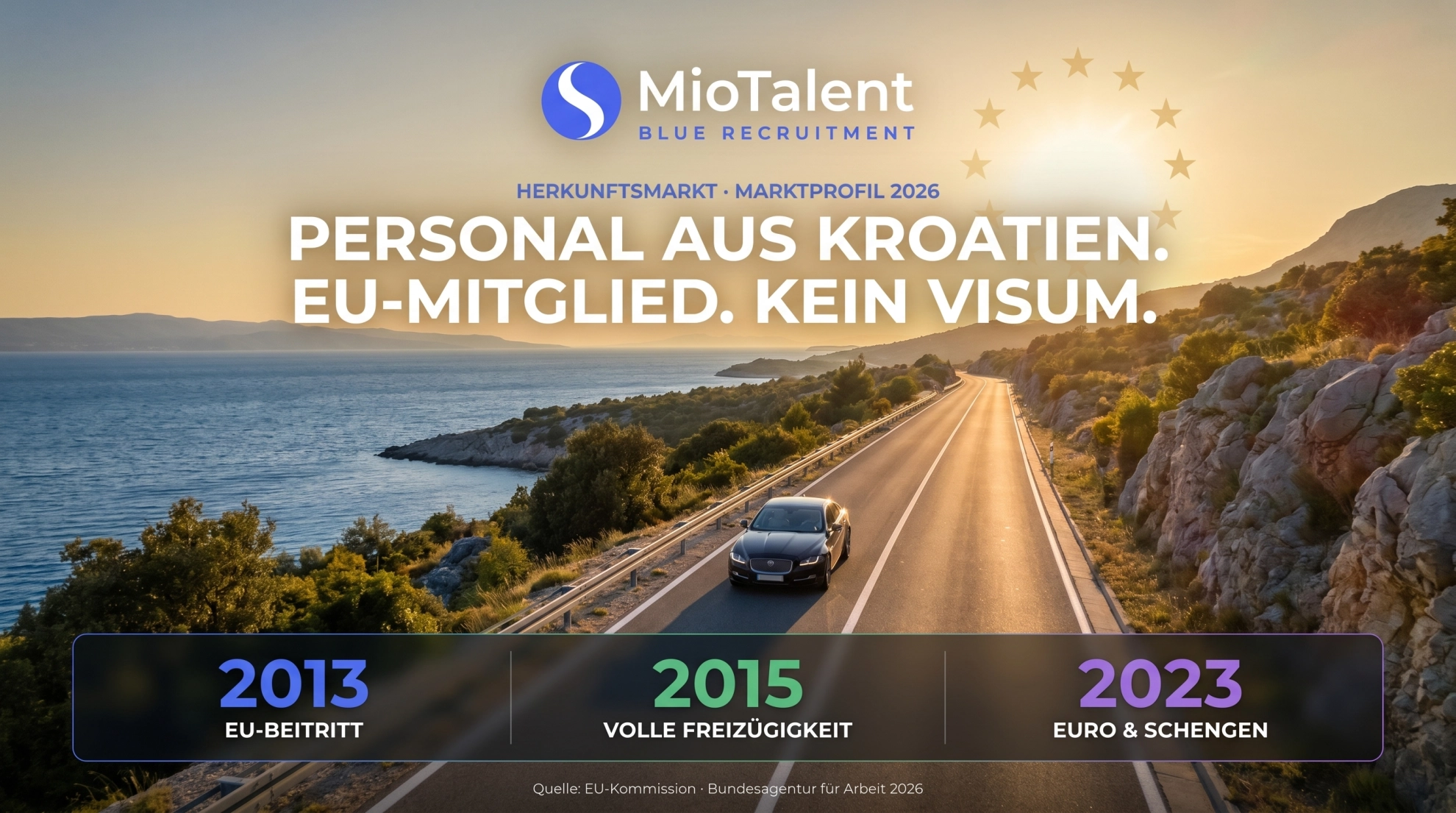
Croatia has been a member of the European Union since July 1, 2013. Since July 1, 2015, Croatian nationals in Germany have enjoyed full freedom of movement for workers, and since January 1, 2023, the country has also been a member of the eurozone and the Schengen Area (European Commission).
The free movement of workers refers to the right of EU citizens to take up employment in any EU member state without a visa or work permit, under the same conditions as nationals of that country. In practice, this means that hiring someone from Croatia is not legally considered third-country recruitment, but rather largely a domestic hire involving relocation. There is no visa process, no prior approval from the Federal Employment Agency, no quotas, and no diplomatic mission involved.
This makes Croatia fundamentally different from Serbia, Montenegro, and the other Western Balkan countries, for which the path to immigration is through the Western Balkans Regulation or the Skilled Worker Immigration Act. It is the same geographic region, but with a completely different legal status. Schengen membership since 2023 amplifies this effect in everyday life: no border controls upon arrival or departure, uncomplicated family visits, and easy commuting and return options. This is an underestimated factor in employee retention, as it allows employees to maintain a sense of connection to their home country without every trip turning into a bureaucratic ordeal.
What Is Not Required When Hiring From Croatia
Anyone familiar with the third-country process will recognize the difference immediately. The steps that take the most time in that process are eliminated: the visa application process—including scheduling an appointment at the diplomatic mission abroad—the prior approval from the Federal Employment Agency, the quota issue, and, for non-regulated occupations, the recognition process as well.
The time savings are significant. While the process for third-country nationals takes months, hiring someone from Croatia can be accomplished in a matter of weeks from an organizational standpoint, provided the right candidate is found. Given the average vacancy period of 165 days across all skill levels (Federal Employment Agency, 2026), this is the fastest legal way to fill a position with a worker from abroad. This is precisely why Croatia appears as the first option in many HR strategies—and this is exactly where the honest assessment begins, because legal simplicity says nothing about availability.
There are also significant savings on the cost side: no visa fees, no costs for the application process at the diplomatic mission, and—for unregulated professions—no certification fees. What remains are the expenses associated with any job that involves relocation, from travel and initial housing to onboarding. The difference, then, lies less in the total costs than in predictability: there are simply fewer steps where things can go wrong.
What Remains, Nevertheless
The EU hiring process also has its mandatory steps, which follow a clear sequence. First, the employment contract under German law, which is fully effective from the first day, including the minimum wage and, if applicable, coverage under a collective bargaining agreement. Second, entry into the country, for which an ID card is sufficient. Third, registration of residence with the Residents’ Registration Office, usually within two weeks of moving in. Fourth, the automatic assignment of a tax identification number, enrollment in social security through the employer, and a German bank account for salary payments.
The language issue also remains unchanged. The free movement of workers streamlines bureaucratic procedures, not language acquisition: For positions involving guest contact, a B1-level proficiency remains advisable, while in the kitchen and housekeeping, a lower level is often sufficient to get started. And in regulated professions, such as nursing, recognition of qualifications is mandatory even for EU citizens. So, hiring from Croatia saves you the paperwork, not the preparation. This also applies to integration: housing, support during the first few weeks, and a structured onboarding process are key to retaining employees—for EU citizens just as much as for third-country nationals. The national ID card replaces the visa, but not the welcome infrastructure. Companies that take this aspect seriously get significantly more out of this small market than those that rely solely on the straightforward legal situation.
Plain Language: A Small, Highly Competitive Market
Now for the market perspective, without sugarcoating it. Croatia has just under 3.9 million residents, making it significantly smaller than Serbia, which has around 6.66 million (European Commission, 2026). The available pool of candidates is correspondingly limited. This situation is exacerbated by demographic trends: Croatia has been losing population for years due to emigration, particularly among younger workers—and it is precisely this group that is in high demand in the restaurant and hotel industries.
Added to this is the structure of the Croatian economy itself: Tourism along the Adriatic coast is a mainstay, and its peak season falls precisely during the months when German businesses are also looking for staff. Experienced restaurant and hotel workers are therefore needed—and consequently sought after—in their own country precisely when demand from Germany is at its highest.
And finally, the key point: Croatia itself faces a severe labor shortage and is recruiting workers internationally, particularly for its own tourism season. The freedom of movement that facilitates access for German companies applies in both directions—Croatian skilled workers can just as easily go to Austria, Ireland, or Scandinavia, and many have been doing so for years. The wage gap is also narrowing: Salaries in the Croatian tourism sector have risen noticeably in recent years, and Austria is geographically closer than most German regions. The market with the simplest legal framework is thus also one of the most fiercely competitive. Anyone looking to recruit here isn’t competing with the bureaucratic process, but with all of Europe for the few available workers.
Croatia Compared to the Western Balkans
This results in a clear trade-off between speed and availability. Croatia offers the fastest route, but with a limited and highly competitive supply. The Western Balkan countries outside the EU—primarily Serbia and Montenegro—offer a larger pool of candidates but require applications to be processed through the Western Balkans Regulation, which allows for up to 50,000 approvals per year, or through the Skilled Worker Immigration Act.
In practice, this means that anyone looking to fill a single position on short notice and who finds a suitable candidate from Croatia should seize the opportunity—it doesn’t get any faster than that. However, the decision should then be made quickly, because the same freedom of movement that opens the door to Germany also keeps every other door in Europe open to the candidate. On the other hand, those who need personnel on a predictable and recurring basis are better off relying on the larger markets in the region and accepting the processing time as a predictable factor. It is predictable because the steps are fixed and can be carried out in parallel—unlike a search in a depleted market, where no one can predict how long it will take. Our market profile on chefs from Serbia and Montenegro shows what these markets look like; the article on the Western Balkans regulation explains the basics of the process.
The two are not mutually exclusive. A well-thought-out human resources strategy makes opportunistic use of Croatia and systematic use of the rest of the Western Balkans. One provides a quick win when the opportunity arises, while the other serves as a reliable pipeline for predictable needs.
Who Croatia Is Right For
Croatia is a good fit for businesses that can act quickly when a specific opportunity arises: a job application, a referral, or a contact from previous seasons. It’s suitable for short-term hires and for seasonal staff outside of Croatia’s peak season. It is less suitable as a sole strategy for businesses with ongoing, predictable staffing needs, as the talent pool is too small and competition is too fierce. Three questions can help you assess the situation: How quickly does the position need to be filled? Is there already a specific contact or candidate? And is this a one-time need or a recurring one? The more urgent, specific, and one-time the need, the better Croatia is suited.
The honest conclusion is this: EU membership makes Croatia the easiest source market in the region in terms of procedures, but not the most productive one. With an average vacancy period of 165 days in Germany, both factors ultimately matter—the speed of individual cases and a reliable pipeline of candidates. Our overview of labor migration to Germany in 2026 outlines the various legal pathways available.
Sources: Federal Employment Agency (job vacancy periods for 2026); European Commission (EU accession, free movement of workers, country data).