Work Permit or Residence Permit: The Difference
Hardly any other pair of terms causes as much confusion in international recruiting as “work permit” and “residence permit.” Companies ask for one, government agencies…
We fill your open positions through structured international recruitment—legally sound, GDPR-compliant, and on a success-based model. To put this in context: In the hospitality industry, a vacancy remains unfilled for an average of 198 days; in the construction industry, 297 days; and in the healthcare sector, 296 days (Federal Employment Agency, 2026).
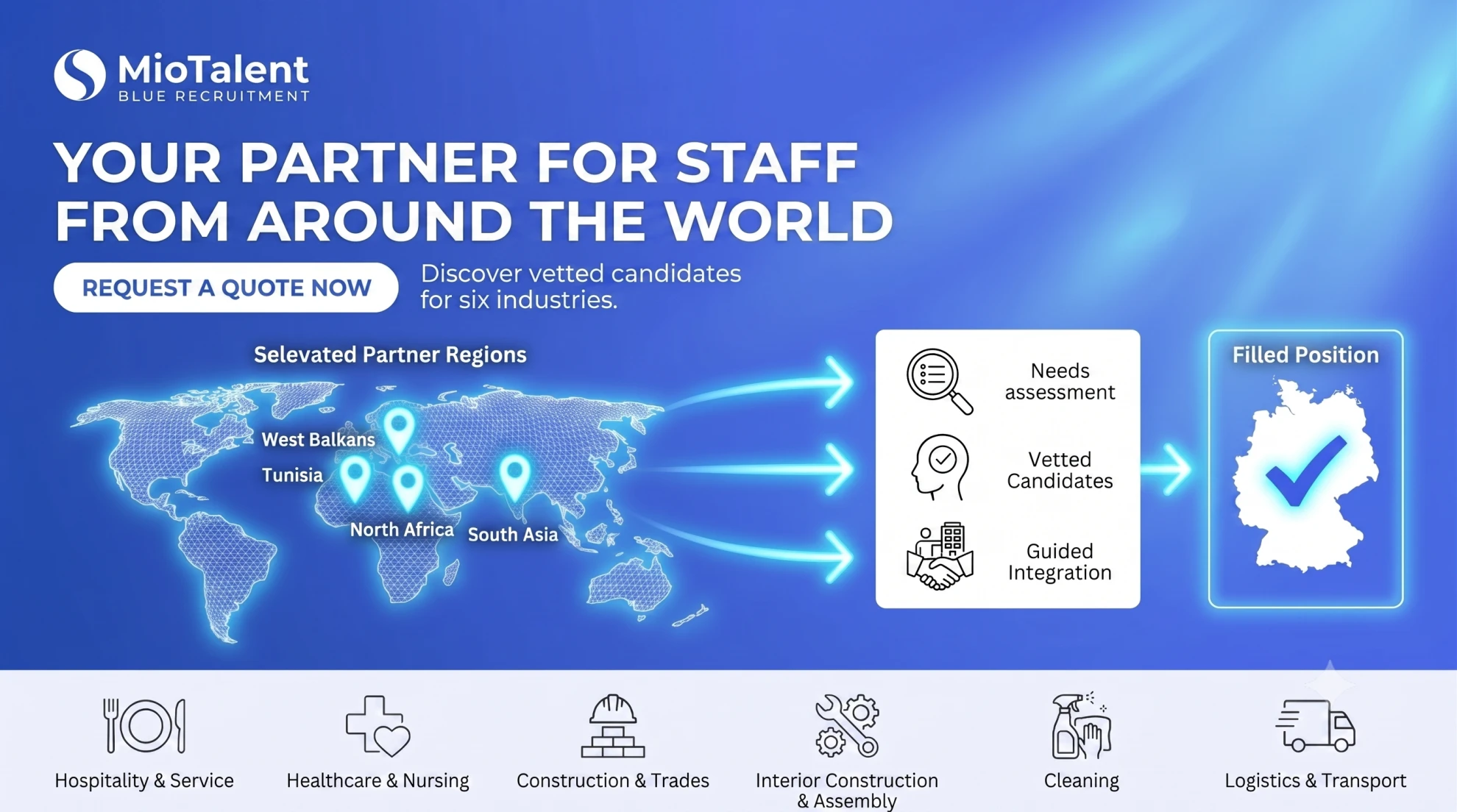
MioTalent connects German companies with vetted candidates from abroad. You focus on your business—we take care of the selection process, contracts, visas, certification, and entry into the country.
We work with select local partners in South Asia, the Western Balkans, Tunisia, and North Africa. Each profession has its ideal region of origin—we make our decisions based on job profile, language requirements, and visa options.
German contacts in Germany — available in person, everything under one roof.
You hire, you don't rent — long-term employees instead of staffing agency markups.
Chefs, servers, bartenders, and kitchen staff for the hotel and restaurant industry. In the hospitality industry, a position remains unfilled for an average of 198 days (Federal Employment Agency, BA).
Certified nursing professionals and care staff for hospitals, nursing homes, and outpatient services. This is a sector that our partners are currently expanding significantly.
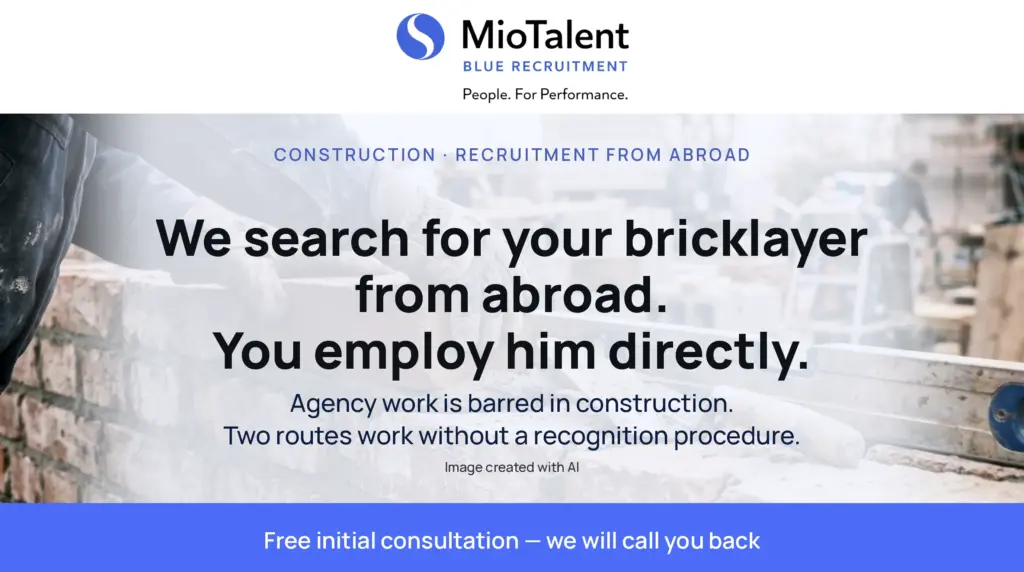
Bricklayers, concrete and steel workers, and construction laborers for structural and building construction. Nationwide, the construction industry is among the sectors with the longest time-to-fill for vacancies (BA).
Installers and skilled workers in plumbing, heating, air conditioning, electrical work, and interior finishing. In SHK trades, a position remains unfilled for up to 296 days (BA).
Cleaning and housekeeping staff for hotels, building cleaning, and property management. Usually without a certification process—making them available more quickly.
Warehouse and logistics workers, as well as professional drivers. In the warehouse and logistics sector, a position remains unfilled for about 156 days (BA).
Germany does not have a skilled-labor shortage. Germany has a recruitment problem. We’re solving it systematically—and we’re laying out the effort, time, and bureaucratic hurdles involved without sugarcoating anything. A serious placement process takes weeks, not hours. Anyone who promises you otherwise is planning without taking reality into account.
We select the appropriate region of origin for each profession—not a one-size-fits-all approach. The key factors are the job profile, language requirements, and visa process.
They hire, not lease: no leasing fees, just long-term employees working directly for the company.
You only pay if the placement is successful. If a placement doesn’t work out during the trial period, we’ll find a replacement.
You can reach us by phone, email, and WhatsApp—in German.
Our local partners follow our legally reviewed procedures and documents.
Our support doesn't end with the signature—we remain available until the integration is complete.
01 · Needs Assessment and Assignment
We determine the candidate’s profile, language requirements, and suitable region of origin.
02 · Candidate Selection and Interviews
Vetted candidates, typically within two to four weeks.
03 · Contract, Visa, and Accreditation
Legally reviewed documents — realistic estimates for government processing times.
04 · Entry and Onboarding
A total of four to six months until the first day of work. We specify these timeframes before the contract is signed—not after.
Together, we’ll figure out: What kind of candidates you’re looking for, which region is a good fit, and what timeframe is realistic. No sales pressure.
For Your Job Postings
Fill Vacant Units
New to the Construction Industry
Temporary Work vs. Direct Hiring
Chief Operating Officer
Chief Executive Officer
Chief Technical Officer
Here are three answers to get you started—you can find all the others on our FAQ page or during our initial consultation.
We operate on a success-based fee structure: You pay only if a placement is made. The terms depend on the profile you’re looking for—we’ll explain them to you transparently during the initial consultation before you hire us. If a placement doesn’t work out during the probationary period, we’ll find a replacement.
Honest answer: usually four to six months from the time the assignment is commissioned until the first day of work. The candidate selection process takes two to four weeks, followed by the contract, visa, and accreditation—government agencies are part of the process. Anyone who promises you 48 hours isn’t taking this reality into account.
We work with select local partners in South Asia, the Western Balkans, Tunisia, and North Africa—in accordance with our legally reviewed procedures and documents. Contracts governed by German law, GDPR-compliant processing, and support throughout the visa and recognition procedures are standard practice.
Tell us about your open position. We’ll give you an honest assessment of whether and how we can fill it—and within what timeframe.
Hardly any other pair of terms causes as much confusion in international recruiting as “work permit” and “residence permit.” Companies ask for one, government agencies…
International recruitment is won in the workplace—but it’s lost at home. Hardly any single factor has such a direct impact on settling in, performance, and…
There is a pair of survey questions that every decision-maker considering international recruitment should be familiar with—and that applies to both groups. In 2024, the…
Mit Cookies und ähnlichen Technologien speichern wir Geräteinformationen und verarbeiten Daten wie Surfverhalten oder eindeutige IDs. Ohne Ihre Einwilligung können bestimmte Funktionen eingeschränkt sein.