Most businesses in the restaurant and hotel industries completely underestimate one aspect of international recruiting: what happens after hiring.
The contract has been signed. The visa has been issued. The new skilled worker arrives. And then—six, nine, or twelve months later—she quits. Or she doesn’t quit, but her performance falls short of expectations. Or she stays in the country but changes employers.
This isn’t an isolated case. It’s a structural problem with identifiable causes. And it can be solved—if you know where to start.
The Unpleasant Data Picture — Germany in International Comparison
Anyone who hires international professionals should know where Germany actually stands in a global comparison—not in terms of how we see ourselves, but in terms of how people who come here perceive the country.
The Expat Insider Index 2025, conducted by InterNations among 10,085 international professionals from 172 countries, paints an unvarnished picture:
- Settling In and Integration: 43rd out of 46. Germany is one of the four countries worldwide where international professionals find it most difficult to settle in.
- General Conditions (Expat Essentials): 46th out of 46. Last place. Four sub-indices were evaluated: language, administration & bureaucracy, affordable housing, and digital life.
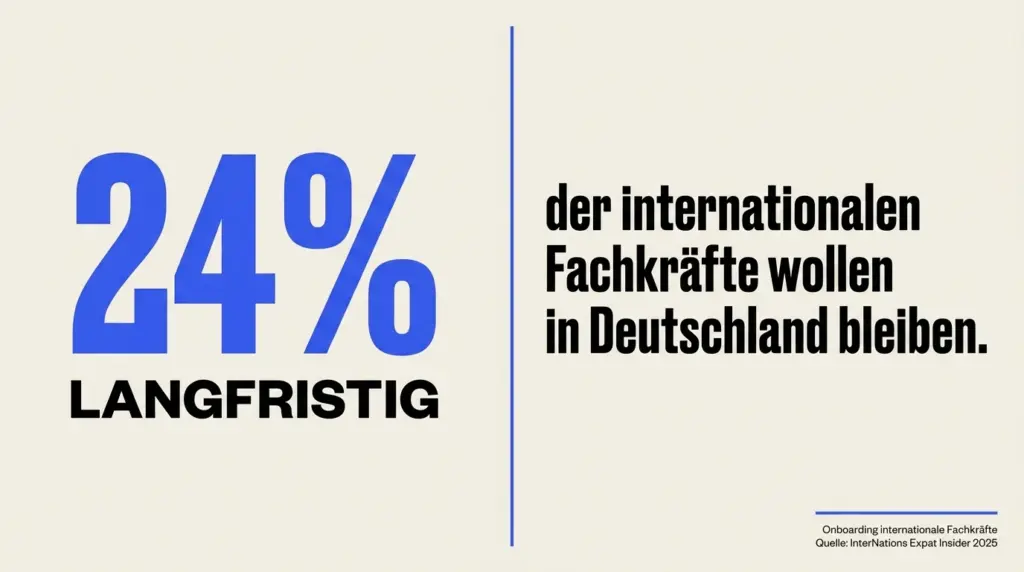
- Length of stay: Only 24% of respondents want to stay long-term. 10% plan to move within the next five years. 7% want to leave within a year. 3% want to leave as soon as possible.
Source: InterNations, Expat Insider 2025 (10,085 respondents, February 2025).
These figures are not a lament. They are the reality against which every personnel decision is made.
Anyone who hires a foreign professional isn’t just dealing with the internal onboarding process. They’re also up against an environment that, structurally speaking, doesn’t welcome that professional. The onboarding process at the company must partially bridge this structural gap—otherwise, that person will be lost.
Why International Professionals Leave Their Employers
The hospitality industry in Germany has a turnover rate of 60.5 (BA 2024)—the second-highest turnover rate of any economic sector. It ranks second only to the temporary employment sector (128.6) and is higher than all other industries.
In an international context, there is a second factor at play: International professionals face an additional source of attrition that German employees do not experience in the same way—structural adjustment.
Based on practical experience, three recurring causes of premature contract terminations can be identified:
Reason 1 — Expectation gap. The skilled worker was recruited in their home country with a promise that does not reflect the reality in Germany. This rarely concerns salary. More often, it involves working hours, housing arrangements, language support, and career prospects.
Reason 2 — Isolation during the first 90 days. At work, the skilled worker faces a daily routine that is impossible to manage without knowledge of the German language. She has no way of connecting with people in her social circle. After three months, her emotional state is negative—even though her professional performance is up to par.
Reason 3 — Excessive bureaucratic demands. Registration with the Residents’ Registration Office, health insurance, income tax card, bank account, lease, and internet service. What is routine for a German employee becomes a series of hurdles for an international professional—each one nearly impossible to overcome without language skills.
These three factors are no coincidence. They are the direct result of what the Expat Insider Index identifies as Germany’s structural weaknesses: language, bureaucracy, housing, and digital infrastructure.
What “International Onboarding” Really Means — A Definition
In German HR terminology, “onboarding” is generally understood to mean “the first few weeks on the job.” This definition is not sufficient for international professionals.
The onboarding of international professionals refers to the structured process of integrating a professional from abroad into a German company—including professional, social, and administrative aspects—which typically begins when the contract is signed and continues at least through the end of the first year.
The difference from national onboarding lies in three additions:
- Extended timeline: The process does not begin on the first day of work, but rather weeks before arrival. Preparation in the home country is part of the onboarding process.
- Expanding the Scope: Onboarding encompasses not only daily life but also the living environment—dealing with government agencies, registering a residence, opening a bank account, and accessing medical care.
- Language Inclusion: Language support is not optional. It is part of an employer’s responsibility—even if it is not required by labor law.
Anyone who fails to take these three aspects into account isn’t conducting international onboarding. They’re conducting national onboarding with a foreign national—and then wonder why the retention rate remains low.
The First 90 Days — What Needs to Happen Structurally
Under German labor law, the probationary period is generally six months. The critical phase of international onboarding is shorter: the first 90 days. This period determines whether the employee will stay with the company or mentally check out.
A structured 90-day onboarding process consists of six steps:
Step 1 — Preparations Before Arrival (Weeks Before Your First Day of Work). Arrange housing or at least secure it for the first 30 days. Make preliminary arrangements to open a bank account. Facilitate initial contact between the specialist and the team (video call, chat, welcome letter).
Step 2 — Day of Reception. Picking someone up at the airport or train station isn’t a luxury. It’s the first sign that the professional is expected. Anyone who shirks this responsibility sends a message that is difficult to undo.
Step 3 — First week on the job. Reduced work schedule. A designated point of contact at the workplace. Dealing with government agencies during the first ten workdays—together, not alone. Language classes begin no later than day 14.
Step 4 — Day 30: Initial consultation. Structured feedback. What works? What doesn’t? What was promised, and what wasn’t delivered? Address any gaps in expectations now—not three months from now.
Step 5 — Day 60: Academic Integration. Full service schedule. Initial assessment of professional competence. Language proficiency assessment. Clarification of possible recognition procedures (see article “Professional Recognition Abroad: How the Process Works”).
Step 6 — Day 90: Strategic Discussion. What are the prospects for skilled workers within the company? What are the prospects at the state level? What measures are needed to ensure a positive outcome on both counts?
Anyone who follows these six steps in a structured manner will have a clear picture after 90 days—and so will the specialist.
The three structural levers—language, housing, and recognition
Behind the 90-day process lie three issues that every employer must address strategically—not on a case-by-case basis for each employee, but as a fundamental company policy.
Lever 1 — Language. What language proficiency level does the company expect upon hiring? B1, B2, or is a lower level sufficient? Who covers the costs of ongoing language courses? How is language progress measured within the company?
In day-to-day restaurant operations, service staff often only need a level of A2 to B1 to get started, with a target level of B1 to B2 within the first year. For kitchen staff, the requirements are often lower (A2), while for reception staff they are higher (at least B2). This distinction should be defined before recruitment—not during it.
Lever 2 — Housing. To what extent does the company provide housing? A fully furnished company apartment, assistance in finding housing, a housing allowance, or nothing at all? International professionals without housing for the first 30 days fail at a stage where German applicants would never fail—they simply don’t make it that far.
The “Affordable Housing” subindex in the Expat Insider 2025 (Germany ranked 43rd out of 46) shows that failing to offer a solution here creates a barrier for skilled workers that they cannot overcome due to structural constraints.
Lever 3 — Recognition. For many positions in the restaurant and hotel industries, formal professional recognition is not strictly required—the Western Balkans regulation allows for employment even without such recognition. However, if the skilled worker wants to build a long-term career in Germany (advancement, transition to other industries, securing permanent residency), the recognition process will eventually become relevant.
An employer who initiates the recognition process in a structured manner within the first 12 months is signaling that this position is not just a stepping stone, but a long-term opportunity.
What Employers Can Do — and What They Can’t
Realism is part of brand communication and part of honest leadership. Three points should be clear:
Employers cannot make up for the entire shortfall in German language proficiency. If Germany ranks 42nd out of 46 in terms of bureaucracy (Expat Insider 2025), that is a structural problem in society. A single restaurant business cannot solve this on its own.
However, employers can structurally determine the difference between staying and leaving. Studies have repeatedly shown that the relationship with one’s direct supervisor and immediate team is the single strongest factor in employee retention—and international professionals are no exception.
Employers should communicate their expectations honestly. Any employer who lures applicants from abroad with a picture that doesn’t reflect the reality in Germany creates a gap between expectations and reality that later leads to termination. Being clear and upfront before the applicant arrives is not a risk—it is the prerequisite for a stable employment relationship.
A structured international recruitment process includes onboarding
International recruitment doesn’t end with the signing of the contract. Nor does it end on the first day of work. It ends—in a practical sense—after the first successful year.
A structured onboarding process is therefore not just an add-on to recruitment. It is part of the same question: How does a contract turn into a lasting employment relationship?
Anyone who plans the recruiting process in a structured way—from the initial interview through the visa application to entry into the country (see the article for details International Recruitment Process: 7 Steps to Hiring) — should approach onboarding with the same level of discipline. Otherwise, losses will occur at a stage where they could have been avoided.
Germany has a structural onboarding problem. But every individual company has a lever it can pull to mitigate this problem for its international skilled workers. Those who pull that lever reap a double return: lower employee turnover and a credible employer brand.
Sources for this post:
- Federal Employment Agency (BA), Staff Turnover Rate in the Hospitality Industry, 2024
- InterNations, Expat Insider Index 2025 (Settling In, General Conditions, Length of Stay)
- Federal Employment Agency, Professional Certification Process 2024