
If you want to hire a skilled worker from abroad, sooner or later the term “recognition” will come up. It sounds like a formality. It isn’t. The figures for 2024 are in, and they tell a very different story from the promises that are common in our industry.
79,100 acknowledgments — and why the number alone doesn’t tell the whole story
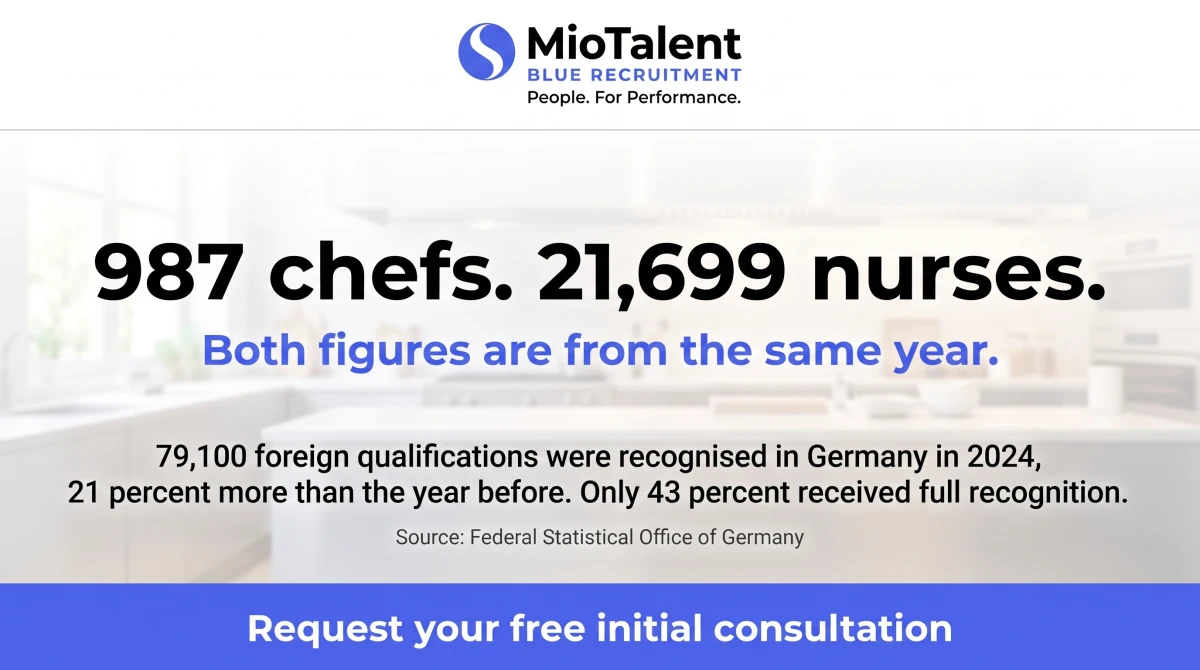
The Federal Statistical Office reports approximately 79,100 approved applications for recognition in 2024. That is 21 percent more than in the previous year, when 65,300 degrees were recognized. Since 2016—the first year that procedures under federal and state law were recorded jointly—the number has more than tripled, rising from 26,200.
This trend is often interpreted as a sign of progress. But that’s only half the story. An increase in the number of approvals does not mean that the process has become easier. First and foremost, it means that more people are going through the same process. Anyone who concludes from this that the approval process is now quick and straightforward is confusing volume with speed.
The expedited skilled worker procedure introduced by the Skilled Worker Immigration Act resulted in 4,900 approvals—representing about six percent of the total 79,100 approvals. The expedited procedure is therefore possible, but it is not the norm.
Where the recognitions actually take place
This is where things get specific for employers. The recognition landscape is not a flat plane; it is a peak. In 2024, health care professions accounted for about 75 percent of applications.
The most common recognized profession is registered nurse, with 21,699 approvals. In second place is physician, with 11,000 recognitions, accounting for 14 percent of the total. Third place goes to engineer, with 4,400 applications approved.
And now for a comparison that rarely comes up in presentations: In the same year, 987 qualifications were recognized for the profession of chef. Nine hundred eighty-seven, nationwide, in twelve months.
If you run a hotel or restaurant and are waiting for the recognition process to provide you with a significant number of chefs, you’ll be waiting for a channel that reaches the three-digit range nationwide. The same applies to large parts of the construction industry. Recognition is a tool for regulated health and academic professions. For the restaurant, hotel, and construction industries, it is not the primary pathway in practice.
Not all recognition is the same
The term obscures the fact that it can refer to four different outcomes.
Recognition is the official determination that a professional qualification obtained abroad is equivalent to a German reference occupation. The assessment focuses not on the individual but on the qualification itself: the curricula in the country of origin are compared with those in Germany, supplemented by documented professional experience.
For professions regulated under federal law, approximately 66,900 cases were decided in 2024. Of these, only one percent resulted in a rejection. Forty-three percent resulted in full recognition. Forty-five percent were granted recognition subject to a condition, meaning that equivalence is achieved only after a compensatory measure is taken. Ten percent received partial recognition.
Read this breakdown again. Less than half of the procedures result in direct, full recognition. For the majority, an additional qualification, an exam, or an adaptation course is required. This is not a flaw in the system, but rather how it works. However, it significantly affects your timeline, which is why it should be addressed at the beginning of a conversation, not at the end.
Second important distinction: regulated and unregulated professions. “Regulated” means that practicing the profession without certification is not legally permitted—nursing, medicine, and certain skilled trades. “Unregulated” means that you may employ a person even without formal certification. In these cases, certification is a factor in determining job classification and compensation, but it is not a prerequisite for employment.
How the process works — briefly, with references
We’ve already described the process in detail: identify the responsible authority, gather the necessary documents, have them certified and legalized, submit the application, undergo an equivalency assessment, and receive a decision. If you’d like to read about this in detail, you can find it here: Professional Recognition Abroad: How the Process Works.
One point from this, however, is crucial for the figures in this article. Statistically speaking, an application is not considered submitted until all the required documents have been provided. The processing period does not begin until that point. If a legalized document is missing, the clock stops—and this does not show up in any statistics because the process has not officially begun yet. The wait time you experience is therefore typically longer than the one that is recorded.
Where the Recognized Ones Come From
The geographical origin is also more concentrated than one might expect. 87 percent of applicants whose applications were approved obtained their qualifications outside the European Economic Area.
Turkey tops the list of countries providing vocational training, with 9,200 certifications. Ukraine follows in second place, having ranked seventh the previous year—a jump that reflects the refugee influx since 2022 and illustrates how quickly this ranking can shift.
For your planning, this means two things. First, the regions of origin from which eligible credentials come are not the same as the regions from which unskilled and semi-skilled workers come. Those who need both must work with two different channels. Second, a ranking in which a country jumps from seventh to second place within a year is not a stable foundation for multi-year planning. Do not rely on a single country of origin.
When You Don’t Need Any Recognition at All
Recognition is not required for assistant and trainee positions. Under the Western Balkans Regulation pursuant to Section 26(2) of the Employment Ordinance, workers from Albania, Bosnia and Herzegovina, Kosovo, North Macedonia, Montenegro, and Serbia may be admitted for any type of employment, regardless of their qualifications. The prerequisites are a specific job offer and approval from the Federal Employment Agency.
That is why, in practice, this approach yields results more quickly than the certification process for construction, renovation, cleaning, logistics, and large parts of the foodservice industry. Not because it is better, but because it does not include the time-consuming verification step.
In its 2024 Skilled Labor Shortage Analysis, the Federal Employment Agency identifies 163 occupations facing labor shortages nationwide. The average time a skilled-worker position remains vacant is 183 days. For your planning purposes, this means: If you choose the certification route, you will further extend an already lengthy hiring process. This may be the right approach if you are filling a regulated position. It is the wrong approach if an unregulated position remains unfilled while a certification process is underway that would not have been necessary for that position at all.
What This Means for Your Workforce Planning
Three practical implications.
First: Before anything else, find out whether your position is regulated. This one question can make or break months of work. It takes just a phone call, yet it’s regularly overlooked because it seems unremarkable.
Second: If you’re looking for jobs in the care sector, you’re working in a field where recognition actually matters—but also where competition for the same candidates is the fiercest. The proportion of foreign nationals among care workers subject to social insurance contributions stood at 18 percent in June 2024, compared to 16 percent across all employees. International recruitment has long been the norm in this field; it is not a unique selling point.
Third: Don’t plan the process in parallel with the need; plan it beforehand. A hiring process that starts in October simply because someone quit in October is too late. This is inconvenient because it requires personnel planning that extends beyond the current quarter. But the alternative is to choose the path that seems quickest right now, only to have to repeat the process six months later.
One final note for context: The information provided is for guidance only and does not constitute legal advice. Responsibilities and requirements vary by state and by profession.
Why We Don’t Use Recognition in Our Marketing
In our industry, recognition is often marketed as a selling point. We don’t do that, for one simple reason: A process whose duration we cannot control is not a promise we can make.
What we can control is the preparation: complete documentation and proper legalization. The correct authority on the first try. And above all: honestly determining in advance whether your position even requires recognition. In a significant number of the cases brought to us, the answer is no—and that shortens the process by months.
Structure trumps chance. This is especially true here because chance is costly in this process.
Read more
- Concerns About International Recruitment: A Fact Check
- Recruiting Q2 2026: Insights for Workforce Planning
Sources
- Federal Statistical Office: 21% Increase in the Recognition of Foreign Professional Qualifications in 2024. Press Release No. 321, 2025.
- Federal Statistical Office: Statistical Report — Recognition of Foreign Professional Qualifications 2024, 2025.
- Federal Ministry of Education, Family, Senior Citizens, Women, and Youth: Recognition of Foreign Professional Qualifications 2024 — New Records, 2025.
- BQ Portal: Recognition Statistics 2024.
- Federal Employment Agency: Analysis of Skilled Labor Shortages.