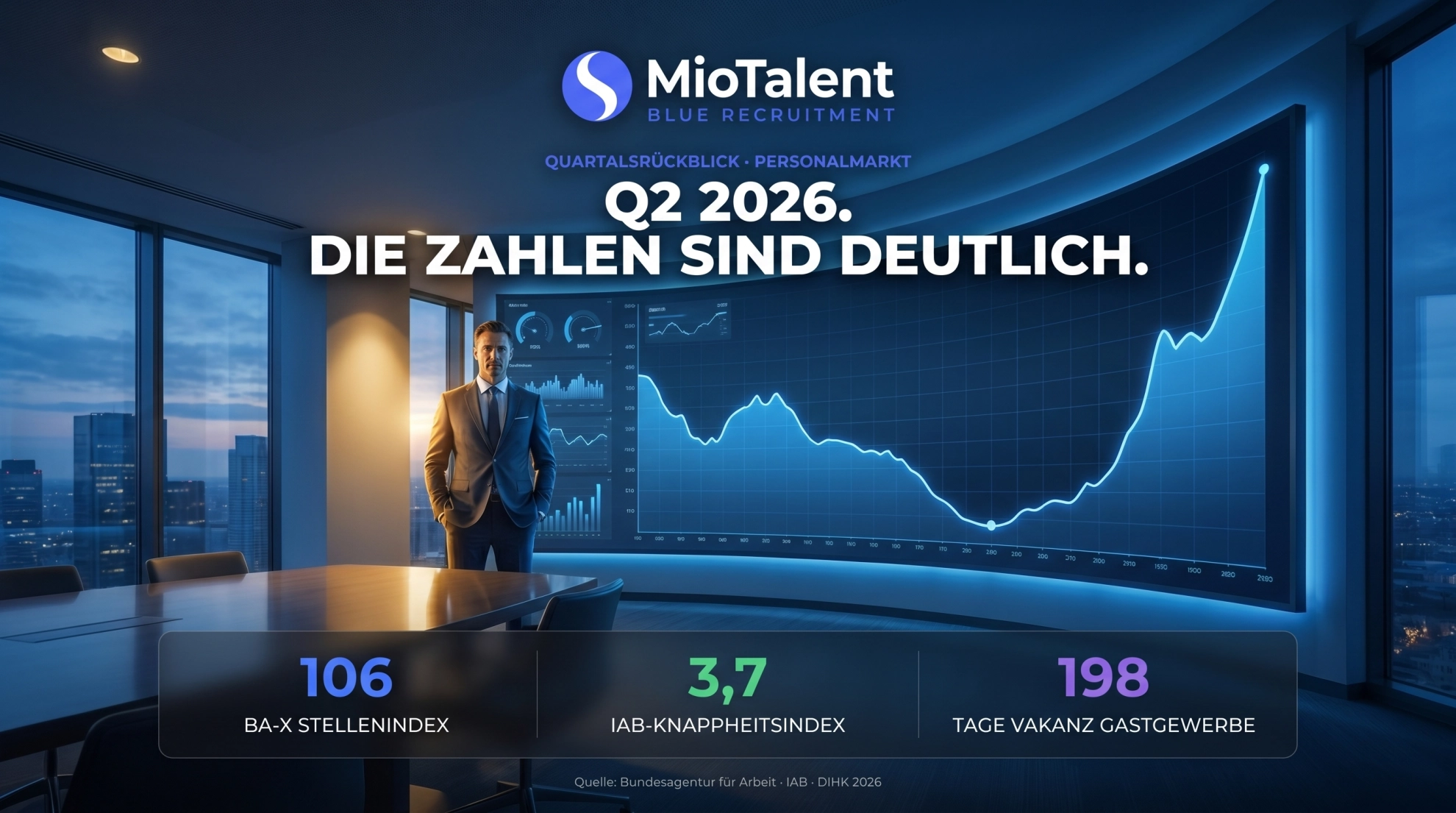
The second quarter of 2026 is coming to a close, and with it, the season of gut feelings: Anyone who wants to be staffed up for fall and winter needs data now, not just impressions. This review analyzes the most important labor market figures for the first half of the year—demand, shortages, time to fill vacancies, and the risk landscape for businesses—and translates them into insights that HR decision-makers in the restaurant and hotel industries should use to plan for the third quarter. All figures come from official sources; the analysis is deliberately matter-of-fact, as the market doesn’t need dramatization to be clear. Four key metrics underpin the analysis: the BA-X Job Index as an early indicator of demand, the IAB Shortage Index as a barometer of hiring activity, vacancy durations as a reflection of on-the-ground reality, and the DIHK Risk Survey as a snapshot of companies’ own sentiment.
Demand: The Job Index Is on the Rise
The BA-X Job Index, published by the Federal Employment Agency, measures labor demand in Germany and is considered a leading indicator: It shows whether companies are hiring more or fewer employees before this is reflected in employment figures. The base year is 2015, with an index value of 100; every point above that indicates demand above this reference level. In February 2026, the index stood at 106 points—the highest level in 14 months (Federal Employment Agency, 2026). Following a long period of sideways movement around 98 to 100 points in 2025, this represents a clear upward trend. The underlying trend is noteworthy: From a high of 114 points in early 2024, the index fell steadily over two years, bottomed out in 2025—and has been rising again since the beginning of 2026, from 100 to 101 to 102 and now to 106.
This is reflected in the current figures: In April 2026, 641,205 job openings were reported to the Federal Employment Agency, just 0.8 percent fewer than in the same month of the previous year—after declines in 2025 had at times reached around ten percent (Federal Employment Agency, 2026). The job cuts of previous years have thus practically come to a standstill. In other words, demand for workers is stabilizing at a high level and is picking up again slightly at present. Anyone hoping for relief from the pressure due to declining competition for workers will be waiting in vain. For planning purposes, this is perhaps the most important single message of the first half of the year, as it changes the starting point for every staffing decision: Competition for workers is increasing again, not decreasing.
The Labor Shortage: What the IAB Index Really Shows
The IAB Labor Shortage Index, compiled by the Institute for Employment Research, measures on a scale of 0 to 10 how difficult it is for companies to fill job openings. In March 2026, it stood at 3.7—down from 4.9 in the spring of 2024 (Institute for Employment Research, 2026). The index combines several indicators of labor shortages into a single metric, thereby making it possible to compare what companies otherwise experience only as anecdotal evidence. At first glance, this suggests an easing of the situation, and this is precisely where an honest assessment is crucial.
Yes, the labor shortage has eased since 2024; the index has fallen noticeably over the past two years. But since mid-2025, it has stabilized within a narrow range between 3.6 and 3.8—the downward trend has come to a halt. So the shortage hasn’t disappeared; it has leveled off at a structurally high level. Combined with the rising job index, this paints a clear picture: the cyclical relief has run its course, and what remains is the demographically driven baseline. And that won’t resolve itself. Anyone who has interpreted the trend since 2024 as a turnaround should take a closer look at the last twelve months: Since mid-2025, the figure has been fluctuating sideways—this is not a cause for relief; it is a new normal level. Forecasts for the supply of skilled workers through 2040 support this interpretation; without immigration, the supply will shrink significantly in all scenarios.
Vacancy periods: 198 days and a gap of 74 days
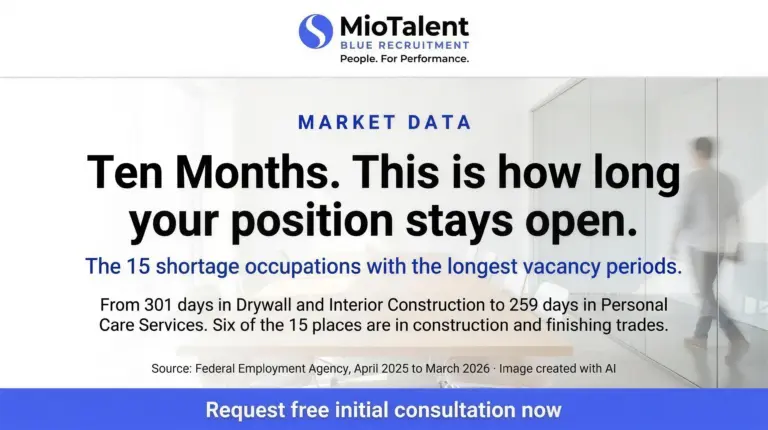
The most tangible figure for companies remains the time to fill—the period between the desired hire date and the actual hire. Across all skill levels, it recently averaged 165 days. This is the figure that translates abstract indices into concrete business reality, because it answers the one question that matters in everyday life: How long will my position remain vacant? Behind this lies a remarkable range: Positions for skilled workers with completed vocational training remained unfilled for 183 days, specialist roles for 157 days, unskilled labor positions for 156 days—and expert positions requiring an academic background for only 109 days (Federal Employment Agency, 2026).
There is thus a 74-day difference between the category filled the fastest and the one filled the slowest. The bottleneck is therefore right in the middle of the qualification spectrum: among traditional skilled workers with vocational training—such as cooks, restaurant specialists, and hotel staff. As a reminder of the classification system: The Federal Employment Agency distinguishes four skill levels—assistant, skilled worker, specialist, and expert—which describe the complexity of the job, not its value. The fact that the skilled worker level, of all things, takes the longest to fill shows where the German training system is no longer closing the gap. The hospitality industry as a whole averages 198 days, making it one of the sectors with the longest hiring times. If you apply this figure to your own business, you can expect a search time of about six and a half months per open position if you rely on the domestic labor market. The 74-day gap has a strategic implication: it refutes the intuition that higher qualifications automatically mean positions are harder to fill. The opposite is true—and that explains why traditional job ads in the skilled worker segment so often come up empty: that’s where the market is the most depleted.
The Risk Landscape: How Companies Assess the Situation
How do companies themselves assess the situation? In the DIHK’s 2026 survey on business risks, which surveyed approximately 25,500 companies, 40 percent cited the shortage of skilled workers as one of the greatest risks for the coming twelve months—ranking sixth on the risk list. At the top of the list are labor costs and weak domestic demand, each at 59 percent, followed by the economic policy environment at 58 percent (DIHK, 2026).
The honest assessment: Across all industries, the labor shortage is a significant risk, but not the dominant one—economic concerns take precedence. This sequence of events is not a reason to let our guard down, but rather an explanation: When demand weakens, the labor shortage is less noticeable in the short term—it is just waiting to come to the forefront again the next time the economy picks up. For labor-intensive industries, however, the picture changes significantly, because without staff, the restaurant and hotel industries simply cannot generate revenue; the shortfall cannot be offset by inventory or machinery. What is interesting is the combination of these two findings: Weak demand coupled with a labor shortage means that businesses must be able to actually capture every bit of revenue the market has to offer. Under these conditions, an unfilled position during peak season is doubly costly: first, due to lost revenue, and second, due to the margin, which is already under pressure during an economic downturn.
What this means for the third quarter
These four findings form the basis for the roadmap for Q3, and it follows a simple logic: working backward. The fall and winter season—conference business, Christmas parties, ski season—begins between October and December. It generates more revenue in the restaurant industry than many summer businesses are willing to admit, and it doesn’t cut a loose. Anyone who wants to secure a position and go through the international process—which takes months—must start in the summer, not in the fall. Specifically: Anyone who wants to be hired by early November should begin the selection process and language preparation in July so that the necessary administrative steps and entry into the country fall within the desired timeframe. Every month of delay at the start will ultimately translate into a one-to-one gap in the season. After all, the 198-day vacancy period applies to those who simply post a job opening and wait.
Added to this is the quota system under the Western Balkans Regulation: The up to 50,000 approvals per year are allocated by month and by nationality and may become scarcer toward the end of the year. That, too, points to an early launch in the third quarter rather than a late one in the fourth. And finally, the data itself: A rising job index means more competition for the same candidates—both in the domestic market and in international markets. The summer of 2026 is therefore not just one time window among many, but the decisive one. Companies that act now also give themselves more options: In the summer, the pool of candidates for winter planning is still large, but by October, everyone is competing for what’s left. It’s the same logic as when shopping: whoever orders first gets to choose from the best selection; whoever comes last takes whatever’s left.
Three Takeaways from the First Half of the Year
First: The hope for a cyclical easing is a thing of the past. The IAB Index is stagnating at a high level, the job index is trending upward, and the number of job openings is stabilizing—the shortage is structural, not cyclical. Basing a human resources strategy on the hope that things will improve is therefore not a strategy, but a delay. The question is no longer whether recruitment is done internationally, but how it is organized.
Second: The shortage is among skilled workers with vocational training, not among college graduates. With 183 days of vacancy time compared to 109 for experts, the middle of the qualification spectrum is the toughest market—exactly where the restaurant and hotel industries recruit.
Third: Now is the time to act for the winter season. If you put off hiring until the summer, you’ll have a job posting in October; if you fill the position over the summer, you’ll have a team in October—and, on top of that, the peace of mind to focus on the business instead of scrambling to fill positions. Our article on seasonal vs. permanent employment explains how the model of a permanent core workforce supplemented by seasonal workers works; the legal framework is provided by the overview of labor migration to Germany in 2026.
Sources: Federal Employment Agency (BA-X Job Index, February 2026; reported job openings, April 2026; Vacancy Durations by Skill Level, 2026); Institute for Employment Research (Labor Shortage Index, March 2026); DIHK (Survey on Business Risks, 2026).