The numbers are known. Yet the positions remain unfilled.
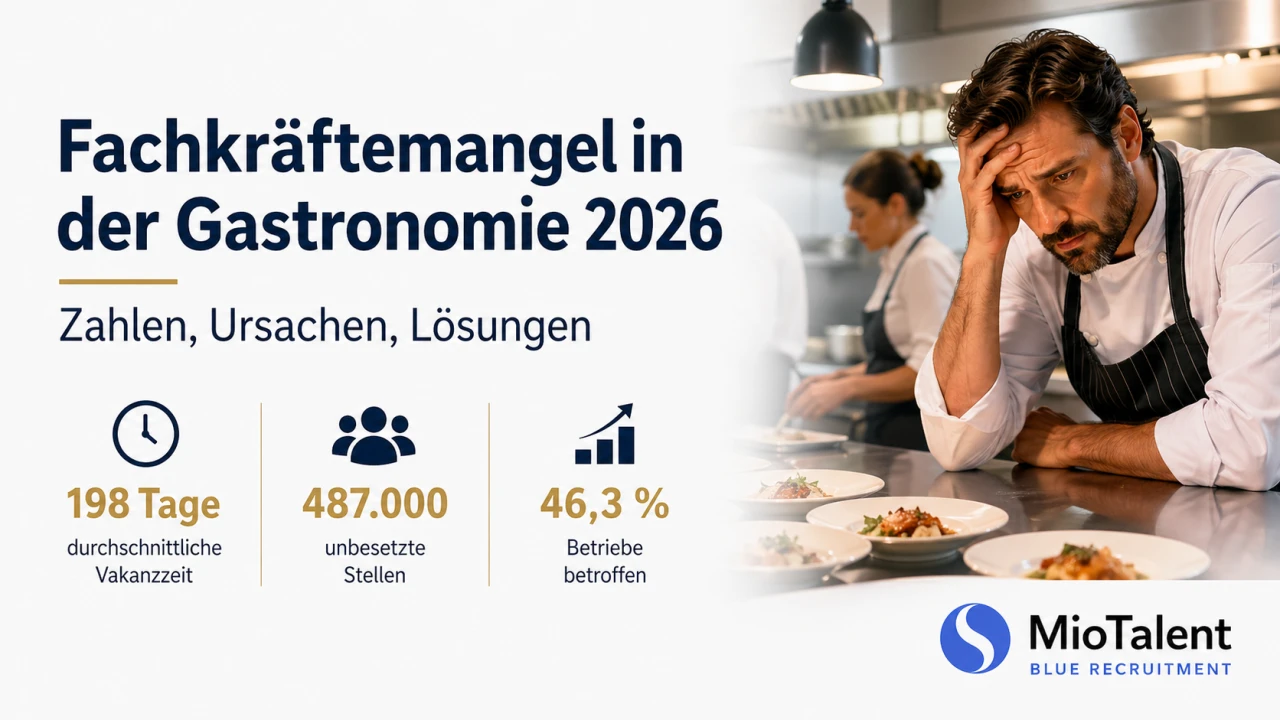
198 days—that’s how long it takes on average in the hospitality industry to fill a job opening. That’s not just a single month. It’s more than six months during which a business operates with fewer staff than it needs. According to the Federal Employment Agency, the hospitality industry thus has the longest vacancy periods of any sector nationwide. And according to the Cologne Institute for Economic Research, nearly 487,000 jobs were unfilled in Germany at the beginning of 2026—many of them in the restaurant and hotel industries.
Anyone who still believes today that the problem is temporary should take a closer look at its causes.
Why the restaurant industry has been hit particularly hard
The shortage of skilled workers is not a new phenomenon. But in the restaurant industry, several structural factors are converging at the same time, which are exacerbating the problem on an ongoing basis.
Demographic Change. The baby boomers of the 1960s will be retiring in the coming years. Anyone who is 58 years old today and working in a kitchen will be leaving the workforce in a few years—and will not be replaced on a one-to-one basis. The younger generations are simply smaller in number.
Decline in the number of apprentices. The Federal Institute for Vocational Education and Training recently reported a decline of just under six percent in new apprenticeship contracts in the hospitality industry. Fewer apprentices today mean fewer skilled workers tomorrow.
Industry image and working conditions. Shift work, weekend work, physical strain—the profession is considered demanding and is consequently avoided. According to the ifo Institute, in 2023 about 46.3 percent of restaurants reported being affected by a shortage of skilled workers. That figure has not improved since then.
Migration to other industries. The pandemic has led many skilled workers to leave the restaurant industry and move to more stable sectors—and they haven’t returned.
What the term “skills shortage” means in practice
In public discourse, the term is often used in a vague way. For businesses that deal with it on a daily basis, it specifically means that there are not enough qualified applicants in the local labor market to fill open positions within a reasonable amount of time.
This doesn’t just affect top-level positions. It affects commis-level cooks, servers, receptionists, and housekeeping staff—positions that are immediately needed in day-to-day operations.
The result is well known: The existing team steps in. Overtime increases. Quality suffers. And the likelihood that more employees will leave the company grows.
Local search alone is no longer enough
Many companies have had the same experience: They post job listings, but receive few or no applications. The ones who do apply aren’t a good fit. Or they end up turning down the job after the interview.
That is not a sign of poor HR management. It is a sign of a local market that has been structurally depleted.
Anyone who limits their search to the local area in this environment is closing themselves off from the part of the job market that actually still has capacity: the international market.
What International Recruitment Can Do—and What It Can’t
International recruitment is not a magic solution. It requires advance planning, structured processes, and realistic expectations. Anyone looking to hire an employee from the Western Balkans today must expect the entire process to take five to seven months—candidate search, selection, paperwork, visa, entry, and onboarding.
What it can do: expand the search pool. Give you access to candidates who simply can’t be reached through local channels. Get the business out of its stagnant state.
The key is to manage the process professionally—with clear responsibilities, well-organized documents, and a realistic view of what can be accomplished within a given timeframe.
Conclusion
The shortage of skilled workers in the restaurant industry is not a temporary problem. It is structural, driven by demographic factors, and will not resolve itself in the coming years. 198 days per vacancy, 487,000 unfilled positions, 46.3 percent of businesses affected—these figures do not describe an exceptional situation. They describe the norm.
For companies that want to take action, the question is no longer whether international recruitment makes sense. The question is how it can be structured and implemented in a realistic way.
MioTalent supports restaurants and hotels with international recruitment—with German contacts, clear processes, and reliable execution.