Anyone running a restaurant or hotel business in Germany in 2026 is familiar with the operational reality: Job openings remain unfilled for longer than they did five years ago. Applications are becoming less frequent. And those who do get hired don’t always stay.
This perception is consistent with the figures. And it has structural causes that go beyond the economic cycle.
How big the problem will be in 2026 — the numbers
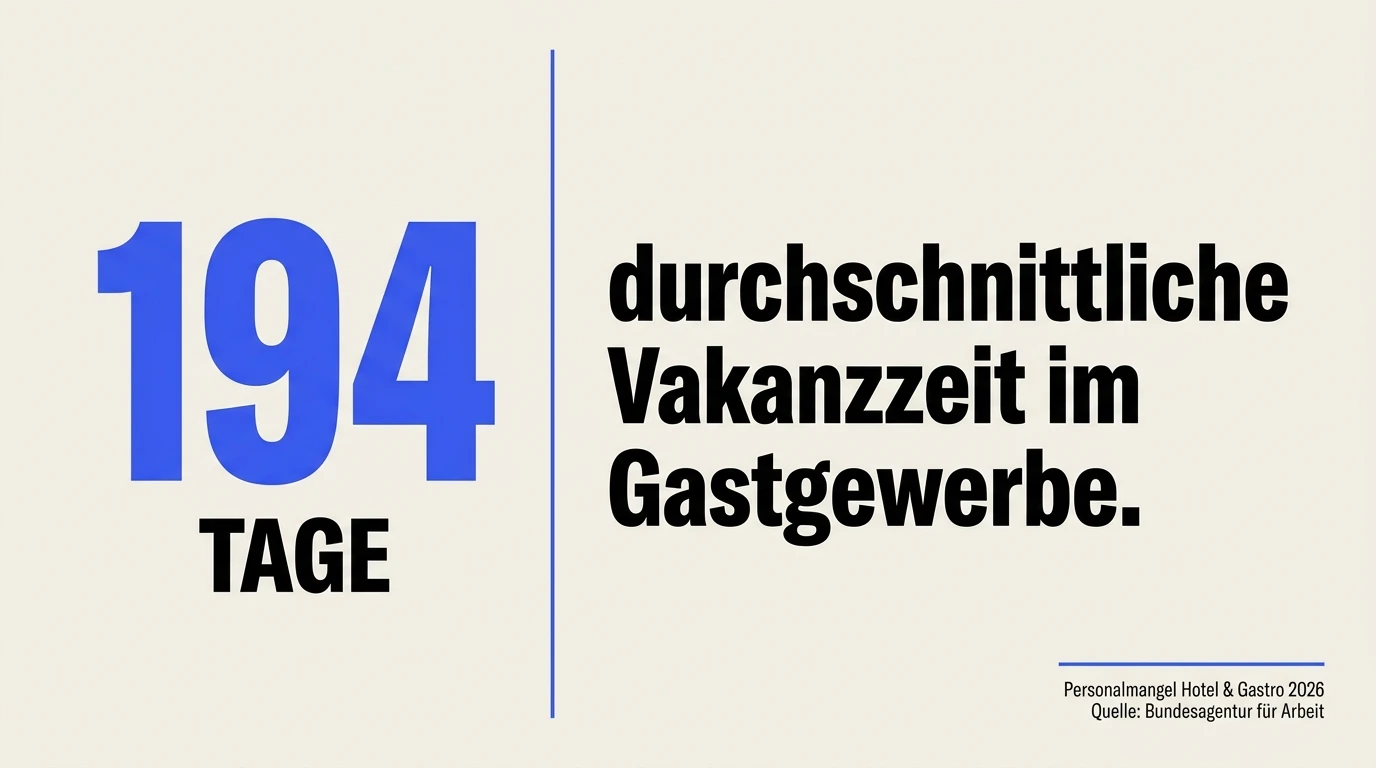
The Federal Employment Agency (BA) measures the average time to fill a vacancy—the period between the planned date of hiring and the actual date of hiring. The following figures are available for the period from May 2025 to April 2026:
- Hospitality Industry: 194 days (vacancy duration by economic sector)
- Average across all economic sectors: 162 days
- Construction industry: 297 days (longest time to fill a position)
- Transportation and Storage: 203 days
- Public Administration, Education, Health: 124 days (lowest)
Source: Federal Employment Agency, Time to Fill by Economic Sector, May 2025 through April 2026.
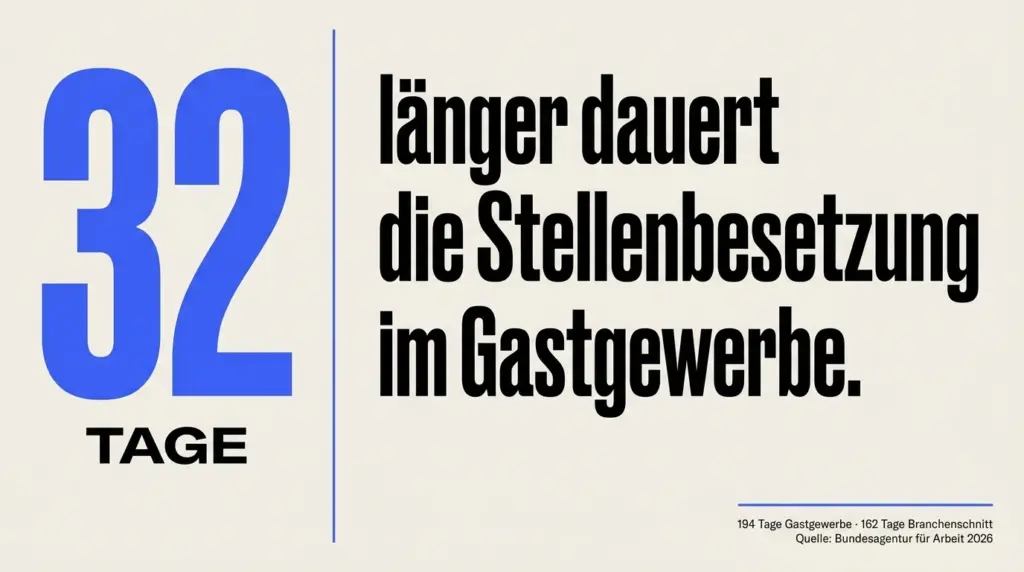
The hospitality industry is thus 30 days above the average for all economic sectors. Structurally, it takes longer to fill a job opening here than in almost all other industries—only construction, transportation, and agriculture take longer.
Added to this is the second-highest turnover rate: 60.5 in the hospitality industry (BA 2024). For comparison: temporary employment stands at 128.6, with all other industries significantly lower. This means that anyone who fills a position faces an increased risk of having to fill it again within 12 months.
Why the Restaurant and Hotel Industries Are Structurally Different
The hospitality industry has three structural characteristics that exacerbate the labor shortage and mean it cannot be explained solely by economic cycles:
Feature 1 — Working Hours. Shift work, weekend shifts, and holiday shifts are standard in this industry. This inherently limits the pool of applicants. Those looking for regular daytime working hours (which is the majority of the workforce) are not eligible for many positions.
Feature 2 — Seasonality. The hotel industry and parts of the restaurant industry experience significant seasonal peaks. Staffing needs fluctuate considerably. This means that full-time, permanent employment is not always economically viable—and for many applicants, temporary employment is less attractive.
Feature 3 — Range of Qualifications. The hospitality industry simultaneously needs entry-level positions (average time to fill: 156 days), skilled workers (183 days), and specialists (157 days). Source: BA 2026, vacancy duration by skill level. This breadth of demand is not as pronounced in many other industries—it spreads the recruitment challenge across multiple labor markets simultaneously.
The combination of these three factors explains why traditional recruiting methods (regional job ads, referrals) are less effective than they were ten years ago.
Regional Variations — A Comparison of the Federal States
The labor shortage is not evenly distributed across Germany. Federal Employment Agency (BA) data on the time vacancies remain unfilled by federal state (May 2025 through April 2026) reveal significant differences.
Federal states with the longest time to fill a position (May 2025 through April 2026):
- Rhineland-Palatinate: 206 days
- Brandenburg: 186 days
- Saxony-Anhalt: 177 days
- Bavaria: 173 days
- North Rhine-Westphalia: 171 days
Federal states with the shortest vacancy periods:
- Berlin: 134 days
- Baden-Württemberg: 142 days
- Schleswig-Holstein: 147 days
Source: Federal Employment Agency, Time Vacancies Remain Open by Federal State, May 2025 through April 2026.
The change from the previous year is striking. In Hamburg, the vacancy period increased by 28 days within a year; in Berlin, by 24 days; and in Brandenburg, by 14 days. At the same time, it decreased by 7 days in Bavaria and by 7 days in Mecklenburg-Western Pomerania.
In other words, even within Germany, the situation is not uniform. A business owner in Hamburg, Berlin, or Brandenburg will face structurally more challenging recruitment conditions in 2026 than a business of the same size in Bavaria or Baden-Württemberg.
The Three Levels of Causes
Structural problems have structural causes. Three distinct levels can be identified:
Level 1 — Demographics. The baby boomers are leaving the labor market. The generations coming after them are smaller. The labor force is shrinking—even without an economic downturn. This is not a forecast; it is a mathematical fact.
Level 2 — Industry Structure. The restaurant and hotel industries compete for job applicants with sectors that structurally pay better, offer more regular working hours, or enjoy greater social recognition. This competition is not new—but it has intensified due to the general shortage of skilled workers.
Level 3 — The labor market as a whole. With 641,205 job openings in Germany in April 2026 (Federal Employment Agency, all economic sectors), the hospitality industry does not enjoy a privileged position. It is part of a broader competition for workers. Those who fail to restructure their operations here will not lose out to a specific competing industry—they will lose out to the market as a whole.
The key conclusion: The labor shortage in the hospitality industry is not simply “yet another” manifestation of the general shortage of skilled workers. It is a particularly pronounced form of the same problem—with its own industry-specific aggravating factors.
What Needs to Change Structurally
Anyone who wants to find an operational solution to a structural problem has two options: improve the conditions in the existing candidate market (better terms, better retention, longer contracts)—or expand the candidate market itself.
Both approaches have their merits. By 2026, most companies will be working on both at the same time.
In practice, expanding the candidate pool is virtually impossible without international recruitment. The Western Balkans Regulation under Section 26(2) of the Employment Regulation (BeschV) (see the cluster article “Western Balkans Regulation 2026: What Employers Need to Know) enables access, for example, to a labor market that is structurally much less strained for entry-level and skilled positions in the restaurant and hotel industries than the German domestic market.
What’s important is to be realistic: International recruitment is not a quick fix. It is a structural tool with its own requirements—visas, credential recognition, onboarding, and integration. Those who implement it in a structured way gain planning certainty. Those who use it as a stopgap measure waste resources.
Conclusion — The labor shortage in the hospitality industry is structural, not cyclical
Data from the Federal Employment Agency for the period from May 2025 to April 2026 paint a consistent picture: 194 days of vacancy duration, a turnover rate of 60.5, and varying degrees of severity across regions, with the highest rates in Hamburg, Berlin, and Brandenburg.
This is not a cyclical phenomenon that will pass after three quarters. It is a structural shift in the labor market, to which the hospitality industry is particularly vulnerable.
Anyone who plans strategically should anticipate this scenario—not pin their hopes on “the market settling down.”
Weiterlesen
- Fachkräftemangel in der Gastronomie 2026: Zahlen und Ursachen — die Zahlen zum selben Befund
- Was eine unbesetzte Stelle im Gastgewerbe wirklich kostet — was der Engpass betriebswirtschaftlich bedeutet
- Deutschland hat kein Fachkräfteproblem, sondern ein Rekrutierungsproblem — die andere Lesart derselben Lage
Sources for this post:
- Federal Employment Agency (BA), Vacancy Duration by Economic Sector, May 2025 through April 2026
- Federal Employment Agency, Vacancy Duration by State, May 2025 through April 2026
- Federal Employment Agency, Time to Fill by Skill Level, 2026
- Federal Employment Agency, Turnover Rate 2024
- Federal Employment Agency, Job Openings, April 2026