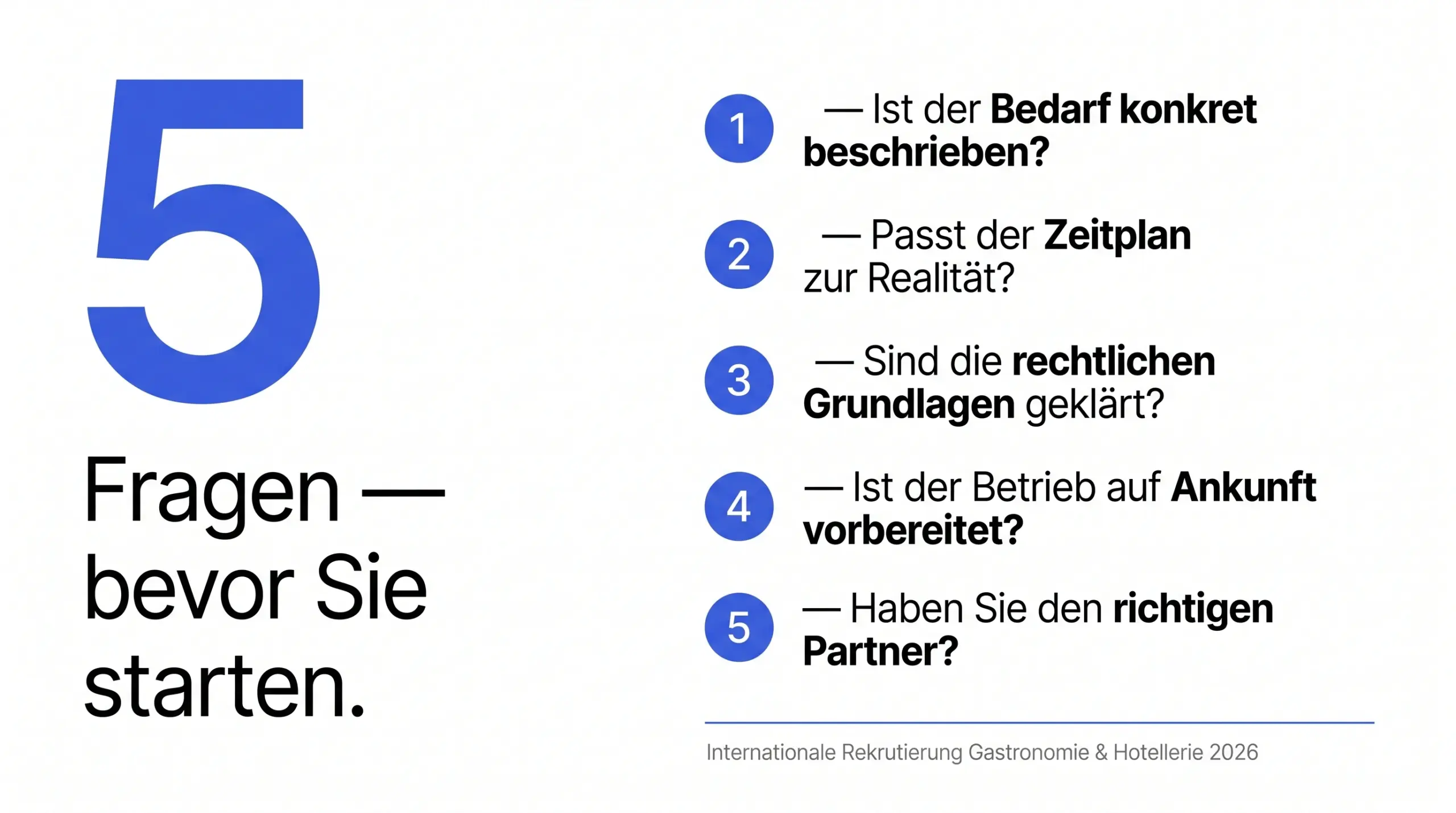
Many companies begin their international recruitment process with an initial meeting with a recruitment agency. That’s too late. The decisions that determine success or failure are made earlier—within the company, in the mind of the owner or management, before a single request is sent out. Five questions can help you make these decisions consciously.
Why Preparation Determines Success or Failure
The Federal Employment Agency reports an average vacancy period of 198 days for the hospitality industry (Source: Federal Employment Agency, 2026). This figure reflects the market as it is—not as businesses would like it to be. Anyone who plans with a six-week lead time is out of touch with reality.
At the same time, a 2024 survey of companies regarding challenges in recruiting foreign skilled workers shows that most of the hurdles are not of a legal or bureaucratic nature—but rather stem from a lack of preparation on the part of employers: unclear job descriptions, unrealistic timelines, and a lack of integration after arrival (Source: Statista, Challenges in Recruiting Foreign Skilled Workers 2024). This is not a criticism of individual companies. It is a structural observation—and one that can be corrected by asking the right questions in advance.
Questions 1 and 2 — Needs and Timeline
Question 1: Is the need described in sufficient detail?
The most common answer to the question about the desired profile is: “We need a cook.” That’s not a profile—it’s a job title. A functional job description outlines the responsibilities the cook will have, the shift schedule they’ll work, the type of cuisine the restaurant serves, the expected language proficiency, and whether the position is geared toward growth or stability.
Each of these variables affects the pool of candidates. A profile that leaves these variables unaccounted for produces candidate profiles that aren’t a good fit—and employers who, after the third failed attempt, wonder whether international recruitment even works. It does work. But it doesn’t work without a profile that reflects the reality of the business.
Helpful self-assessment: Could you explain to a stranger in three minutes exactly who you’re looking for—tasks, shift, language, experience, and perspective? If not, your profile isn’t ready yet.
Question 2: Does the schedule reflect reality?
International recruitment takes time. Realistically, it takes four to six months from the needs assessment to the start of employment for a candidate from the Western Balkans—assuming everything is fully prepared and there are no delays from government agencies. For candidates from other countries of origin, six to nine months is a more realistic timeframe.
Anyone looking to hire employees for the Christmas season in October and starting the search in September is bound to fail—not because of the quality of the recruitment agency, but because of simple math. The right time to recruit for October is in April.
So the question isn’t just: When do I need someone? But rather: When do I need to start so that someone will be there by then? You should figure this out before the first meeting.
Questions 3 and 4 — Law and Operations
Question 3: Have the legal grounds been clarified?
International recruitment is not uncharted legal territory—but it does involve requirements that differ from those of domestic hiring. Three key points must be clarified before getting started.
First: Which procedural pathway applies to the target group of candidates? The Western Balkans Regulation, the Skilled Workers Immigration Act, and the EU’s free movement of workers each have different eligibility requirements, different timeframes, and different documentation requirements.
Second: Has the employment contract been drafted in accordance with German law? Without a signed contract, a visa application cannot be submitted. This contract must accurately reflect the minimum wage, working hour regulations, and social security requirements—even if the candidate is still abroad.
Third: Who will handle communication with the authorities? The diplomatic mission, the Federal Employment Agency, and the immigration office do not communicate with one another—someone has to coordinate this. MioTalent handles this coordination as part of the process. Anyone who does this on their own should know what to expect.
Question 4: Is the organization prepared for the arrival and integration of new arrivals?
Onboarding isn’t the end of the process—it’s the beginning of another one. What happens in the first 30 to 90 days determines whether the candidate will become a long-term employee.
Specifically, this means: Is housing arranged before the employee arrives? Is there a designated point of contact on the team—someone who can help with practical matters, not just technical ones? Are administrative procedures scheduled for after arrival—registering with the residents’ registration office, applying for a residence permit, opening a bank account?
These questions may sound like organizational issues, but they are crucial for building loyalty. An employee who spends their first week struggling alone with red tape, language barriers, and getting their bearings will not develop loyalty to the company—even if the salary is right and the job is a good fit.
Question 5 — The Partner
Question 5: On your own or with structured support?
In principle, international recruitment is possible without external assistance. Companies can post job openings on international job portals, contact candidates directly, handle visa processes on their own, and submit documents without using a service provider. This is legally permissible and may be appropriate in certain cases.
In practice, the direct route often fails not because of a lack of will, but because of the effort involved. The time required for candidate search, pre-screening, document preparation, communication with government agencies, and onboarding far exceeds what a business can manage while operating at full capacity—especially in the restaurant and hotel industries, where operational demands and personnel management already tie up most of the staff’s capacity.
The relevant question, therefore, is not: Can I do this on my own? But rather: What will it cost me in terms of time and energy—and what will it cost me if it fails? A failed first recruitment project not only incurs costs, but also breeds skepticism about the entire approach. This skepticism is the real risk.
What the 5 answers show collectively
Anyone who has answered these five questions isn’t done with the recruitment process—but they’re ready for it. “Ready” means the job posting is specific enough to find candidates who are truly a good fit. The timeline is realistic enough to avoid panic. The legal framework is clear enough to handle the process safely. The company is prepared enough to welcome and retain a candidate. And the decision regarding external support has been made deliberately.
That’s not a perfect starting point—there’s no such thing. But it’s a resilient one. And resilient starting points are the foundation for structured recruitment to work.
Weiterlesen
- Recruiting-Prozess international: 7 Schritte zur Einstellung — was nach der Vorklärung folgt
- Dauer internationale Rekrutierung: Realistische Zeitpläne — womit Sie zeitlich rechnen müssen
- Personal aus dem Ausland: Für welche Unternehmen es sinnvoll ist — ob der Weg zu Ihrem Betrieb passt