Not every position in a hotel is equally well-suited for international recruitment. This isn’t a question of the candidates’ quality—it’s a question of how well the position requirements align with what international recruitment can realistically achieve. Those who understand this recruit strategically. Those who ignore this recruit blindly and end up surprised.
Why Not Every Position Is Equally Suitable
The Federal Employment Agency reports a vacancy duration of 198 days for the hospitality industry (Source: Federal Employment Agency, 2026). The turnover rate stands at 60.5—one of the highest figures across all industries (Source: Federal Employment Agency, 2024). These figures describe the starting point, not the goal. The pressure is real. The temptation to turn to international recruitment as a solution for every open position is understandable. But it is the wrong approach.
Four criteria determine how well a position is suited for international recruitment.
Language intensity describes the amount of daily communication required for the position—with guests, colleagues, and managers. The higher the language intensity, the higher the minimum proficiency level a candidate must possess—and the smaller the pool of eligible candidates.
The qualification requirements specify whether the position requires a formally recognized degree or whether professional experience and demonstrated expertise are sufficient. The latter is easier to manage for international recruitment—especially under the Western Balkans Regulation, which does not require professional certification.
Onboarding effort refers to how quickly a new employee can become productive. Positions that require a significant onboarding effort and have a short retention period are less economically viable for international recruitment than positions that run smoothly after a brief adjustment period.
The administrative process describes the procedure that applies to the position and how long it takes. For positions that need to be filled quickly, the time required for the visa process is a limiting factor.
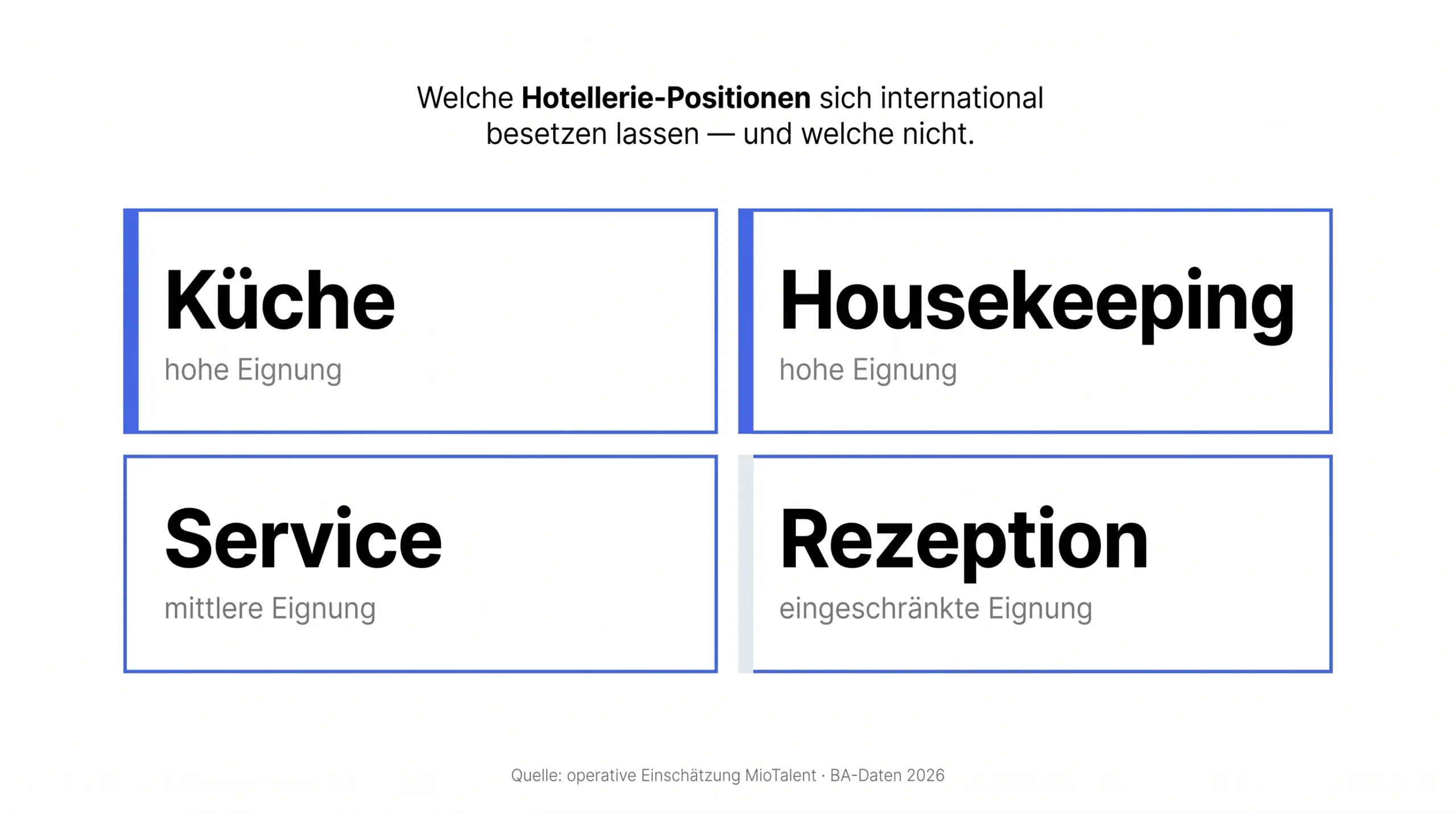
Positions with a high level of suitability
Kitchen Staff: Chef, Commis de Cuisine, Pastry Chef
Kitchen positions are structurally best suited for international recruitment. The reasons for this can be found in all four criteria.
Language intensity: low to moderate. Communication in the kitchen follows clear, concise patterns—instructions, feedback, and safety guidelines. In-depth conversations with guests generally do not take place. A German language proficiency level of A2 to B1 is sufficient for most kitchen positions from an operational standpoint.
Qualification Requirements: In Germany, there is no mandatory recognition requirement for chefs in unregulated professions. The Western Balkans have a strong tradition of culinary training—chefs from Serbia, Montenegro, and Bosnia and Herzegovina are familiar with European culinary standards. What needs to be assessed is actual professional competence, not the title on the diploma.
Training requirements: moderate. Every kitchen has its own procedures that must be learned. However, an experienced commis from the Western Balkans can usually be integrated into the kitchen and become productive within two to four weeks.
Open positions: Chef de Partie, Commis de Cuisine, Entremetier, Gardemanger, and experienced Pastry Chef. Dishwashers with career prospects may also be hired through this process.
Housekeeping and Room Service
Housekeeping positions are particularly well-suited for international recruitment because the language barrier is the lowest and the transition into operations is the most straightforward.
Language intensity: low. Direct communication with guests is minimal in standard housekeeping duties. Internal communication follows clear protocols—lists, checklists, and brief verbal coordination. A1 to A2 is sufficient for operational purposes.
Qualification requirements: minimal. Housekeeping requires attention to detail, physical stamina, and reliability—no formal qualifications that require certification.
Training effort: low to moderate. Company-specific standards are typically taught within a few days.
Retention potential: high, provided that working conditions and onboarding are right. Housekeeping staff who are welcomed warmly and treated fairly develop strong loyalty to their employer—because the job market for this position in Germany is limited.
Breakfast service and light meal service
Positions in the breakfast service involve less speaking than the full evening service because communication with guests is manageable and standardized. Orders are taken on a limited basis, and questions follow a predictable pattern.
For these positions, B1 is a realistic minimum level—with active support from the team during the first few months. Candidates with an A2 level who are highly motivated to learn can also be integrated into these positions if the company provides targeted support during the first 90 days.
Positions with moderate suitability
Service and Restaurant Associate
Full-service evening waitstaff is the most language-intensive role in the restaurant and hospitality industry. The employee explains dishes, takes special requests, responds to complaints, advises on wine pairings, and represents the establishment in direct contact with guests—every day, for several hours.
Realistic minimum level: B1; B2 for high-end establishments. This is achievable—but it narrows the pool of candidates and extends the preparation time. Anyone looking to fill service positions internationally must view language preparation as part of the process, not as the candidate’s sole responsibility.
“Moderate suitability” does not mean “not possible.” It means: more preparation, a clearer candidate selection process, and more active onboarding. Companies that do this are also successful in filling service positions with international candidates.
Bartender and Barista
Bartending positions are hybrid in nature: they require a high level of technical expertise and moderate to high language intensity, but in many establishments, they involve a clearer communication structure than full-service roles. Standard orders, recommendations from a limited selection, and conversations with guests that do not involve in-depth consultation.
The same applies to barista positions in coffee shops or hotel lobbies: Communication is more standardized, so the language level can be lower. B1 is a realistic goal here.
Positions with Limited Suitability
Reception and Front Office
Front desk positions are the most linguistically and communicatively demanding roles in a hotel. The employee serves as the first point of contact for international guests, handles written inquiries in multiple languages, coordinates both internally and externally, resolves complaints, and represents the hotel’s brand.
German at the B2 level is the minimum requirement; English is practically mandatory, and other languages are a plus. This is generally achievable through international recruiting—but the pool of available candidates is smaller, the preparation requirements are higher, and the time to fill the position is longer.
“Limited suitability” does not mean “not feasible.” It means that this is not the right entry-level position for a company’s first international hire. Companies that already have experience with international employees and have mastered the onboarding process can also successfully fill receptionist positions.
Management Positions: Sous Chef, Department Head, F&B Manager
Leadership positions require not only professional expertise but also the ability to lead teams in a different language and cultural context. This is certainly possible—but it requires a level of language proficiency well above B1 and a cultural adaptability that can only be demonstrated in everyday life.
For international hires into leadership positions, a two-step approach is recommended: first join as a specialist, get to know the company and the team, and improve your language skills—and then grow into the leadership role. In practice, directly filling international leadership positions without prior knowledge of the company is the exception, not the rule.
What this assessment means specifically for workforce planning
Position evaluation has a clear operational implication: When recruiting internationally, you should start with the positions that are the best structural fit—kitchen, housekeeping, and breakfast service. In those areas, the process is faster, there is greater tolerance for mistakes, and the chances of success are higher. Positive early experiences build the knowledge and capacity needed to fill more demanding positions later on.
Anyone who starts out in a front-of-house or sous chef position without any experience in international recruitment is missing out on the opportunity to learn step by step. That’s not an argument against ambition—it’s an argument for taking things in the right order.
How MioTalent Supports the Job Selection Process
During the initial consultation, MioTalent works with the employer to assess which positions are suitable for international recruitment—and in what order it makes sense to address them. This is not a sales pitch. It is an assessment based on operational experience with candidates from the Western Balkans and with businesses in the restaurant and hospitality industries.
If a position isn’t a good fit, we’ll say so up front. This protects both sides—the company from a time-consuming process with no realistic outcome, and the candidate from a role that isn’t a good fit.
Weiterlesen
- Deutschkenntnisse Gastronomie: B1, B2 oder reicht weniger? — welches Sprachniveau die Position verlangt
- Köche aus Serbien und Montenegro: Marktprofil 2026 — woher die Küchenprofile kommen
- Unterkunft internationale Mitarbeiter: Was vorbereiten? — was der Betrieb vor der Anreise klären muss