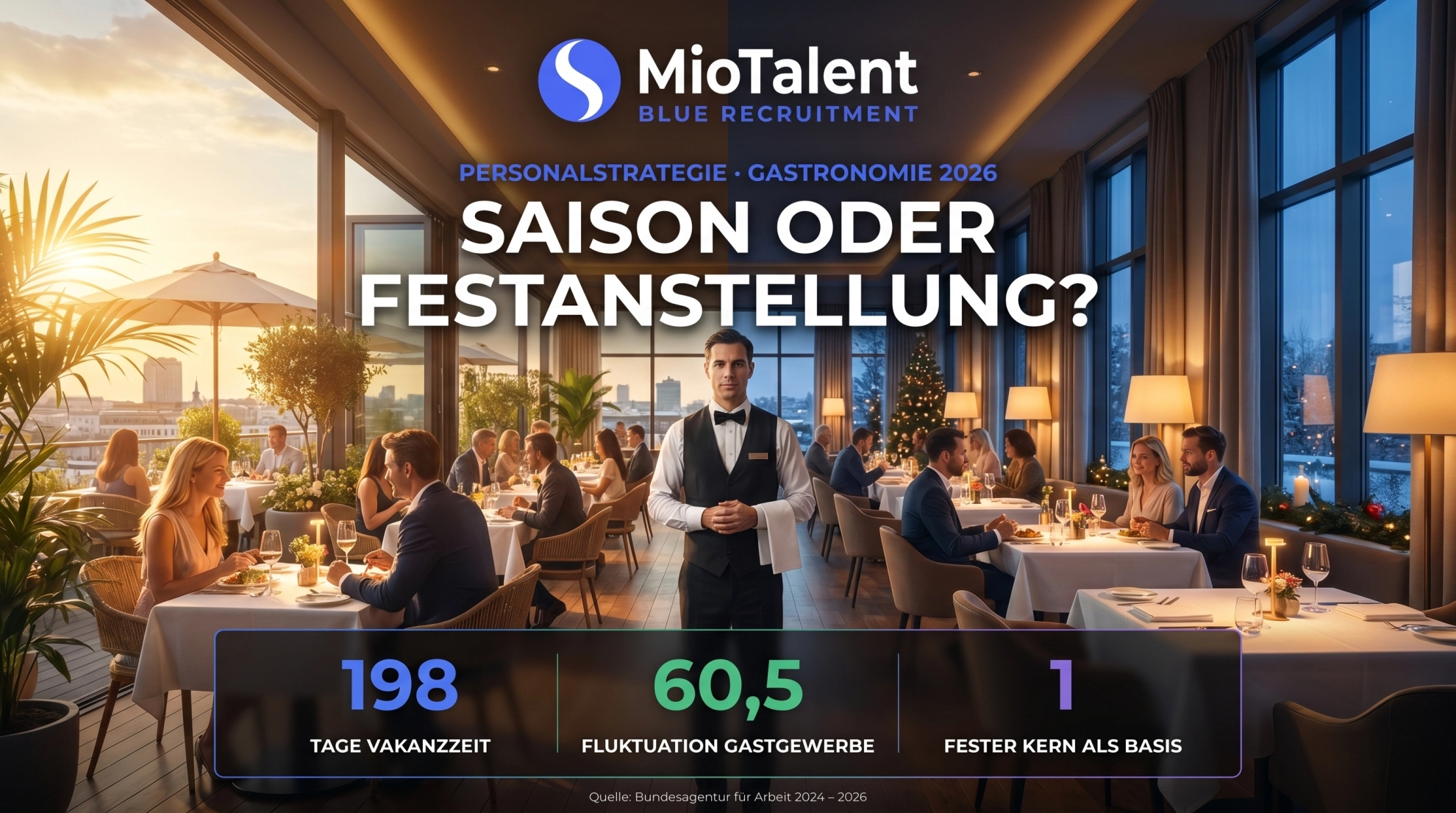
Every spring, the same question arises in the restaurant and hotel industries: Should we hire seasonal workers for the peak season or fill permanent positions for the entire year? The answer determines not only labor costs for the coming months but also staffing strategy for the coming years. This article objectively compares both models, outlines the legal differences, and explains why, in a market with an average vacancy period of 198 days, the question must be answered differently than it was ten years ago. After all, the tacit assumption underlying the seasonal model—that someone will turn up in the spring—no longer holds true.
Two Models, Two Logics
Seasonal work refers to temporary employment that meets a recurring, time-limited need—such as summer outdoor dining, the winter season at a ski resort, or the conference business in the fall. Permanent employment refers to an open-ended employment relationship that exists regardless of fluctuations in workload.
Both models follow their own logic. The seasonal model aligns labor costs with the revenue curve and achieves this flexibility at the cost of an annual recruitment and training cycle. The permanent employment model prioritizes reliability and quality and pays for it with fixed costs during the off-season. Neither model is inherently correct—but market conditions have shifted the balance. In the hospitality industry, a job opening remains unfilled for an average of 198 days, or about six and a half months (Federal Employment Agency, 2026). Those who recruit anew every year are searching in exactly this market—and bear the risk, year after year, that the season will begin before the team is in place.
The Pros and Cons of Hiring Seasonal Staff
The strengths of the seasonal model are real. Labor costs align with workload; the business doesn’t have to pay winter salaries based on summer revenue; and a season serves as a genuine trial period: Those who prove themselves are offered a contract or a permanent position the following year. And on the employee side, there are groups for whom this model is a perfect fit: students, people with seasonal lifestyles, and workers who specifically choose to work by the sea in the summer and in the mountains in the winter.
The weaknesses are just as real, and they have grown in recent years. First, the endless cycle of recruitment: Anyone looking for staff in March for May is operating in a market where the average tenure is 198 days—the seasonal model assumes that the search will be successful faster than the industry average, year after year. Second, the repeated onboarding process, which reduces productivity in the first few weeks of every season. Third, the loss of quality: well-established processes, relationships with regulars, and operational knowledge are lost with every seasonal employee who leaves. And fourth, the competition for the best people, because experienced seasonal workers have a choice—and anyone offering them only four months is competing with businesses that offer twelve.
The Pros and Cons of Permanent Employment
The strongest argument in favor of permanent employment comes from the industry statistics themselves: The turnover rate in the hospitality industry was most recently 60.5 (Federal Employment Agency, 2024). Put simply, this means that, mathematically speaking, the industry replaces well over half of its workforce within a year. In such an environment, employee retention is the greatest competitive advantage a business can have: Those who retain their employees save on the costs of replacing staff, the time spent training new hires, and the loss of quality—costs that competitors bear year after year.
Added to this are the subtle but effective benefits: well-coordinated teams, consistent quality, regular customers who see familiar faces, and an employer brand that gets passed along—even in the home countries of international employees, where recommendations among colleagues often carry more weight than any job posting.
The flip side is the cost burden during the off-season. It’s real, but manageable: work time accounts that convert overtime from the high season into time off during the off-season, vacation planning aligned with the workload curve, and shifting maintenance, training, and projects to the slower months turn the fixed-cost problem into a planning task. Mixed costing is also part of the solution: The off-season months are then not a loss center, but rather the price paid to ensure that the peak season runs smoothly without staffing concerns—factored into the annual plan instead of being lamented anew every fall. Those who solve this problem reap the benefits of customer loyalty at a predictable cost.
An Overview of the Legal Differences
Legally, the models differ primarily in three respects. First, the fixed term: Under the Part-Time and Fixed-Term Employment Act, a fixed-term contract without objective grounds is permitted for up to two years, with a maximum of three extensions within that timeframe. If there is an objective reason—such as a temporary operational need, like a seasonal demand—fixed-term contracts are also permitted beyond this period and may be renewed repeatedly.
Second, short-term employment: Employment that is limited to a maximum of three months or 70 working days in a calendar year and is not performed on a regular basis remains exempt from social security contributions — a model that is particularly relevant for short-term spikes in demand and temporary help, not for key positions such as kitchen management or shift supervision, which require continuity.
Third, what remains the same: the minimum wage, pro-rated vacation entitlement, continued pay, and other protective rights apply to seasonal workers just as they do to permanent employees. A fixed-term contract changes the duration of the employment relationship, not the rights associated with it—a point that is often underestimated in calculations. For the specific drafting of contracts in individual cases, it remains advisable to have them reviewed by an expert, as errors in the fixed-term contract can quickly lead to an indefinite employment relationship that was not intended. On the other hand, the return of proven seasonal workers is handled cleanly: Renewing a fixed-term contract based on objective grounds for the next season is permissible and standard practice in the industry—provided that seasonal demand is indeed the reason and the contracts are worded accordingly.
The International Dimension
For companies that recruit internationally, the math changes significantly once again. Recruiting from third countries—for example, through the Western Balkans regulation—is a process that takes months, involving selection, language training, administrative procedures, and onboarding. This investment pays for itself over the course of the employment. Making this investment for a single four-month season rarely makes business sense; for a permanent position that lasts for years, however, it does. Permanent employment is therefore the natural fit for international recruitment. Our article on the duration of international recruitment shows how long the process realistically takes.
For genuine seasonal needs, EU markets are a better option, especially Croatia, where the free movement of workers applies and no visa process is required—though with the limitations of a small, competitive market, as our Croatia profile honestly points out. And there’s a middle ground: Tried-and-true seasonal workers who return year after year effectively create a bond without a year-round contract. Those who nurture these relationships, rather than starting from scratch every season, combine the flexibility of one model with the reliability of the other. In concrete terms, “nurturing” means: confirming their return for the next season well in advance instead of radio silence during the winter, helping with housing, and having an honest conversation about when a returning seasonal worker can transition to a permanent position.
Which Model for Which Business
Four questions will help you make a decision. First, the seasonal trend: How wide is the gap between the strongest and weakest months? The flatter the curve, the stronger the case for permanent positions; the more extreme the peak, the greater the need for seasonal staff. Second, the historical rehire rate: Companies that re-advertise the same positions year after year—and regularly run up against the 198-day reality—end up paying more for the seasonal model than it appears at first glance. Third, quality standards: Concepts that rely on well-established processes and brand recognition tolerate little change. Fourth, the planning horizon: Those who want to grow in the coming years build on a permanent core.
In practice, the answer is rarely an either/or situation, but rather a hybrid model: a permanent core that ensures quality and processes, supplemented by seasonal staff during peak periods. The strategic question is then no longer “Seasonal or permanent?” but “How large does the permanent core need to be to ensure the business runs smoothly even if the seasonal hiring effort fails?” With an average vacancy period of 198 days, this is not a theoretical question, but a risk assessment that determines the outcome of a failed peak season. The permanent core is the insurance against market fluctuations—seasonal workers are the return on investment when the recruitment effort succeeds. Our overview of labor migration to Germany in 2026 outlines the legal options available for staffing the permanent core.
Sources: Federal Employment Agency (Vacancy Duration in the Hospitality Industry 2026; Turnover Rate 2024); Part-Time and Fixed-Term Employment Act.