International recruitment is won in the workplace—but it’s lost at home. Hardly any single factor has such a direct impact on settling in, performance, and long-term retention as housing, and hardly any other factor is considered so late in the planning process. This article provides a comprehensive overview of the topic: why the housing issue in Germany is an employer’s issue, what options are available, what the legal and financial considerations are, and what the organizational timeline looks like—from signing the contract to becoming self-sufficient. It is aimed at businesses of all sizes, because the housing issue arises just as much for a country inn with two international employees as it does for a city hotel with twenty—only the appropriate solution differs. And it consistently follows one principle: Housing is not a favor from the employer, but a key component of the process—with legal, financial, and organizational rules that are worth understanding.
Why the accommodation provider makes the decision
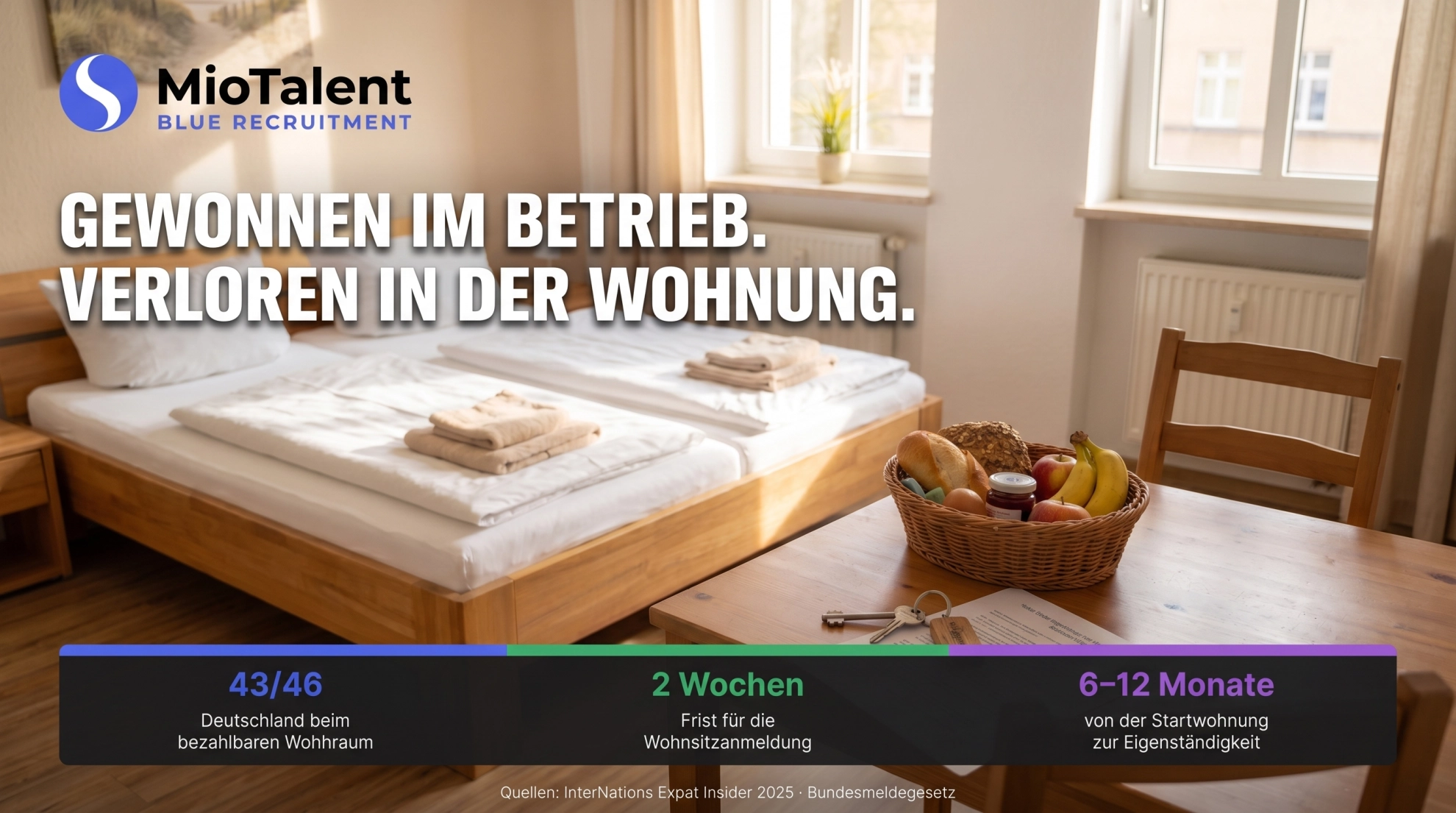
The stark reality: An international professional can hardly enter the German housing market on their own. Without a German rental history, without a Schufa credit report, without pay stubs from the past few months, and often without the language skills needed for viewings and contract negotiations, looking for an apartment from abroad is practically hopeless. Added to this is the market situation itself: In many regions, even locals are competing for every available apartment with long lists of applicants—an application from a distant foreign country ends up at the very bottom of that pile, if it’s even opened at all. The employer, on the other hand, has everything the applicant lacks: creditworthiness, local knowledge, language skills, and a network of landlords, regulars, and suppliers that finds apartments before they’re even advertised. What locals find tedious is simply insurmountable for immigrants without support. The Expat Insider 2025 confirms this in a country-by-country comparison: When it comes to affordable housing, Germany ranks 43rd out of 46 countries surveyed (InterNations, 2025).
So anyone who hires internationally and leaves the housing issue up to the individual has not delegated the task but has instead left the success of the entire placement at the mercy of an insurmountable problem. And the resulting costs are well known: With a turnover rate of 60.5 in the hospitality industry (Federal Employment Agency, 2024), every avoidable early resignation—and housing frustration is one of the most common triggers—is a direct path back to 198 days of vacancy. To put it another way: Resolving a housing issue is the most cost-effective retention strategy in the entire toolkit, because it stabilizes the very foundation of life on which everything else depends—sleep, rest, settling in, and daily life.
An Overview of the Options
Four models have become established in practice, and they differ primarily in the extent of responsibility the business assumes and how quickly the solution can be implemented. First, company-owned housing: staff rooms or apartments on or near the premises, traditionally common in the hospitality industry and seasonal businesses, and often the only immediately available solution, especially in areas with a tight housing market. Strengths: immediately available, fully predictable, close to the workplace. Weaknesses: living and working in the same place requires clear rules, and the quality of the rooms shapes the employer’s image more than some businesses realize—photos of staff rooms circulate in the same chat groups in employees’ home countries as job postings do.
Second, an apartment rented by the company and assigned to an employee—either as a single-occupancy apartment or as a shared living arrangement for several employees. Strengths: market-standard quality, clear separation from the workplace. Weaknesses: The company bears the rental risk and administrative burden, and in the case of shared living arrangements, well-thought-out occupancy rules are needed to ensure that this cost-saving solution does not become a source of conflict. Third, company housing for larger organizations with ongoing needs. Both options require that someone within the company actually take on the administrative responsibilities—where this capacity is lacking, the model fails not because of the idea itself, but because of day-to-day realities. And fourth, assisted housing placement: The organization does not act as a landlord itself but actively facilitates the process—helping with the search, acting as a guarantor for landlords, and accompanying residents on viewings. This is the weakest model for the initial phase—too slow, too uncertain—but the right one for the eventual transition to independence.
The choice depends on the size of the business, the regional market conditions, and the planned duration—the only thing that matters is that it is a deliberate choice and not something improvised in the week before arrival. It also makes sense to phase the process: close to the business and furnished for the start, in line with market standards and chosen by you for the duration—these approaches are not mutually exclusive; they follow one another.
Legal: Separate Contracts, Non-Cash Compensation, Standards
Three legal points deserve attention. First, the structure of the contracts: It is strongly recommended that the employment contract and the lease be treated as separate agreements. A close link—where housing is tied solely to the employment relationship—creates double hardship and double dependence in the event of a conflict; a clear separation with a separate lease agreement and market-standard terms protects both parties and signals fairness. If the employment relationship ends, the rules of tenancy law—including their notice periods—apply: the person loses their job, but they don’t lose the roof over their head overnight. It is precisely this security that distinguishes reputable employers from the stories told in the employees’ home countries about unscrupulous employers.
Second, non-cash compensation: If the employer provides housing free of charge or at a reduced rate, this constitutes a monetary benefit under tax and social security law, which is valued according to the official non-cash compensation rates set forth in the Social Security Remuneration Regulation; these rates are adjusted annually. This is where the payroll department or tax advisor needs to be brought on board early on to ensure that the first payroll calculation is accurate and the non-cash benefit is correctly assessed from the start—surprises regarding net pay are detrimental to the trust that the housing is actually intended to build.
Third, the standards: Housing provided by the employer must be adequate—sufficient space, privacy, and functional amenities. Cutting corners here means skimping on the aspect with the greatest symbolic significance: The first room is the company’s first message to the new employee—even before the first day of work. And here’s a point with immediate practical relevance: No apartment, no registration. Registering one’s residence within two weeks requires a confirmation from the landlord, and this registration is linked to a tax identification number, a bank account, and thus the first proper paycheck. Accommodation is therefore not just a matter of comfort, but a prerequisite for the entire chain of administrative procedures.
Financially: Who Pays for What — The Honest Breakdown
Three models have proven effective for cost allocation. In the first, the employee pays market-rate rent to the company or directly to the landlord—the company handles the logistics, not the subsidy. In the second model, the company provides housing free of charge or at a reduced rate for a defined initial period as a deliberate investment in the employee’s transition, with the aforementioned non-cash compensation implications reflected in payroll. In the third model, a transitional arrangement applies: reduced rates for the first few months, followed by market rates thereafter, with a clearly specified cut-off date that is included in the offer from the outset.
No matter which model is chosen, two principles always apply. First, transparency before arrival: rent, utilities, and any deductions must be included in the initial offer, not in the first bill—and they must be stated as absolute amounts, not just hinted at. Second, fairness as the benchmark: Overpriced company housing with wage deductions is not only a reputational risk but also destroys the very sense of loyalty that the housing is meant to foster. The investment is weighed against the alternative: Replacing a tenant costs time spent searching, onboarding, and—on average for the industry—months of vacancy—compared to that total, a rent subsidy for half a year is a minor expense. This calculation should be put on paper before the cost issue is discussed—it reliably shifts the discussion from the question of the costs to the question of the costs of the alternative.
Organizational: The Schedule in Reverse
The issue of housing follows the same principle as the entire process: planned in reverse from the date of entry and carried out in parallel with the administrative steps. The search for or reservation of housing begins when the contract is signed—not only after the visa is issued. The specific address should be finalized four weeks before arrival so that the registration appointment and initial errands can be planned. Upon arrival, you should have the basic amenities ready—a bed, a refrigerator, internet access, basic kitchen supplies, and provisions for the first week—as well as the landlord’s confirmation. The first week involves registration and an orientation to everyday life in Germany—from recycling to quiet hours to maintaining peace in the building, which is a greater source of conflict in Germany than any government agency could ever be. Having a dedicated contact person for housing issues during the first few weeks costs very little and defuses most problems before they become issues—from misunderstandings about heating costs to complaints from neighbors.
And then there’s the step that’s most often missing: the planned transition to independent living. The provided housing is a temporary solution, not a permanent one—after six to twelve months, with pay stubs, proof of registration, and improved language skills, the employee can move into their own apartment, ideally with support from the company in securing a guarantor and handling paperwork with government agencies. Those who actively support this transition, rather than fearing it, benefit twice over: the employee gains independence, and the company reclaims the housing for the next placement. In this way, a one-time investment creates a rotating system: The starter apartment supports several new arrivals in succession through their first few months, and each generation makes way for the next.
The apartment is part of the employment contract—whether or not it’s mentioned in the contract
The bottom line in a nutshell: In international recruiting, housing is not a minor issue, but rather part of the offer on which a candidate’s acceptance often specifically depends—and, after arrival, the factor that determines whether the placement will turn into a long-term commitment. Companies that handle this issue professionally address several of the questions that international applicants ask anyway, as our article on employer branding for international professionals shows. And they avoid the classic sixth mistake from our overview of the seven mistakes in international recruitment: leaving the arrival process to chance.
Sources: InterNations Expat Insider 2025 (Expat Essentials, affordable housing); Federal Employment Agency (turnover rate 2024; time to fill vacancies 2026); Social Security Wage Regulation; Federal Registration Act.