International professionals can choose where they want to work—and Germany isn’t making it easy for its companies in this regard. Employer branding for international candidates therefore means more than just a nice-looking careers page: it means compensating for a weak location with strong company attributes. This article explains why employer branding operates by different rules abroad, what international candidates actually look for, and what elements form the foundation of an authentic, effective brand. First, let’s set the record straight: This isn’t about logos and campaigns, but about why a qualified person should choose your company specifically—and why they’ll stay.
Why the Employer Brand Works Differently Abroad
Employer branding refers to the process of building and maintaining an employer brand—that is, the image that current and future employees have of a company. Domestically, this image competes with that of neighboring companies. In an international context, it competes with entire countries: A job applicant in Belgrade or Tirana isn’t just choosing between two hotels, but between Germany, Austria, and other potential destinations. This shifts the criteria: Issues that are taken for granted domestically—housing, language, dealing with government agencies, and transportation—become top-priority decision-making factors in an international context. An employer brand that remains silent on these matters fails to address the most important questions.
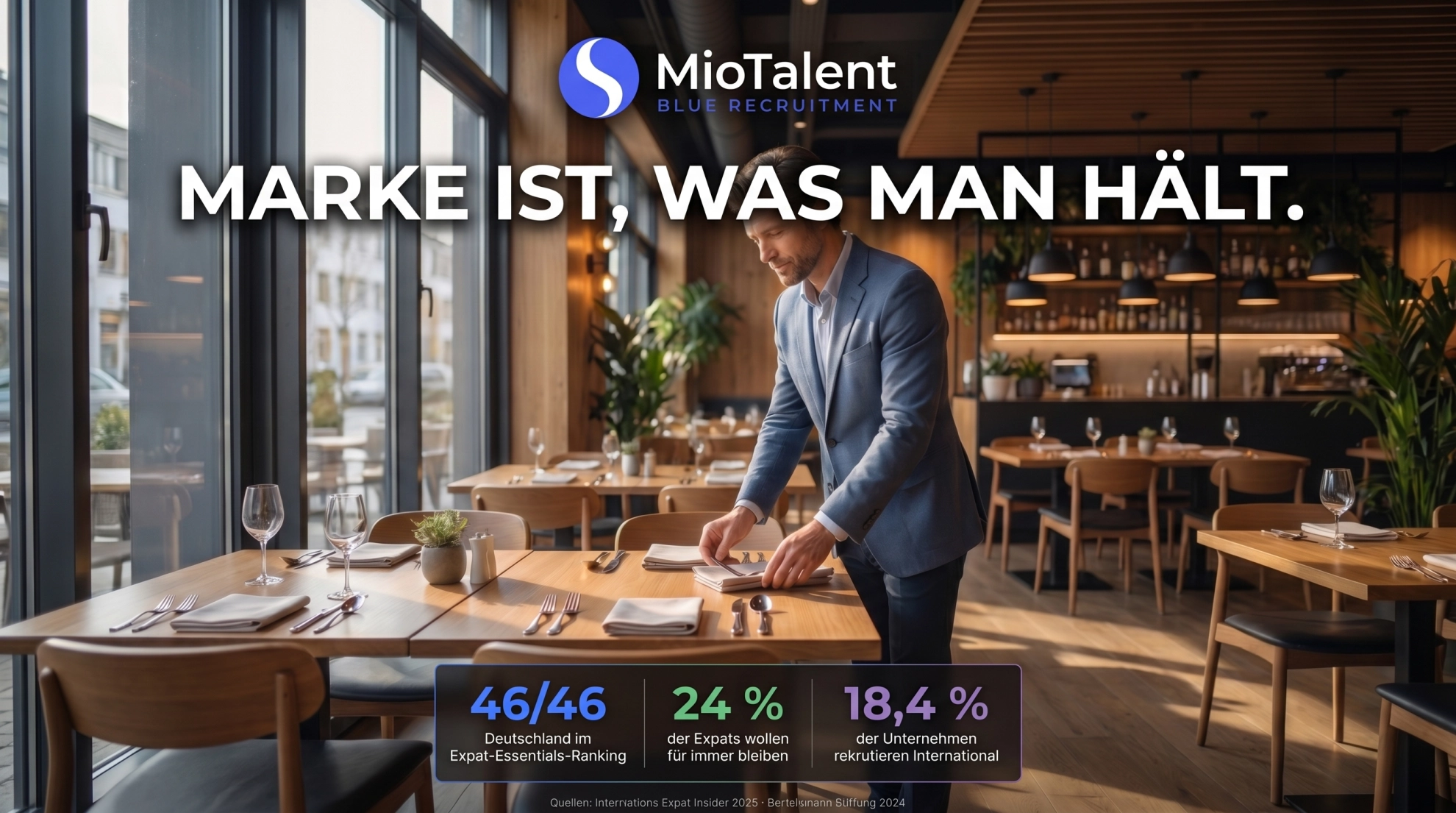
Yet competition among German companies abroad is less intense than many think: Only 18.4 percent of the companies surveyed recruit skilled workers from abroad at all (Bertelsmann Foundation, 2024). Those who approach this in a structured way are therefore operating in a field that the majority of competitors have not yet even entered. In the hospitality industry, where a position remains unfilled for an average of 198 days (Federal Employment Agency, 2026), this head start is worth its weight in gold: Those who are visible and credible abroad tap into a market where most competitors aren’t even competing. This is precisely what makes the employer brand a lever—it just needs to be built differently than for the domestic market.
Plain Language: Germany Doesn’t Sell Itself
Let’s start with the uncomfortable reality. In the Expat Insider 2025, Germany ranks last in terms of the fundamental conditions for international professionals—the so-called “Expat Essentials”—coming in at 46th out of 46 countries surveyed, behind all other industrialized nations in the study. The subcategories explain why: 45th in language, 42nd in administration and bureaucracy, 43rd in affordable housing, and 46th in digital life (InterNations, 2025).
For the employer brand, this means: The location doesn’t sell the company—the company must help sell the location. Anyone who advertises in job postings with “Work in beautiful Germany” is promoting something that international professionals see right through in the rankings. On the other hand, those who say, “We know that dealing with government agencies, finding housing, and the language can be difficult here—and we’ll take care of whatever we can for you,” address the actual factors driving the decision. The location’s weaknesses are the stage on which a well-organized company can shine. Incidentally, this approach isn’t a marketing gimmick but the core of the brand: plain language instead of diplomacy builds exactly the kind of trust that glossy marketing never creates—when you honestly name the hurdles, people believe you when you offer solutions.
What International Applicants Really Look For
A look at retention intentions provides the other side’s perspective: 24 percent of expats worldwide want to stay in their host country permanently, only 7 percent plan to leave within a year, and just 3 percent want to leave as soon as possible (InterNations, 2025). The majority, then, is not looking for a temporary stint but for long-term prospects—and evaluates employers precisely on that basis. This is good news for companies: Those who think long-term will attract people who want to stay for the long haul. The intention to stay is there; it just needs to find an employer who deserves it—and who doesn’t squander that trust in the first few months.
Specifically, this means: The reliability of the promises is being evaluated. Is the stated salary accurate—both gross and net—and was the difference between the two even explained? Is housing arranged or just “provisional”? Is there support with government agencies and the language? And are there opportunities for advancement beyond the first position? These questions aren’t answered on the career page, but in conversations—with the company and, more importantly, with fellow countrymen who already work there. Anyone who gives evasive answers to specific questions during the selection process has already lost this test—long before the contract is on the table. Conversely, every precise, credible answer is a building block for your reputation.
The Building Blocks of an Authentic Employer Brand
All of this leads to a five-point plan. First, an honest job description: Duties, working hours, seasonal peaks, and requirements as they are—embellished job postings lead to tomorrow’s resignations, and with a turnover rate of 60.5 in the hospitality industry (Federal Employment Agency, 2024), no one can afford that. Second, transparent pay: gross and net amounts, bonuses, and how overtime is handled—clearly stated rather than left open to negotiation—surprises on the first pay stub are the quickest way to lose trust. Third, secure housing: not a vague promise of assistance, but a concrete offer for the first few months. Fourth, language support: whoever organizes and pays for the course signals that the person is expected to stay. Fifth, support: a designated contact person for dealing with government agencies, daily life, and the first 90 days. Each of these five points addresses one of the questions international applicants are bound to ask anyway—the key is being able to answer them before they’re even asked.
What stands out about this list is what’s not on it: promotional videos, glossy brochures, social media campaigns. None of these things are harmful, and some may even help later on—but none of them can replace the five building blocks. An international employer brand is built on keeping promises, not on presentation. Only once the substance is in place do visibility measures pay off: well-maintained review profiles, active presences on the channels that are actually used in the candidates’ home countries, and job postings written in a language and tone that show respect rather than resorting to clichés.
The Most Effective Channel: Recommendations in the Country of Origin
The reach of an employer brand abroad is almost never built through advertisements, but through people. In their home countries, experiences with German employers spread by word of mouth—within families, among former colleagues, and in communities. An employee who is satisfied after one year reaches more potential applicants in her hometown than any campaign could; a disappointed employee reaches the same people with the opposite story.
This leads to what is perhaps the most important insight of this article: An international employer brand and employee retention are one and the same endeavor. Every measure that retains current employees—fair treatment, promises kept, genuine career prospects—simultaneously attracts the next generation of talent. Some companies have turned this into a system and actively ask satisfied employees to recommend candidates from their personal networks—with the pleasant side effect that recommended candidates arrive with realistic expectations because they know the truth firsthand. This is precisely where collaboration with a partner that has its own infrastructure in the candidates’ home countries comes into play: The local recruiter’s reputation becomes an extension of the company’s employer brand—or its first real test, if the partner is poorly chosen. And each of the typical mistakes we described in our article on the seven mistakes of international recruitment damages the brand twice: in the eyes of the person affected and in the eyes of everyone they tell about it.
A brand is what you make of it
Employer branding for international professionals is not a marketing project, but an organizational initiative with external impact. The order of priority is clear: first the five building blocks, then visibility; anyone who reverses this order will only make the gap between promise and reality more apparent. A company that delivers on its promises—in a country where, according to all available data, life isn’t easy for immigrants—has a unique selling point that cannot be replicated: reliability in action. It requires organizational effort rather than a budget; its impact lasts for years rather than just the duration of a campaign; and it grows stronger with every promise kept. Our overview of labor migration to Germany in 2026 outlines the legal pathways involved in international hiring.
Sources: Bertelsmann Foundation (Tools to Combat the Skilled Labor Shortage, 2024); InterNations Expat Insider 2025 (Expat Essentials, Length of Stay); Federal Employment Agency (2026).