When we talk to companies about international recruitment, one objection comes up more often than any other. It usually comes not as a question but as a statement: they don’t understand German.
That is not a prejudice. It is the statistically most common reason companies give against recruiting from abroad — and it is justified. What is true about it and what is not can be determined fairly precisely.
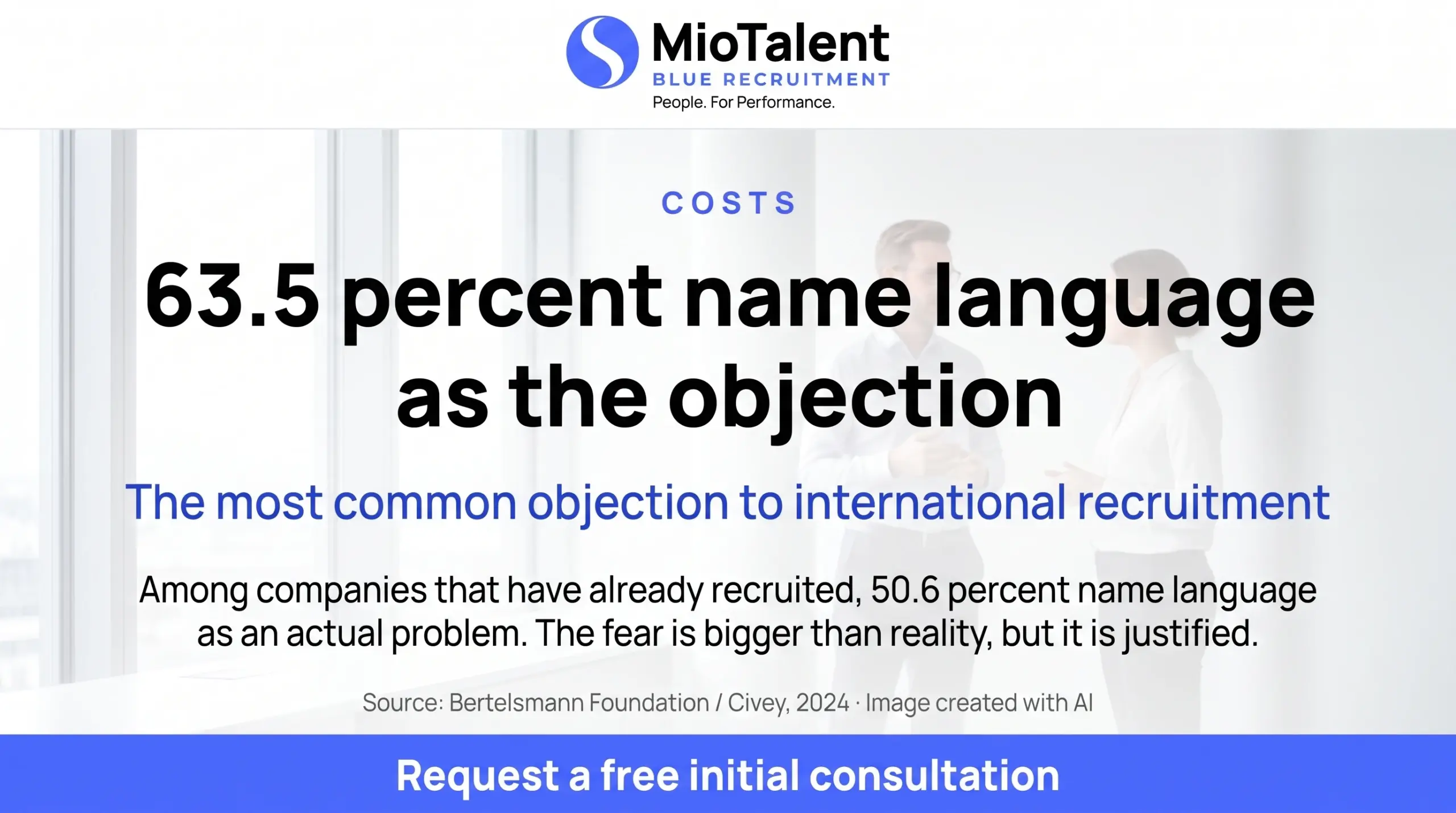
63.5 percent
In June 2024 the Bertelsmann Foundation, together with Civey, surveyed five hundred decision-makers. All from companies with skills shortages, all without foreign skilled workers in the business. The question: what speaks against it?
- Language communication difficulties: 63.5 percent
- False expectations of applicants: 45.3 percent
- Qualification hard to assess: 40.8 percent
- Enough workers available domestically: 23.9 percent
- Bureaucratic hurdles: 22.1 percent
Language is almost twenty percentage points ahead of the second reason. It is not one argument among several; it is the argument.
And now the figure that belongs beside it. The same institutes surveyed 501 companies over the same period that have already recruited internationally. They were asked about the problems that actually occurred:
- Language: 50.6 percent
- Bureaucratic hurdles: 40.7 percent
- False expectations: 31.1 percent
- Recognition: 29.7 percent
- No problems: 24.6 percent
Language remains the biggest topic even after recruitment. It falls from 63.5 to 50.6 percent — the fear is therefore somewhat bigger than the actual problem, but not dramatically. Anyone who believes the language issue resolves itself once the person is here is mistaken.
What the objection gets right
Three points where the concern is factually justified.
Technical language is not everyday language. Someone with B1 can shop, make small talk and understand instructions in principle. That is not enough for nursing documentation, for a handover conversation, or for a relative’s question about their mother’s condition. In the kitchen it is not enough for communication under time pressure, on the construction site not for safety briefings.
Dialect is a topic of its own. Anyone who has learned standard German understands less in Bavaria, Saxony or the Ruhr region than the certificate suggests. This is rarely a permanent problem, but a real one in the first weeks.
Language breaks down under stress. Those who speak confidently when it is calm lose it under pressure. Precisely the situations in which understanding matters most — emergency, conflict, time pressure — are the ones in which it works worst.
Anyone who knows these three points has formulated a justified objection. Anyone who does not know them and still promises that language is no problem is selling something.
What the objection gets wrong
And now the other side.
Language level is plannable, qualification is not. A language level can be tested before entry, documented with a certificate and raised specifically through a course. An intensive course from B1 to B2 comprises, depending on the provider, 400 to 600 teaching hours. That is effort, but it is calculable effort with a predictable result. Compare that with the question of whether an applicant is a professional fit — that is answered at the earliest during the probationary period.
The language course can take place in Germany. For training under Section 16a of the Residence Act, the purpose of stay expressly includes attending a German language course in preparation. The person may enter and first learn the language. This considerably shortens the overall time compared with waiting for a higher level in the country of origin.
Language grows faster on the job than in a course. In our experience, someone with B1 makes more progress in three months of everyday work than in three months of lessons — provided there is someone who talks to them. That is precisely the point at which companies make the difference.
And the uncomfortable counter-question: how good is communication in your business right now? In many kitchens, on many construction sites and in many care teams, people with different native languages have long worked together. The benchmark is not the perfectly German-speaking crew — in the sectors concerned it no longer exists in many places.
The proficiency levels, briefly explained
Because letters and numbers keep coming up in conversations without it being clear what lies behind them: the Common European Framework of Reference has six levels from A1 to C2. Three of them are practically relevant for you.
A2 means: simple sentences, familiar topics, basic needs. For employment this is generally not enough, except for heavily guided activities with always the same routines.
B1 means: understanding the main points when clear standard language is spoken, expressing oneself coherently on familiar topics. This is the level most candidates enter with. For helper and semi-skilled activities it works, for specialist conversations it does not.
B2 means: understanding more complex texts, communicating spontaneously and fluently, holding a specialist conversation in one’s own field. This is the level expected in nursing and the one that also makes the difference in the kitchen as soon as someone is to take on responsibility.
The jump from B1 to B2 is the most expensive and the most important. It costs, depending on the provider, 400 to 600 teaching hours. Set that against the cost of a position that instead stays open for further months — then the figure is put into perspective.
Important for practice: a certificate says that someone has passed an exam. It says nothing about how well the person speaks when they are tired, when someone speaks dialect or when things get hectic. Hold a video conversation before you decide. Ten minutes say more than any piece of paper.
What actually helps
Four things that make the difference, in order of their effect.
First: a named contact person. Not a formal mentoring programme with a manual, but a colleague one can turn to in the first weeks. This costs nothing but an arrangement and is the most effective lever we know.
Second: technical vocabulary before grammar. For the specific activity, two to three hundred words are needed that really occur in everyday work. Creating this list and providing it in advance brings more in the first weeks than any general proficiency level.
Third: written material wherever possible. Duty rosters, handovers, safety instructions. Those who can read what they have heard understand more — and those who could not follow under stress can read up.
Fourth: realistic expectations in the team. The first weeks take longer. If that is said beforehand, it is a planned circumstance. If no one says it, it is a disappointment.
What the objection reveals about the company
One final thought that rarely comes up in conversations.
When a business says language is the problem, there is often a second statement in it: we have no structure for onboarding. That is not a reproach — in small businesses with thin staffing, onboarding is usually what happens on the side when there is time.
But that is where international recruitment fails more often than on certificates. Someone still learning the language needs more guidance in the first weeks than a German-speaking skilled worker. If this guidance is not organised, the impression arises that the person cannot do it — when in fact the structure in which they could learn it is simply missing.
The test for this is simple: how does onboarding work at your business today, for a German-speaking new hire? Is there a process, a responsible person, a list of what should happen in week one? If yes, international recruitment will very probably work at your business. If no, language is not your real problem — it merely makes an existing one more visible.
That is uncomfortable, but it is the more honest diagnosis. And it is the reason we always ask about onboarding before a placement.
Why we don’t argue this away
In our industry the language objection is readily brushed aside. Everyone speaks German, no problem, we check that beforehand. Such sentences are convenient and do not survive the first handover.
We say instead: the objection is justified, it is the most common, and it does not disappear through a certificate. What makes it manageable is preparation — a level tested beforehand, a funded course where necessary, a vocabulary list for the activity, a named contact person in the business.
That is unspectacular. But it is the difference between a hire that holds after three months and one that fails after three months.
One caveat at the end that we do not conceal: there are positions where a high language level is non-negotiable. In nursing with direct patient contact, in safety-critical activities, everywhere misunderstandings become dangerous. Anyone who sells you B1 as sufficient there is acting negligently. For helper and semi-skilled activities in cleaning, logistics or interior construction, the calculation looks different.
Further reading
- Concerns about international recruitment: the fact check
- Two paths into nursing, only one needs recognition
Sources
Bertelsmann Foundation / Civey: Reasons against recruiting foreign skilled workers. Survey 05/06 to 14/06/2024, 500 decision-makers in companies with skills shortages without foreign skilled workers.
Bertelsmann Foundation / Civey: Problems employing foreign skilled workers. Survey 05/06 to 14/06/2024, 501 respondents.
Federal Ministry of Justice: Section 16a Residence Act — vocational training; further vocational training. URL: https://www.gesetze-im-internet.de/aufenthg_2004/__16a.html (accessed 12/08/2026).