When German businesses consider international recruitment, sooner or later the term “Western Balkans” comes up. And rightly so. The region is one of the most pragmatic recruitment channels currently available to the restaurant and hotel industries. But many businesses don’t fully understand what’s involved—and that leads to unrealistic expectations on both sides.
This article explains what the Western Balkans Regulation actually means, which countries are affected, which professions are eligible, and what the real limitations of the process are.
What is the Western Balkans Regulation?
The legal basis is Section 26(2) of the Employment Regulation. This provision allows nationals from six specific countries in the Western Balkans to work in Germany—regardless of their qualifications and without the need for there to be a shortage of workers in a particular occupation.
This is a key difference from the regular Skilled Immigration Act, which generally requires recognized vocational training or a college degree. The Western Balkans regulation thus opens the German labor market to people whose credentials are not—or not yet—recognized in Germany.
The requirements are a specific job offer from a German employer, a visa application submitted to the appropriate German diplomatic mission abroad, and approval from the Federal Employment Agency. This is not an expedited process—but it is a structured one that works reliably when prepared professionally.
Which countries are included?
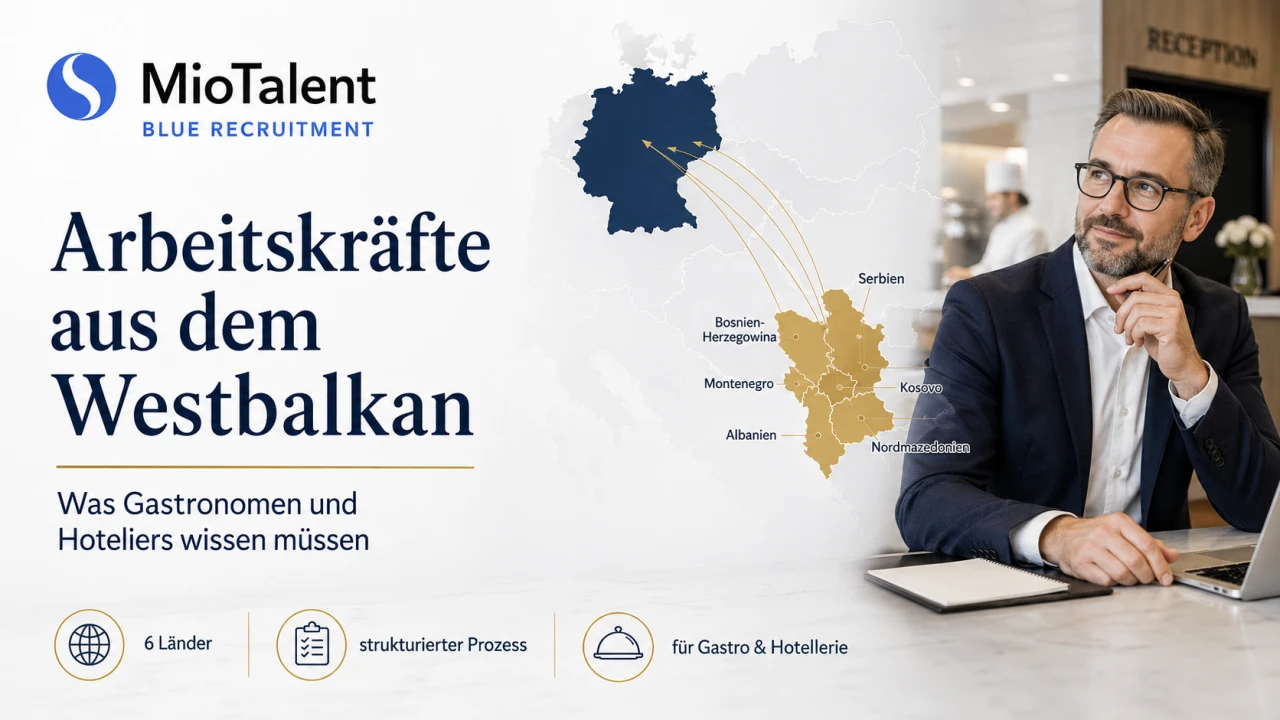
The regulation applies to nationals of the following six countries:
- Albania
- Bosnia and Herzegovina
- Kosovo
- North Macedonia
- Montenegro
- Serbia
Croatia is not covered by this regulation. As an EU member state, Croatian citizens enjoy full freedom of movement for workers within the EU and do not need a visa to work in Germany.
What kinds of jobs are suitable?
Since the Western Balkans regulation does not require any specific qualifications, it is particularly relevant for operational positions that are currently unfilled in day-to-day business. In the restaurant and hotel industries, this primarily applies to:
Kitchen positions such as commis de cuisine, chef de partie, or kitchen assistants. Service staff and restaurant professionals. Front desk staff with appropriate language skills. Housekeeping and house management.
It is important to note that this regulation does not mean that qualifications are irrelevant. It means that German authorities are not required to review and recognize qualifications in advance. The employer selects the candidate—and is therefore responsible for ensuring the candidate’s professional qualifications.
What the rule Does Not Mean
In practice, this is where people most often oversimplify the issue. The Western Balkans regulation will not solve the staff shortage overnight.
The process requires a specific job offer, a complete visa application, approval from the Federal Employment Agency, and processing by the relevant diplomatic mission abroad. Each of these entities has its own processing times. According to the Federal Employment Agency, the average time a position remains vacant in 2026—across all industries—is 165 days, with procedural delays factored in.
Anyone starting today should expect the entire process to take five to seven months before they actually begin work. It’s possible to start sooner, but that can’t be planned for.
What Businesses Need to Keep in Mind Specifically
In practice, three points determine whether things run smoothly or result in unnecessary delays.
Complete documentation from the very beginning. Missing or incomplete documents are the most common cause of delays in the visa process. It should be clear from the outset what the applicant must provide, what the employer must provide, and what needs to be coordinated.
Realistic job descriptions. Not every job is suitable for every candidate from every region. Anyone who writes a job description that would be nearly impossible to fill in Germany will also have a hard time finding candidates internationally. Being clear about required and preferred qualifications saves time.
Preparing for the arrival. Housing, the first day of work, orientation, and dealing with government agencies—these issues must be resolved before the employee arrives, not after. If you wait until the employee arrives to start making arrangements, you risk early turnover, which will undo all the effort put into the process.
What the Numbers Say
According to a 2024 study by the Bertelsmann Foundation, 18.4 percent of German companies already recruit employees from abroad. The majority do not yet do so—often because the process, the effort involved, and the legal framework are unclear. It is precisely this lack of clarity that can be resolved.
Conclusion
The Western Balkans Regulation is a sensible and practical way to expand the scope of opportunities for the restaurant and hotel industries. It is not a fast-track process, but it is a structured one. And it works reliably when the process is professionally prepared and clearly managed.
For companies recruiting internationally for the first time, this is often the most practical way to get started.
MioTalent organizes international recruitment from the Western Balkans—with its own on-site agency, German contacts, and a process tailored to the realities of the German workplace.