
It’s the end of June, the patios are packed, and the issue of staffing for the fall seems far off. That’s exactly the mistake that will come back to haunt you in October. Because in this industry, months pass between the decision to fill a position and the employee’s first day on the job—and in the hospitality industry, fall isn’t the end of the season, but rather the start of the second one for many businesses. This article does the math that no one wants to do in June and shows exactly what needs to be done now—with a timeline, steps to take, and a five-point list for the coming weeks.
The bill no one wants to pay in June
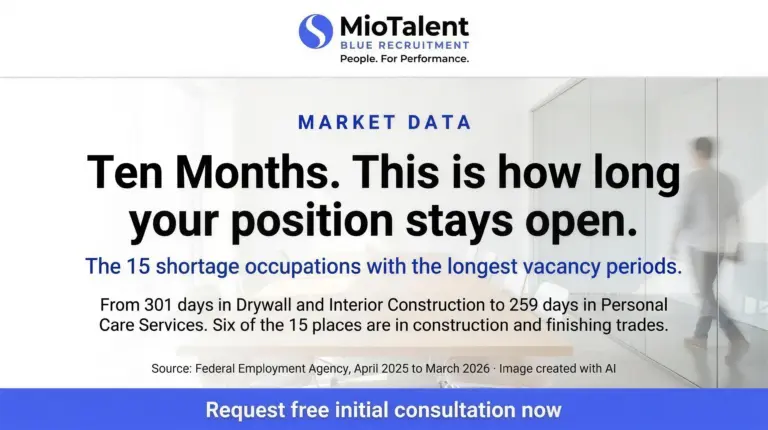
The key figure is well known, but its implications are rarely fully considered: In the hospitality industry, a job opening remains unfilled for an average of 198 days—about six and a half months (Federal Employment Agency, 2026). If you work backward from this figure on the calendar, you arrive at an uncomfortable conclusion: A position that is supposed to be filled by early November and is advertised today has already missed its target given the average search time. Across all industries and skill levels, the figure is still 165 days—so even those looking outside the hospitality industry will find no comfort in these statistics.
Of course, the average isn’t set in stone; some positions get filled faster. But basing workforce planning on the best-case scenario in the statistics isn’t planning—it’s wishful thinking. The sensible takeaway is this: If you want to be ready by fall, your window of opportunity is now—in the summer, not after summer vacation. The psychological obstacle to this insight is a packed patio: as long as business is booming and the team is on its feet, taking precautions feels like over-caution. But staffing planning is like heating system maintenance—if you do it in the summer, you won’t freeze in the winter. The businesses that complain in November about full houses instead of empty work schedules are the ones that made the difference back in June.
Why Fall Is Underestimated
Fall has a perception problem in the hospitality industry: It’s overshadowed by the summer season, even though it’s the start of the business that keeps many establishments afloat financially. Starting in September, the conference and event business picks up; Christmas parties follow in November, bringing weeks of double bookings; and in winter sports regions, the second peak season of the year begins. Anyone operating with half their staff at that time is turning down revenue that can’t be made up—a canceled Christmas party won’t be rescheduled for January, and the corporate group that celebrated elsewhere once often won’t return at all the following year. Autumn thus punishes staffing gaps twice over: in current revenue and in the core business of the following year.
Then there’s the staffing side of things: The industry’s turnover rate stands at 60.5 (Federal Employment Agency, 2024). This also means that some of the team currently running the terrace won’t be there come fall. Fall planning therefore involves not only covering new peaks in demand but also replacing foreseeable departures—and both require the same lead time. An honest look at your own turnover history is more helpful here than any industry statistic: How many departures occurred each year between August and October in recent years, and which positions were affected? This figure should be factored into fall planning before the first new position is budgeted—it is the most realistic leading indicator a business has.
The schedule, working backward
Proper planning doesn’t start today, but on the target date—and works backward from there. The process involves three steps. First, set the target date: When does the person need to be trained and fully operational—not just in the country, but actually productive? Depending on the position and language proficiency, this difference can amount to several weeks and is often overlooked in almost every planning process. Second, map out the steps: onboarding, entry and registration, visa procedures, language preparation, and selection. For international hires, these phases add up to several months, even when they’re carried out in parallel. Third, mark the latest possible start date—and compare it to today’s date.
For the winter season, the answer is clear: the latest practical start date is in the summer. Added to this is a unique feature of the Western Balkans regulation, which governs many fall appointments: the annual quota of up to 50,000 approvals is distributed across months and nationalities and can become scarcer toward the end of the year. So the process itself also rewards an early start. And there’s a third time-related factor that’s often overlooked: language preparation. Achieving a usable level of German takes months and cannot be rushed—it can only be started early enough so that it runs parallel to the administrative steps rather than following them. Our article on the duration of international recruitment details what each phase entails and how long they realistically take.
The Three Paths and Their Lead Times
There are three options for fall hiring, and they differ primarily in terms of the lead time. The first is the traditional domestic search: post the job opening and wait. Its lead time is the vacancy period itself—198 days on average across the industry, with no guarantee of a successful outcome. It remains the right approach for serendipitous finds and referrals, but as a standalone strategy, it’s a gamble against the odds. Furthermore, the BA-X Job Index has recently risen to 106 points, its highest level in 14 months (Federal Employment Agency, 2026)—so competition for the same small pool of candidates is actually increasing again, not decreasing.
The second option is via the EU, for example to Croatia: no visa required, no quotas, and logistically feasible within weeks—but it’s a small, highly competitive market whose own tourism season doesn’t pick up until the fall. For short-term fall staffing, this could be exactly the right window of opportunity: when the season ends on the Adriatic, the next one begins in Germany’s winter sports regions. Those who strategically capitalize on this transition can fill positions with staff who come directly from the field.
The third option is orderly recruitment from third countries through the Western Balkans Regulation or the Skilled Workers Immigration Act: it has the longest lead time, but offers the most predictable outcome—and it is the only option that combines a large pool of candidates with a fixed procedure. Those who want to use it for the fall should start now; those who want to use it for spring 2027 should plan for it this fall. In practice, well-positioned companies combine all three approaches: the domestic track runs in parallel, the EU option is used when a specific candidate becomes available, and the third-country pipeline provides the predictable baseline supply.
What Specifically Needs to Be Done Now
Five steps turn this insight into a concrete plan that can be implemented in two weeks. First, quantify the fall staffing gap: Which positions need to be filled starting in October and November—including foreseeable departures, not just new hires? Second, choose the recruitment path for each position: domestic, EU, or third country, based on urgency and whether the role needs to be filled repeatedly. A one-time, short-term vacancy requires a different approach than a position that needs to be filled every year. Third, if pursuing an international route, immediately initiate the selection process and have language training begin as soon as the candidate accepts the offer. Fourth, set up the document and administrative steps as a parallel project, with clear responsibilities: What falls under the company’s purview, what is the candidate’s responsibility, what is the partner’s responsibility—and what can be done simultaneously. Fifth, review the core staff: Those who are thinking beyond the fall should fill the positions now that support the organization year-round—and without which every season becomes a nail-biter—the logic behind this is explained in our article on seasonal staff versus permanent positions.
Summer Determines Winter
The crux of fall planning is both inconvenient and simple: it happens in the summer—or not at all. Processes take time, government agencies are part of the system, and the 198-day industry lull applies to everyone who waits. Those who plan now secure choice, peace of mind, and a full staff during the quarter with the highest revenue; those who start in September end up with leftover positions and improvisation—and pay the price in canceled bookings and overtime for the core team. There’s no secret between the two—just a start date. Our overview of labor migration to Germany in 2026 outlines the specific legal avenues available for staffing.
Sources: Federal Employment Agency (Vacancy Duration in the Hospitality Industry 2026; Turnover Rate 2024; Western Balkans Regulation 2026).