For many employers, the work visa is the biggest unknown in international recruiting. Not because it’s particularly complicated—but because it involves several departments that don’t communicate with each other. Those who understand the process save time. Those who don’t end up paying for it later.
Why the visa is the most critical time factor in recruiting
The Federal Employment Agency’s BA-X Job Index stood at 106 points in February 2026—the highest level in 14 months (Source: Federal Employment Agency). The demand for staff is rising. At the same time, the average time a position remains unfilled in the hospitality industry is 198 days (Source: Federal Employment Agency, 2026). This means that while the market is looking for workers, job openings remain unfilled for a long time.
A major reason for this is the visa process—not because it fails, but because it is underestimated. Anyone who assumes that a candidate can enter the country in four weeks is not taking reality into account. The process begins with preparing documents and ends with the residence permit after entry. In between, there are several government agencies, each with its own deadlines.
Which government agencies are involved in the process
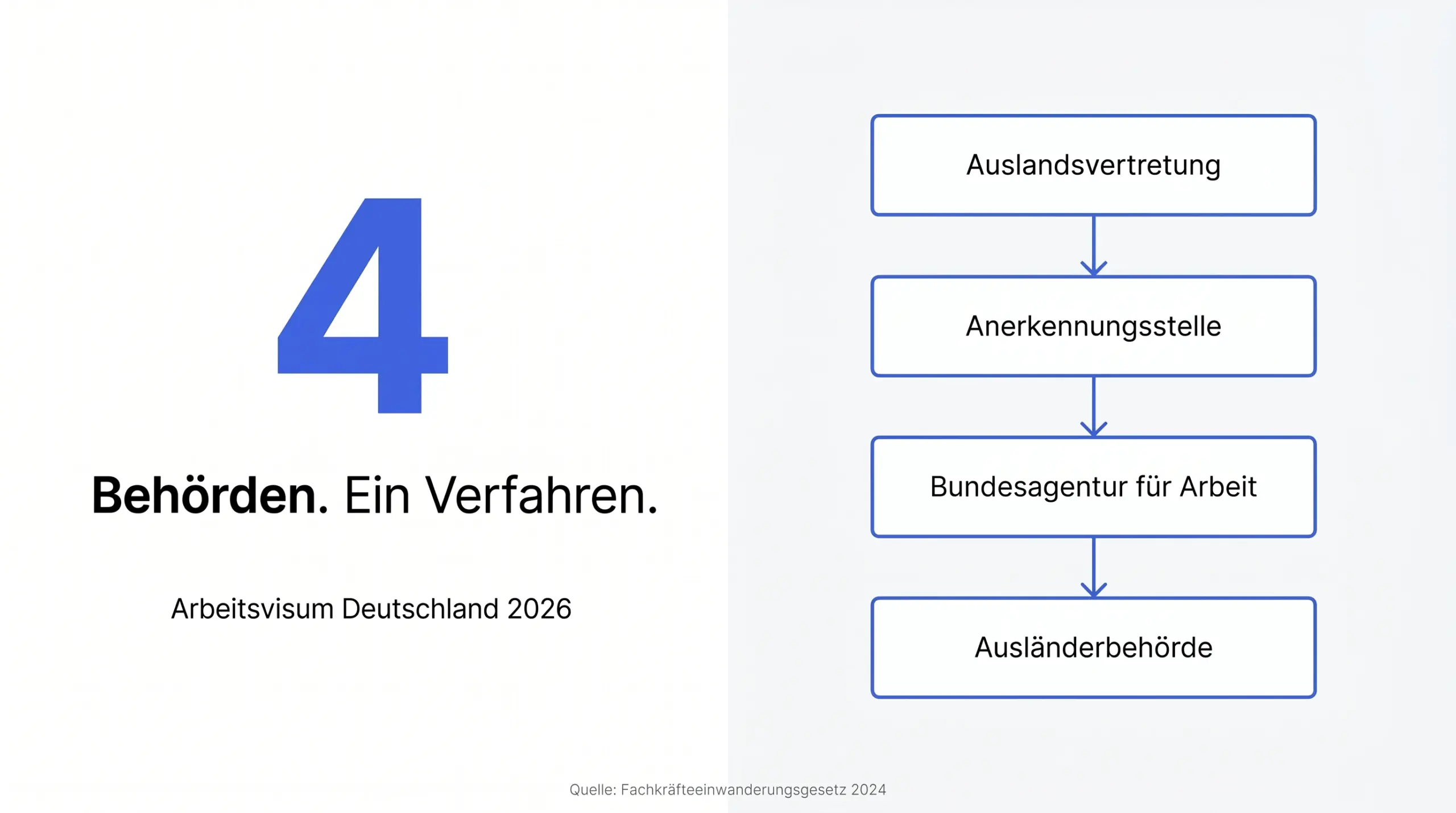
A work visa refers to the residence permit that allows a foreign national to enter Germany for the purpose of gainful employment. It is not issued by a single agency but requires the coordinated efforts of up to four institutions.
The German diplomatic mission abroad
The visa application is submitted to the German embassy or consulate in the applicant’s home country. There, the application is received, reviewed, and—upon approval by the Federal Employment Agency—the visa is issued. The wait time for an appointment varies greatly depending on the country of origin and the workload of the diplomatic mission. In some countries, the wait time just to book an appointment can be several months.
The Recognition Office
If the candidate practices a regulated profession or if a formal equivalency assessment of a foreign degree is requested, a recognition authority is involved. These agencies vary depending on the professional field—for skilled trades and commercial professions, they are often the Chambers of Industry and Commerce or Chambers of Skilled Trades; for healthcare professions, they are the state authorities. The review process typically takes several weeks to months.
In the restaurant and hotel industries, the following applies: Chef, restaurant manager, and hotel manager are not regulated professions in Germany. A mandatory recognition exam is therefore not required in most cases—foreign credentials do not need to be formally recognized in order to be allowed to work. What matters is proof of a comparable qualification or professional experience.
The Federal Employment Agency
Under the standard procedure, the Federal Employment Agency grants approval for employment—the so-called approval procedure. It verifies whether the terms of employment meet German standards and whether eligible domestic applicants are available (priority review). Under certain procedural pathways, such as the Western Balkans Regulation, the priority review is waived. This significantly speeds up the process.
The Immigration Office
After entering the country on a visa, the applicant must generally apply for a residence permit at the local immigration office in the area where they work. The visa itself is initially valid for a limited period. The residence permit for employment is the actual permanent status that legally allows the holder to work in Germany.
Three Ways to Obtain a Work Visa
Skilled Worker Immigration Act
The Skilled Workers Immigration Act (FEG), as amended in 2024, is the standard procedural pathway for qualified skilled workers from third countries. It requires a recognized or equivalent professional qualification and allows entry to take up employment in a specific job. A signed employment contract is a prerequisite.
This route is the most comprehensive and generally allows entry from all countries. Processing times vary widely—depending on the country of origin, the diplomatic mission, and the quality of the documents submitted.
Western Balkans Regulation, § 26(2) of the Description of Benefits Regulation (BeschV)
The Western Balkans Regulation is a fast-track procedure for workers from Albania, Bosnia and Herzegovina, Kosovo, North Macedonia, Montenegro, and Serbia. It does not require formal recognition of professional qualifications or a priority review by the Federal Employment Agency. What matters is a concrete job offer from a German employer.
The program operates on a quota basis—which means it is subject to an annual cap. Experience has shown that this is the most reliable and efficient procedure for the restaurant and hotel industries, because it involves fewer reviewing agencies and the documentation requirements are more clearly defined.
Free Movement of Workers in the EU
For candidates from EU member states, the visa process is completely waived. Croatia has been a full Schengen member since 2023, and Romania and Bulgaria since 2024. Workers from these countries do not need a visa or a work permit—they can be hired immediately. The only requirement is to register with the local registration office after entering the country.
How long does it really take?
A realistic timeline for the visa application process varies depending on the route taken. As a general guide based on practical experience:
– Western Balkans Regulation: two to four months from the date of application to entry, provided all required documents are submitted
– Skilled Worker Immigration Act: three to six months, depending on the diplomatic mission and the Federal Employment Agency’s approval process
– EU freedom of movement for workers: no visa requirements; entry is permitted at any time
This information applies only if all documents are complete and there are no follow-up inquiries from the authorities. Any missing document, any unclear translation, or any terminal outage at the embassy will delay the process. This is not an exception—it is the rule.
What Employers Need to Do Specifically
The most common mistake in the visa application process is not that the applicant lacks the necessary qualifications. It is the absence of an employment contract or an incomplete one. Under German law, without a signed contract, there can be no visa application. Without a visa application, there can be no entry into the country. This sequence of steps cannot be bypassed.
Documents required from the employer prior to submitting the visa application: the employment contract containing all mandatory information required under German labor law, proof of the job duties and the planned compensation, and—depending on the application process—the completed application form from the Federal Employment Agency. MioTalent prepares these documents and coordinates their submission—the employer reviews and signs them.
Common Mistakes and How They Happen
The most common misconception: The visa is seen as the final step. In practice, it’s the third-to-last step—after selection and contract drafting, but before onboarding and integration. If you schedule it too late, you’ll lose several months.
A second misconception: All countries operate the same way. That is not the case. A candidate from Montenegro follows a different process than a candidate from Ukraine or India. Anyone recruiting internationally needs country-specific knowledge—or a partner who has it.
A third misconception: Once approved, everything is taken care of. The residence permit must be renewed after entry and updated if there are any changes. Anyone who fails to assist their employee with this process risks losing the permit—and, as a result, losing the employee.
Related articles in this series: A complete explanation of the Western Balkans Regulation will be published on May 8, 2026. The Pillar article on professional recognition in Germany will follow in calendar week 25.