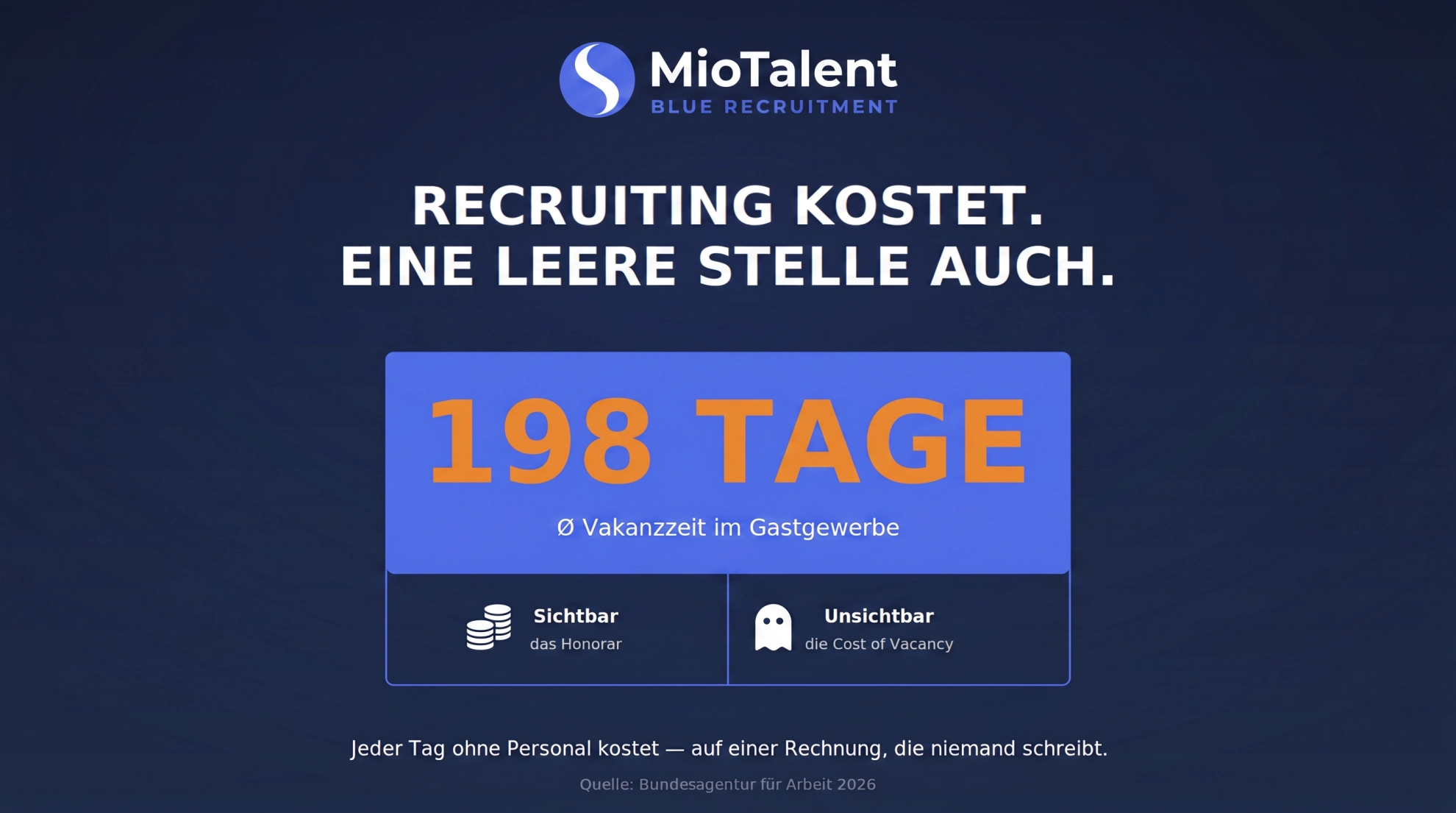
When hiring a foreign skilled worker, it is not goodwill that determines the duration of the process, but rather the completeness of the documentation. Every missing document sets the process back—and in the hospitality industry, every day a position remains open costs money (average vacancy duration: 198 days, Federal Employment Agency, 2026). This checklist organizes the documents according to the three phases of the process, identifies responsibilities, and shows the order in which everything is needed. It is deliberately sorted by timeline rather than by importance, because in this process, the correct sequence is more critical than any single document.
Phase One — Documents Required Before Applying for a Visa
Before a visa application can even be submitted, the groundwork must be in place. “Document clarity” here refers to the state in which all supporting documents required for preliminary approval are complete, valid, and translated. If even one piece of this is missing, the process cannot even begin.
- A valid passport with sufficient remaining validity for the entire process.
- A concrete job offer or a signed employment contract—the foundation for every next step.
- Job description, including the required skill level.
- Proof of qualification (training or academic certificate), depending on the path.
- For skilled workers: a notice of recognition or proof that the recognition process is underway.
Two points are often overlooked here. First, depending on the country of origin, foreign documents must be accompanied by an apostille or legalization in order for German authorities to recognize them. Second, the equivalence of many degrees can be assessed in advance using the Anabin database, which evaluates foreign educational qualifications. Without an employment contract and proof of qualifications, nothing will happen, and for skilled workers, the Skilled Worker Immigration Act (as of 2024) requires at least two years of vocational training or an equivalent qualification.
Whether certification is required at all depends on the profession. In regulated professions such as nursing or medicine, it is mandatory. In unregulated professions—which include most jobs in the restaurant and hospitality industries—it is often not required or is based on experience. This single decision determines what documentation Phase One requires at all, and should therefore be clarified right at the beginning.
Phase Two — Documents for the Visa Application Process
Once the basic requirements are met, the application is submitted to the relevant German diplomatic mission in the applicant’s home country. Preliminary approval refers to the Federal Employment Agency’s advance approval of employment, which shortens the subsequent visa process. Depending on the route—the Skilled Workers Immigration Act or the Western Balkans Regulation—the scope varies, but the core requirements remain the same:
- A fully completed visa application submitted to the diplomatic mission abroad.
- Prior approval from the Federal Employment Agency, if required.
- Certified translations of all foreign-language documents.
- Proof of sufficient means of support or the agreed-upon salary.
- For candidates from the Western Balkans who are over 45 years of age: Proof of a minimum gross annual salary of 55,770 euros (as of 2026) or an adequate retirement plan.
- Proof of health insurance for entry.
Employers can further expedite the process: Through the expedited skilled worker procedure, the company initiates the process directly with the relevant immigration office for a fee, which significantly shortens the processing time. The most common mistake in this phase involves translations: Missing or uncertified translations result in the application being rejected, even if the content is correct. It is purely a procedural error that costs weeks and is entirely avoidable.
Phase Three — Documents After Entry
The process is not complete upon arrival in Germany; rather, it shifts to a new phase. Several steps must be taken promptly to ensure that employment begins in compliance with the law and that the first paycheck is processed correctly:
- Registering your residence with the Residents’ Registration Office — generally within two weeks of moving in.
- Residence permit from the relevant immigration office.
- Tax Identification Number — is automatically assigned after you register your residence.
- Social Security number — provided by the employer when enrolling in Social Security.
- A German bank account for salary payments.
- Set up payroll using the available tax and social security data.
Pay stubs can only be prepared correctly once the tax identification number and Social Security number are available. Those who take care of these steps in advance, rather than waiting for them, can significantly shorten the time until the first regular, fully paid workday. In particular, the residence registration—with its two-week deadline—can be planned in advance, often even before the person arrives in the country.
Originals, Copies, and Certified Copies
It’s not just which documents you have that matters, but also their format. Government agencies generally require certified copies rather than simple printouts, and foreign-language documents must be translated and certified by sworn translators. Many diplomatic missions also expect you to present the originals at your appointment. If you clarify early on which documents are needed as originals, certified copies, and certified translations, you can avoid having to resubmit your application due to formal deficiencies alone. A practical rule of thumb: it’s better to prepare one too many certified copies than one too few. You should also keep an eye on the validity periods of individual documents, as some may expire during a lengthy process and need to be reobtained.
Who Does What — Responsibilities
There are three parties involved in the process, and clarity regarding their roles prevents most delays. The employer provides the employment contract, job description, and, if applicable, prior approval, as well as initiates the expedited procedure. The candidate submits their passport, proof of qualifications, translations, and personal documents. The authorities—the diplomatic mission, the Federal Employment Agency, the recognition office, and the immigration office—review the documents and issue the necessary approvals. If each party completes its part simultaneously rather than sequentially, the overall duration is reduced the most.
The Most Common Errors in Documentation
Five mistakes crop up time and again in practice, and all five are preventable. First, uncertified translations, because a simple translation is not sufficient for the authorities. Second, the absence of an apostille or legalization of the original documents. Third, starting the recognition process too late—it should run parallel to the visa process, not after it. Fourth, incomplete proof of qualifications, such as missing transcripts or training regulations, which lead to follow-up questions. Fifth, the wrong order, where phase three is prepared before phase one is even complete.
Each of these mistakes prolongs a process that is already under time pressure, given the average vacancy period of 198 days in the hospitality industry. The good news is that these are organizational mistakes, not substantive ones, and are therefore entirely manageable.
How long all of this will take
A realistic timeline is measured in months, not weeks. The accreditation process (if necessary), the visa application process, and the administrative steps after entry all add up, and several of these depend on processing times that the business cannot control. That is precisely why the industry average of 198 days of vacancy in the hospitality sector is a realistic benchmark and not a doomsday scenario. An example of effective parallel processing: While the certification process is underway, translations, apostilles, and proof of health insurance can already be compiled so that the visa application can be submitted immediately after preliminary approval. The only factor entirely within the employer’s control is the completeness and order of the documents—and it is precisely this factor that determines whether the process falls at the lower or upper end of this range.
Why Order Matters
The documents build on one another. Without an employment contract, there is no prior approval; without prior approval, there is no visa; without a residence registration, there is no tax identification number; and without that, there is no accurate pay stub. It’s a chain in which each link supports the next. Processes take time, and government agencies are part of the system—that can’t be eliminated through optimization. But having a complete set of documents in the correct order is the most powerful lever an employer has at their disposal. With an average vacancy period of 198 days in the hospitality industry, this very lever can make a difference of weeks—in either direction.
From a Complete Application to a Decision to Dismiss the Case
Hiring a foreign skilled worker is not a gamble, but a predictable process with clear steps. If you prepare the documents during the three phases, assign responsibilities, avoid common clerical errors, and follow the proper sequence, you can turn a process that’s considered complicated into a manageable checklist. That is the real difference between a company that waits for months and one that can fill positions according to a plan. It is precisely this predictability that a well-prepared document package provides, long before the first government agency even begins its review.
Our overview of labor migration to Germany in 2026 explains which procedure applies to your specific position—the Skilled Workers Immigration Act, the Western Balkans Regulation, or the Experience Track. Our article on skilled workers, specialists, and experts explains how to classify the position into the correct requirement level in advance.
Weiterlesen
- Berufsanerkennung Ausland: So funktioniert das Verfahren — was mit den Unterlagen im Verfahren geschieht
- Arbeitsvisum Deutschland 2026: Anerkennung, Behörden, Ablauf — welche Behörde welches Dokument sehen will
- Arbeitserlaubnis oder Aufenthaltserlaubnis: Der Unterschied — welcher Titel wofür gebraucht wird
Sources: Federal Employment Agency (Vacancy Duration in the Hospitality Industry and the Western Balkans Regulation 2026); Skilled Workers Immigration Act (as of 2024).