
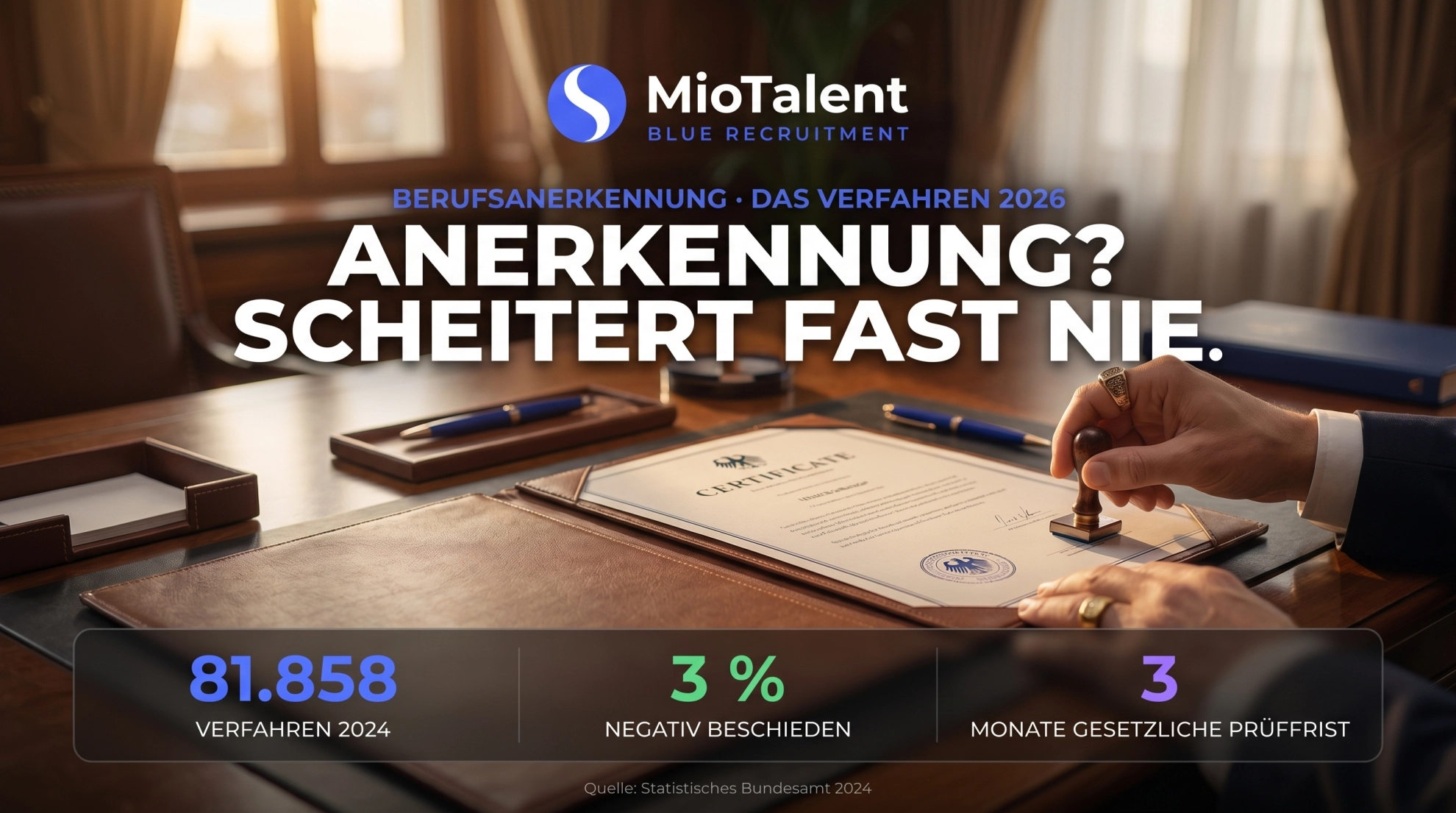
Hardly any other term commands as much respect among employers as professional recognition—and hardly any other term does so without good reason. The idea of months-long procedures with an uncertain outcome deters companies from recruiting internationally, even though official figures paint a different picture: recognition procedures almost never fail. This article explains what professional recognition is, when it is actually required, how the process works step by step, what it realistically costs in terms of time and money, and what employers can specifically do to speed it up. It is intended as a foundational text—the main page to which our other articles on legal matters and procedures refer.
What Recognition Is — and When It Is Required
Professional recognition refers to the formal determination that a professional qualification obtained abroad is equivalent to a German reference occupation. In Germany, it is governed by the Professional Qualifications Assessment Act, which grants every person with a foreign degree the right to undergo the assessment process—regardless of nationality or residency status. It is not the individual who is assessed, but rather the qualification: the content, duration, and level of the foreign training are compared with German training regulations. The result is a decision granting full equivalence, partial equivalence, or—rarely—a rejection.
Whether certification is required depends on two questions. The first: Is the profession regulated? In regulated professions such as nursing, medicine, or certain trades, you cannot work without certification—there’s no way around it. Most jobs in the restaurant and hotel industries, on the other hand, are not regulated; a cook may work even without a recognized degree. The difference can be determined by a simple question: Does the government protect the practice of the profession itself, for example because the health or safety of third parties is at stake? If so, the profession is regulated. If, on the other hand, the activity is one that anyone who has mastered it is allowed to perform, then it is not regulated—and certification goes from being a requirement to being an option.
The second question: Which path to residency will be chosen? Anyone who intends to enter the country through the Skilled Worker Pillar of the Skilled Worker Immigration Act must have a recognized qualification, as this is the ticket to this path. Those entering under the Western Balkans Regulation or the experience-based track do not need one. Recognition is therefore less often mandatory than many believe—but where it is required, it determines the entire process. And even where it is not mandatory, it can still be beneficial: A recognized degree grants full skilled worker status, facilitates future changes to the residence permit, and serves as proof of qualifications for any future employer. The decision for or against this process is therefore always a strategic one, not a bureaucratic one.
The Numbers: How the Cases Turned Out in 2024
Official statistics dispel the most widespread misconception. In 2024, 81,858 recognition proceedings were decided in Germany. Of these, 37,017 resulted in full equivalence, a large number more in partial equivalence or the requirement to complete a compensatory measure—and only 2,754 applications were denied. That is just over three percent (Federal Statistical Office, 2024). And even this three percent is no coincidence; rather, it is usually the result of an inappropriately chosen reference occupation or a fundamental lack of training certificates—that is, factors that can be verified before the application is submitted.
To put it another way: Anyone who begins the recognition process will succeed in 97 out of 100 cases. The process is not a game of chance, but an assessment with clearly defined criteria and a very high success rate. The relevance to the industry can also be quantified: In 2024, the profession of chef was among the most frequently recognized foreign qualifications in Germany, with 987 positive recognition decisions. For the restaurant and hotel industries, recognition is therefore a well-established process, not an exception. The agencies are familiar with the typical countries of origin, the standard training programs, and the recurring questions—which makes the process more predictable in practice than its reputation might suggest.
What the statistics also show is that partial equivalence is not a failure. It specifically identifies which skills are lacking and paves the way for retraining—often on the job while working. For employers, this is more of a roadmap for onboarding than an obstacle.
The Process, Step by Step
The recognition process follows a fixed sequence of five steps. First, the German reference occupation is determined: Which vocational training occupation most closely corresponds to the foreign qualification? This initial decision determines which agency is responsible and what comparison criteria will be used. It deserves careful consideration, because choosing an inappropriate reference occupation leads to a comparison that yields a worse result than the actual qualification warrants—an avoidable mistake right from the start.
Second, the responsible authority is identified. For occupations falling under the jurisdiction of the Chambers of Industry and Commerce—including chef—the primary authority is the IHK FOSA. Skilled trades are overseen by the Chambers of Skilled Trades, while regulated professions such as nursing are overseen by the respective state authorities.
Third, the documents are compiled: educational credentials, employment references, proof of identity, and a resume—depending on the position, these may require certified copies and certified translations. This step is entirely in the hands of the candidate and the employer and is also the most common source of errors. A proven approach is to work through the list of requirements from the relevant agency point by point and check off each item before submitting the application—an hour of careful attention can save weeks of having to resubmit documents. Common omissions include missing transcripts, uncertified translations, and missing apostilles on original documents.
Fourth, the agency assesses equivalence. This is where the statutory deadline applies: The decision must be issued within three months of receipt of the complete documentation, with a possible extension in complex cases. The word “complete” is key—an incomplete file does not trigger the start of the deadline.
Fifth, a decision is issued: full equivalence, partial equivalence with specified gaps, or rejection with justification. In cases of partial equivalence, an adaptation program can bridge the gaps; in regulated professions, a knowledge test or an adaptation course is available for this purpose. Important for planning: This path, too, is a defined process with a foreseeable end—not an open-ended procedure—and in many companies, it is in any case part of what a good onboarding process would entail anyway.
Anabin: The Preliminary Assessment Before Submitting the Application
Before submitting an application at all, it’s worth checking the Anabin database. It documents foreign educational credentials and institutions and allows for an initial assessment of how a degree would be classified in Germany. Anabin does not replace an official decision, but it answers the strategic preliminary question: Is it worth pursuing the recognition process, or is there a faster alternative for this candidate? Especially for applications from countries with well-documented educational systems, the database provides guidance in minutes that used to require weeks of correspondence.
This preliminary review takes very little time and prevents the most costly planning mistake: starting a recognition process that wouldn’t have been necessary for the specific position—or, conversely, choosing a course of action that won’t work without recognition. Our article on “Skilled Worker,” “Specialist,” and “Expert” explains how to classify the position yourself in advance.
Duration and costs assessed realistically
The total duration consists of two parts: the time required to gather documents, certifications, and translations—which is the applicant’s responsibility—and the statutory review period of three months from the date the application is deemed complete, which is the agency’s responsibility. Realistically, this means a timeframe of several months—closer to the statutory deadline if the process is well-organized, and significantly longer if it is poorly organized.
When it comes to costs, transparency is key rather than a flat rate: Fees vary depending on the relevant agency, profession, and federal state, and additional costs for translations and certifications may apply. An accurate estimate can only be provided on a case-by-case basis. It’s important to put the scale into perspective: Given an average vacancy period of 165 days across all skill levels (Federal Employment Agency, 2026), recognition is a small expense with a big impact—it opens the path to skilled employment and permanently documents the qualification, including for future job changes and salary levels. Conversely, anyone who advertises fixed, all-inclusive prices for recognition ignores the variables that actually determine the costs—a red flag, not a service.
Many employers therefore deliberately cover these costs as an investment. This is not only fair, but also a sign of commitment: Those who invest in recognizing their employees are visibly investing in their shared future.
What Employers Can Do Specifically
All of the above points to a clear course of action. There are five levers directly within the company’s control, and none of them requires specialized legal knowledge—just organization. They also form a checklist that can be used to structure any individual case in just a few minutes. First, decide early on whether recognition is even necessary for the chosen procedure—this single decision can, in case of doubt, save the entire process. Second, start the process in parallel rather than afterward: The recognition process runs alongside the language course and visa preparation, not after them. Third, make the completeness of the application package a top priority, as it alone determines when the three-month period begins; our document checklist provides the details. Fourth, view partial equivalence as a tool: The identified gaps can often be closed through on-the-job training within your own company—the decision notice becomes a training plan that also documents in black and white what the person is already capable of. Fifth, be aware of the alternative: For unregulated occupations with experienced candidates, the experience-based track or the Western Balkans regulation may be the faster route.
Recognition is therefore not an obstacle, but rather a tool with clear rules, a high success rate, and a predictable duration. Those who use it strategically—where it is necessary or useful, rather than reflexively everywhere—turn the most dreaded term in international recruitment into a predictable procedural step with a success rate that most assessments can only dream of. Our overview of labor migration to Germany in 2026 provides context for the overall legal framework.
Sources: Federal Statistical Office (Recognition Procedures and Most Commonly Recognized Qualifications, 2024); Federal Employment Agency (Vacancy Durations, 2026); Vocational Qualifications Assessment Act; Skilled Workers Immigration Act (as of 2024).